Published in:
Blog
UK Company Financial Data from Companies House: What You Actually Get

The UK has the most accessible company registry in the world. Companies House makes every filed document available for free — no subscription, no registration, no paywall. But "free and available" does not mean "complete and usable." If you work in credit risk, PE due diligence, transfer pricing, compliance, or procurement, you need to understand exactly what UK company financial data contains, what it doesn't, and where the gaps are that will cost you time.
5.44MActive Companies
2.2MAccounts Filed / Year
FREEAll Filings & API
60–75%Digitised (XBRL)
🇬🇧 The Registry: Companies House
Full NameCompanies House — executive agency of the Department for Business and Trade
Web Portalfind-and-update.company-information.service.gov.uk
Register Size5.44 million active companies (March 2025). 5.11M private Ltd, ~4,000 PLCs, ~49,000 LLPs, ~5,400 overseas branches.
Annual Filings~2.2 million sets of accounts per year. ~5,000 electronic filings per day.
LanguageEnglish. Some Welsh companies file bilingual (English + Welsh).
CostFree. All documents, bulk data, and API. No subscription or registration for web searches.
Who Files Financial Statements
Every UK limited company must file annual accounts with Companies House — private limited (Ltd), public limited (PLC), and limited liability partnerships (LLP). Sole traders and general partnerships are exempt.
Filing deadline: 9 months after financial year-end for private companies, 6 months for public. Late filing penalties start at £150 and escalate to £1,500. In practice, the most recent accounts available for any company are 6–15 months old.
Dormant companies still file accounts — simplified balance sheets with no useful financial data.
What Financial Data Is Available
UK filing requirements are tiered by company size. The bigger the company, the more data you get. The majority of UK companies are small or micro — and their filings contain very little.
Company Size Thresholds (from 6 April 2025)
A company qualifies if it meets two of three criteria:
| Category | Turnover | Balance Sheet | Employees |
|---|---|---|---|
| Micro | ≤ £1M | ≤ £500K | ≤ 10 |
| Small | ≤ £15M | ≤ £7.5M | ≤ 50 |
| Medium | ≤ £54M | ≤ £27M | ≤ 250 |
| Large | Above medium | Above medium | > 250 |
Financial Data Available by Company Size
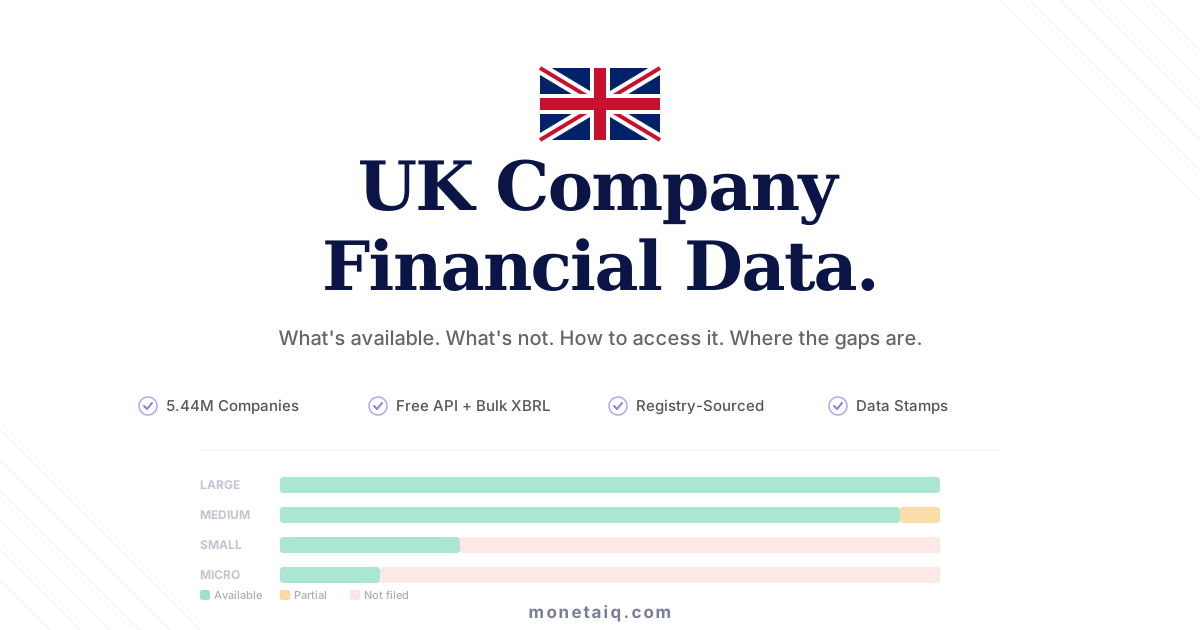
| Data Point | Large | Medium | Small | Micro |
|---|---|---|---|---|
| Balance sheet | Full | Full | Abridged | Minimal |
| Revenue (turnover) | Yes | Yes | No | No |
| Profit & loss | Full | Full | No | No |
| Cost of sales / gross margin | Yes | Sometimes | No | No |
| Cash flow | Yes | Yes | No | No |
| Directors' report | Yes | Yes | Optional | No |
| Auditor's report | Yes | Yes | Exempt | Exempt |
| Notes to accounts | Full | Full | Limited | None |
| Employee count | Yes | Yes | Sometimes | No |
The core limitation: The vast majority of UK's 5+ million companies are small or micro. For these companies, you get a balance sheet only — no revenue, no profit, no margins, no cash flow. If you're running TP benchmarking, credit scoring, or PE screening, this is the wall you'll hit.
What Financial Data Is NOT Available
- Revenue (turnover) — not disclosed by small or micro companies. The single biggest gap.
- P&L detail — no cost of sales, gross margin, or operating expenses for small/micro.
- Cash flow statement — medium and large only.
- Management accounts or forecasts — never filed. Statutory accounts are historical only.
- Segment reporting — not required for private companies.
- Group / consolidated accounts — small groups are exempt.
- Real-time data — accounts are 6–15 months old. No quarterly reporting for private companies.
Five Ways to Access the Data
All five methods are free. The difference is format, volume, and whether you get actual financial line items or just metadata.
1. Web Portal PDF
find-and-update.company-information.service.gov.uk
Search by name or number. Download individual accounts as PDF. No registration. Doesn't scale — one document at a time, often not machine-readable.
2. REST API JSON
developer-specs.company-information.service.gov.uk
Free JSON API. Company profile, officers, filing history, charges, PSC data. Rate limited to 600 requests per 5 minutes. Free API key required.
The API does not return parsed financials. It returns filing metadata and document links. To get balance sheet or P&L numbers, you download the filing and parse it yourself.
3. Bulk XBRL / iXBRL Download XBRL
download.companieshouse.gov.uk/en_accountsdata.html
Free daily and monthly ZIP files. All electronically filed accounts. Files are iXBRL (.html) or XBRL (.xml). ~97% in iXBRL. The primary source for building a UK financials database at scale.
4. Basic Company Data CSV
download.companieshouse.gov.uk/en_output.html
Monthly snapshot of all active companies. Name, number, address, SIC code, status. No financial data. Use it to build a universe, then enrich.
5. PSC Data (Beneficial Ownership) JSON
Free JSON snapshot of all Persons with Significant Control records. UK is one of the few countries where UBO data is fully public.
6. Streaming API (Real-Time Changes) JSON
developer-specs.company-information.service.gov.uk/companies-house-public-data-api/reference/streaming-api
Separate from the REST API. Provides a real-time event stream of changes to the register — new filings, officer appointments/resignations, address changes, insolvency events. Useful for monitoring and alerting workflows. Delivers JSON events via HTTP long-polling. Requires a free API key. This is the closest thing Companies House offers to live data, though it covers filing events, not the financial content within the filings.
Format Summary
| Method | Format | Machine-Readable? | Contains Financials? |
|---|---|---|---|
| Web portal | Depends | Yes | |
| REST API | JSON | Yes | No — entity data only |
| Bulk download | iXBRL / XBRL | Yes (with parser) | Yes — tagged line items |
| Company CSV | CSV | Yes | No — entity only |
| PSC data | JSON | Yes | No — ownership only |
| Streaming API | JSON events | Yes | No — filing events only |
The Digitisation Gap: Why ~25–40% of Filings Are Invisible
This is the part most people don't know about.
Companies House reports that only ~60–75% of the 2.2 million annual account filings are submitted electronically. The remainder — between 550,000 and 880,000 sets per year — are filed on paper or as scanned PDF images.
- The bulk XBRL download only covers 60–75% of filings. Paper filings are excluded entirely.
- Image-based PDFs contain no machine-readable data. You need OCR to convert images to text, then AI parsing to extract financial line items.
- Older filings are worse. Pre-2015 filings are disproportionately paper-only.
- XBRL taxonomy inconsistencies. Different accounting software maps the same concept to different tags. Comparing at scale requires normalisation.
How MonetaIQ solves this
MonetaIQ processes both the structured XBRL filings and the non-digitised paper/image filings. Every filing — electronic or scanned paper — goes through OCR and AI extraction, then gets normalised into the same structured format with standardised financial line items.
Result: Complete coverage of UK company financials. Not just the 60–75% in the XBRL bulk download. Every record carries a data stamp showing source, filing date, and extraction method.
Filing Timeline: How Old Is the Data?
UK private companies have 9 months from year-end to file. Most file close to the deadline. No quarterly reporting exists for private companies.
Day 0
Financial year ends
Weeks 1–12
Accounts prepared by directors
Weeks 8–20
Audit completed (if required)
Up to Month 9
Accounts filed with Companies House
Within days
Filing appears on the register
Next business day
Included in daily XBRL bulk download (if electronic)
Bottom line: you are looking at financial data that is 6 to 15 months old.
Upcoming Reform: The P&L Filing Requirement
The Economic Crime and Corporate Transparency Act 2023 included provisions requiring all small companies to file profit and loss accounts for the first time. Abridged accounts would no longer be an option.
Status (January 2026): Companies House confirmed these changes will not be introduced in April 2027. The reforms are under review. At least 21 months' notice will be given before any new requirements take effect.
If implemented, this would add revenue and profitability data for millions of small companies that currently file only a balance sheet. Until then: small and micro companies file balance sheet only. No P&L. No revenue.
Accounting Standards: UK GAAP vs IFRS
UK companies file under one of two accounting frameworks, and which one they use affects the financial line items you'll see in their accounts:
FRS 102 (UK GAAP) — the default for the vast majority of UK private companies. Based on the IFRS for SMEs standard but adapted for the UK. Most small and medium UK companies file under FRS 102, or its simplified variant FRS 105 for micro-entities. Financial statements under FRS 102 follow a specific format with prescribed line items that differ from full IFRS.
IFRS (International Financial Reporting Standards) — mandatory for UK companies with securities admitted to trading on a regulated market (AIM-listed, Main Market-listed). Some large private companies voluntarily adopt IFRS if they operate internationally or have foreign parent companies that consolidate under IFRS.
Why this matters: If you're comparing a UK Ltd filing under FRS 102 with a German GmbH filing under HGB or a French SAS filing under French GAAP, the line items won't map one-to-one. Revenue recognition rules, lease accounting treatment, and financial instrument classification all differ between frameworks. TP teams running comparables across jurisdictions and credit analysts building cross-border scorecards need to normalise for these differences — either manually or through a data provider that maps local GAAP to a standardised schema.
The Charges Register
UK companies must register charges (mortgages, debentures, floating charges, and other security interests over company assets) with Companies House within 21 days of creation. This data is publicly available and is returned by the REST API.
The charges register shows:
- Charge holder — the lender or secured party (typically a bank)
- Date created and date satisfied (if discharged)
- Short description of the assets secured — e.g. "all property and assets" or "freehold property at [address]"
- Status — outstanding, satisfied, or part-satisfied
This is critical for credit risk assessment. An outstanding charge tells you the company has secured debt. Multiple outstanding charges from different lenders can signal leveraged or distressed positions. A satisfied charge confirms a loan has been repaid. The charges register is one of the few real-time signals available for UK private companies, since charges must be registered promptly — unlike financial accounts, which lag by 6–15 months.
Late Filing and Compliance Rates
Not every company files on time, and understanding compliance rates gives you context on data completeness.
Companies House issued £34.4 million in late filing penalties in the 2023–24 financial year — more than three times the £10.2 million issued in 2019–20. The number of companies penalised for delays exceeding six months rose from 3,418 in 2019–20 to 11,463 in 2023–24. Late filing penalties range from £150 (up to 1 month late) to £1,500 (over 6 months) for private companies, doubling automatically for companies that file late in two consecutive years.
Dormant companies and first-time filers are disproportionately represented in late filing statistics — Companies House received over 13,800 appeals from dormant companies alone in 2023–24. Many dormant company directors don't realise they still have a filing obligation.
What this means for data users: At any given time, a proportion of companies on the register will have overdue accounts. If you're pulling data at scale and a company's most recent filing is 2+ years old, it may be non-compliant rather than inactive. Cross-referencing the filing due date (available via the API) with the most recent filing date tells you whether accounts are current or overdue.
Identity Verification (ECCTA 2023)
Since November 2025, all new directors, Persons with Significant Control, and authorised filers must verify their identity with Companies House — either directly through GOV.UK One Login or via an authorised corporate service provider (ACSP). Existing directors and PSCs have a transition period running through 2026.
This is a direct result of the Economic Crime and Corporate Transparency Act 2023. Before this change, anyone could be listed as a director using self-reported information with no verification. Fraudulent incorporations using stolen identities were common — Companies House removed over 100,000 entries and rejected 10,200 suspicious applications between March and July 2024 alone.
Impact on data quality: Identity verification doesn't directly affect financial data, but it significantly improves the reliability of officer and PSC data. For KYB and compliance workflows, this means the director and beneficial ownership information on the register is becoming materially more trustworthy than it was before 2025. However, the transition period means that many existing officers have not yet verified — so legacy records should still be treated with caution.
Data Quality: What You Can and Can't Trust
Companies House is a repository, not a regulator. It's important to understand the limits of the data:
- Financial figures are self-reported. Companies House does not validate the numbers in filed accounts. A company could file inaccurate financial statements and they would appear on the register uncorrected. There is no reconciliation against tax filings, bank records, or other sources.
- SIC codes are self-selected. Companies choose their own Standard Industrial Classification code at incorporation and can change it via their confirmation statement. Many companies use generic codes (e.g. 70100 — "Activities of head offices") that tell you nothing about their actual business activity. SIC codes should not be relied upon as the sole basis for industry classification or TP comparables selection.
- Registered addresses can be misleading. Many companies use a registered agent's address, an accountant's office, or a virtual office as their registered address. The registered address does not necessarily indicate where the company operates.
- Officer data is improving but still mixed. Pre-2025 officer records are unverified. Since November 2025, new appointments require identity verification. During the transition period (through 2026), the register contains a mix of verified and unverified officers.
- Financial data is reliable in structure. While the numbers themselves are self-reported, the filing format (UK GAAP / FRS 102) imposes a consistent structure. A balance sheet that shows assets, liabilities, and equity will always have those components — even if the underlying values could, in theory, be inaccurate.
Bottom line: Companies House data is best treated as a primary source that should be cross-referenced — not as a single source of truth. For high-stakes decisions (credit underwriting, acquisition due diligence, regulatory reporting), combine Companies House filings with credit reports, bank references, management accounts obtained under NDA, and independent verification.
What You Can and Can't Do
Use Case Feasibility
| Use Case | Notes | |
|---|---|---|
| Check company exists & is active | Yes | Free, instant via web or API |
| View filed financial statements | Yes | Free PDF for any company |
| Balance sheet data | Yes | All limited companies |
| Revenue and profitability | Partial | Medium + large only |
| Build a financials database at scale | Partial | XBRL covers 60–75%. Rest needs OCR + AI. |
| Compare companies on revenue / margins | Limited | Only above small threshold |
| Real-time monitoring | No | Data is 6–15 months old |
| TP benchmarking | Partial | Medium/large with full P&L. Small excluded. |
| Credit risk assessment | Partial | Balance sheet for all. P&L ratios for medium+. |
| KYB / compliance | Yes | Entity, officers, PSC/UBO — all free. |
Complete UK Company Financial Data — Including the 25–40% That Isn't Digitised
Explore MonetaIQ UK Coverage
Frequently Asked Questions
All UK company financial statements are available for free through Companies House. You can search any company by name or number at find-and-update.company-information.service.gov.uk and download their filed accounts as a PDF. No registration or subscription is needed. For programmatic access, Companies House also provides a free REST API (600 requests per 5 minutes) and free daily bulk downloads of all electronically filed accounts in iXBRL/XBRL format. The UK is the only major economy where all company filings, bulk data, and API access are completely free.
It depends on the company's size. Large and medium companies file full financial statements including a balance sheet, profit and loss account, cash flow statement, directors' report, auditor's report, and detailed notes. This gives you revenue, cost of sales, operating expenses, and net profit. Small companies file only a balance sheet with limited notes — no revenue, no P&L, no cash flow. Micro-entity companies file only a minimal balance sheet showing total assets, liabilities, and equity. Since the majority of the UK's 5+ million companies are classified as small or micro, most filings do not contain revenue or profitability data.
No. Under current UK filing rules, small companies (turnover under £15 million, balance sheet under £7.5 million, fewer than 50 employees) are not required to file a profit and loss statement. Their publicly filed accounts contain only a balance sheet — total assets, liabilities, and shareholder equity. Revenue, cost of sales, gross margin, operating expenses, and net profit are not disclosed. This is the single biggest limitation of UK company financial data and affects the majority of companies on the register. The government planned to require P&L filing for small companies from April 2027 under the ECCTA 2023, but this reform is currently under review and has been postponed indefinitely.
The Companies House API is a free REST API that returns company profile data, officer information, filing history, charges, insolvency records, and Persons with Significant Control (PSC) data in JSON format. It requires a free API key and is rate-limited to 600 requests per 5 minutes. However, the API does not return parsed financial line items — it does not give you balance sheet totals, revenue, or profit figures directly. To get actual financial numbers, you need to use the API to locate the filing document, download it (usually as PDF or iXBRL), and parse the financial data yourself. For bulk extraction, the daily XBRL download product is more practical than the API.
Companies House publishes a free bulk accounts data product at download.companieshouse.gov.uk. It includes daily ZIP files (published each morning, Tuesday through Saturday) and monthly ZIP files covering the previous 12 months. Each ZIP contains individual account filings in iXBRL (.html) or XBRL (.xml) format. Approximately 97% of electronic filings are in iXBRL. These files are both human-readable (they render in a web browser) and machine-parseable (they contain embedded XBRL taxonomy tags). You will need an XBRL parser to extract structured financial line items. The bulk product only includes electronically filed accounts — approximately 60–75% of total annual filings. Paper and scanned PDF filings are not included.
Companies House reports that only 60–75% of the approximately 2.2 million annual account filings are submitted electronically in XBRL or iXBRL format. The remaining 25–40% — between 550,000 and 880,000 sets of accounts per year — are filed on paper or uploaded as scanned PDF images. These paper filings are stored as image-based PDFs that contain no machine-readable text. They are excluded from the bulk XBRL download product entirely. To extract financial data from these filings, you need optical character recognition (OCR) to convert the scanned images into text, followed by AI-based parsing to identify and structure the financial line items. Older filings are disproportionately non-digital, so building 5+ years of history for smaller companies often requires processing image PDFs.
UK private companies have 9 months after their financial year-end to file accounts with Companies House (6 months for public companies). Most companies file close to the deadline. Once filed, the accounts typically appear on the register within a few days and are included in the next daily XBRL bulk download. This means the most recent financial data available for any given company is typically 6 to 15 months old. There is no quarterly or interim reporting requirement for UK private companies, so statutory accounts are the only public financial data available. For time-sensitive use cases like credit monitoring or active deal due diligence, this data lag is a significant constraint.
Yes. Since 2016, UK companies are required to identify and file details of their Persons with Significant Control (PSC) — individuals who hold more than 25% of shares or voting rights, or who otherwise exercise significant control over the company. This PSC data is publicly accessible through the Companies House web portal, the REST API, and a free bulk JSON download. The UK is one of the few countries in the world where beneficial ownership data is fully public. By contrast, most EU countries restricted public access to UBO registers following the 2022 European Court of Justice ruling, and the US only began collecting beneficial ownership data in 2024 through FinCEN with no public access.
The Economic Crime and Corporate Transparency Act 2023 (ECCTA) included provisions that would require all small companies to file profit and loss accounts and directors' reports for the first time, eliminating the option to file abridged or filleted accounts. This was originally expected to take effect from April 2027. However, in January 2026, Companies House confirmed that these changes will not be introduced in April 2027 and that the reforms are still under review. No new timeline has been announced. Companies will receive at least 21 months' notice before any new requirements take effect. If and when implemented, this would be the most significant expansion of UK financial transparency in decades — adding revenue and profitability data for millions of companies that currently file only a balance sheet.
If a US (or any non-UK) company operates a subsidiary incorporated as a UK limited company, that subsidiary must file annual accounts with Companies House under UK rules — regardless of the parent company's home jurisdiction or the fact that the US has no equivalent public filing requirement. This is a widely used technique in compliance, credit risk, and due diligence workflows. For example, if you cannot access financial data on a US-headquartered company directly, checking whether it has a UK subsidiary (searchable by name on Companies House) can provide balance sheet data and, if the subsidiary is medium or large, full P&L and cash flow information. The same approach works for Chinese, Japanese, or other foreign parent companies with UK operations.
Full accounts include a complete balance sheet, profit and loss statement, cash flow statement, directors' report, auditor's report (if applicable), and detailed notes covering accounting policies, fixed assets, debtors, creditors, and related-party transactions. Abridged accounts are a reduced filing option available to small companies — they include only a summarised balance sheet and limited notes. There is no profit and loss statement, no cash flow, no directors' report, and no auditor's report. Micro-entity accounts are even more limited: a bare-minimum balance sheet showing total assets, liabilities, and equity with no notes at all. The practical impact is that abridged and micro filings tell you what a company owns and owes, but not what it earns or spends.
As of March 2025, Companies House maintains records of over 5.44 million active companies. This includes approximately 5.11 million private limited companies (Ltd), around 4,000 public limited companies (PLC), approximately 49,000 limited liability partnerships (LLP), and about 5,400 registered branches of overseas companies. The register has grown by approximately 1.67 million companies over the past decade. Around 2.2 million sets of financial accounts are filed each year, with approximately 5,000 electronic filings processed per day.