The Complete Guide to French Company Financial Data in 2026

France runs one of Europe's most digitised company data ecosystems — and one of its most fragmented. Three government registries, eight sector regulators, a confidentiality regime that hides the P&L of nearly half of all filings, and a UBO register that closed to the public in July 2024. Here's what's actually available, what's not, and where to get it.
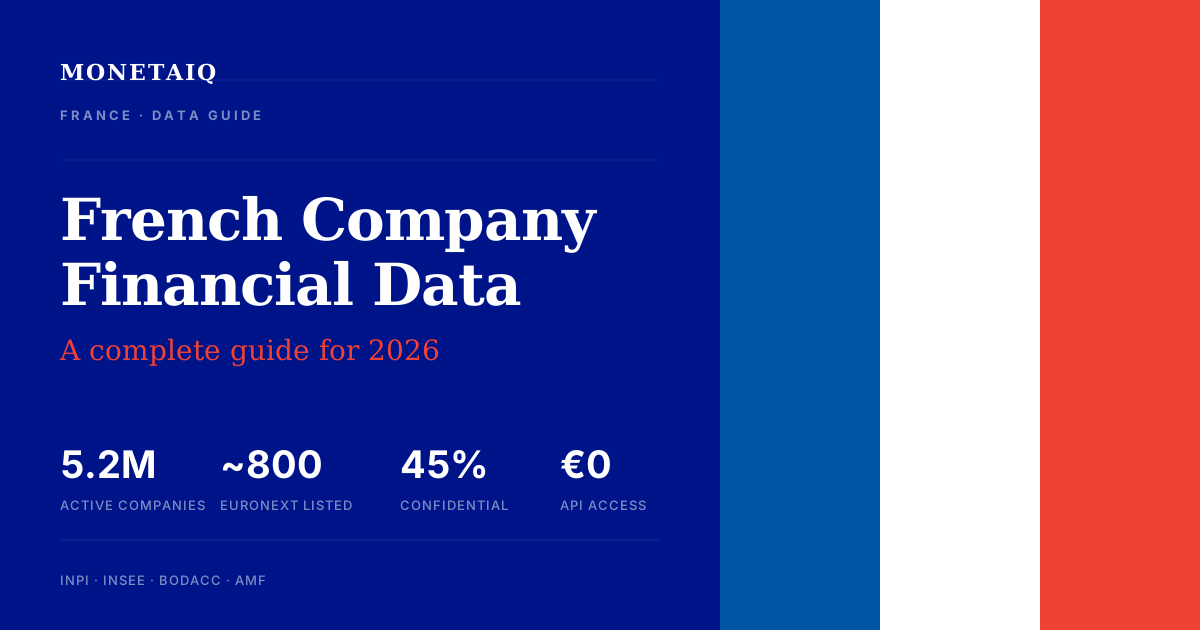
If you work in credit risk, KYB, M&A, transfer pricing, or competitive intelligence, you'll hit France sooner or later. The country has 5.2 million economically active businesses and roughly 1.2 million annual account filings each year. Headlines about "free open data" are mostly true — but the gap between "free" and "complete" is wider in France than anywhere else in Western Europe.
This guide covers private and public companies, all the official sources, the cost (or lack of it), the 2024–2026 legislation that changed access rules, the workarounds when accounts are confidential, and the specific data fields you can rely on versus the ones you can't.
The French Company Population
The starting point is scale. France's SIRENE directory, maintained by INSEE, registers every legal entity in the country — companies, sole traders, associations, public bodies. As of 2023, INSEE counts 5.2 million economically active companies in the marketable non-agricultural and non-financial sectors. The full Sirene directory holds around 14 million active legal units (SIREN) and around 30 million records when including historical and closed entries dating back to 1973.
The flow is heavy: 1,165,800 new business creations were registered in 2025 — a record — of which roughly 758,600 were micro-entrepreneurs (sole traders under a simplified tax regime) and 301,300 were companies (SARL, SAS, SA, etc.).
For financial data, only the corporate slice matters. Sole traders and micro-entrepreneurs don't file accounts with the commercial court. The pool that actually files annual financials is the population of commercial companies — SAS, SARL, SA, EURL, SASU, SCS, SCA — and certain civil entities above thresholds. INPI processes around 1.2 million annual account filings per year.
On the public side, Euronext Paris hosts approximately 800 listed companies across the regulated market and Euronext Growth (the SME multilateral trading facility). The CAC 40 covers the largest 40; the SBF 120 the broader large-and-mid-cap segment.
SAS, SARL, SA: What You'll Encounter
Three corporate forms account for the overwhelming majority of French commercial entities you'll work with. The differences matter for what data you can pull.
| Form | Full name | Typical use | Ownership transparency |
|---|---|---|---|
| SAS / SASU | Société par actions simplifiée (unipersonnelle) | Now the default for new companies. Flexible governance, no shareholder cap. | Low. Shareholder identity not in any structured public filing. Share transfers don't have to be registered. |
| SARL / EURL | Société à responsabilité limitée (unipersonnelle) | Traditional SME structure. Capped at 100 partners. | High. Associates listed in the statuts, which are public on data.inpi.fr. |
| SA | Société anonyme | Larger companies and listed entities. Required for some regulated activities. | Medium. Board of directors public. Shareholders only public if listed. |
Two other forms appear less often but matter for credit risk and KYB: the SCI (société civile immobilière) — used to hold real estate, only files accounts under specific conditions — and the SNC (société en nom collectif) — partners have unlimited joint liability, often used in tax-driven structures.
The Three Systems You Need to Know
French company data is split across three official sources. Each is run by a different government body, each holds different fields, and you'll usually need at least two of them to get a complete picture.
| System | Maintained by | Contains |
|---|---|---|
| SIRENE | INSEE | Identity. Every entity's SIREN/SIRET, legal form, NAF code, address, status, headcount band. Updated daily. |
| RNE (via INPI) | INPI | Filings. Annual accounts, statutes, articles, board resolutions, mergers. The financial layer. |
| BODACC | DILA | Legal events. Incorporations, sales/transfers, insolvencies, account-filing notices. The audit trail. |
Since 1 January 2023, the Registre National des Entreprises (RNE) replaced the older RCS (Registre du Commerce et des Sociétés) as the unified national register. INPI manages it. All filings now flow through the Guichet Unique, INPI's single online portal. The transition matters for anyone with historical pipelines: data structures changed, and the API schema for accounts pre-2023 differs from the post-2023 schema. As of late 2024, around 30% of filings still arrived through the old greffe (court clerk) channels, but those routes are being closed.
Beyond INPI: The Sector Regulators
If your scope includes regulated industries, INPI alone won't cut it. Several French sector regulators hold financial and operational data that never reaches the commercial registry — or that's published in a structured format INPI doesn't carry.
| Regulator | Sector | Public data of interest |
|---|---|---|
| ACPR | Banking, insurance, payment institutions, e-money | REGAFI register of authorised financial firms (free, public). Solvency II Pillar 3 disclosures for insurers. Sanctions decisions. Crisis-resolution actions. |
| AMF (GECO) | Asset managers, investment firms, financial advisors | Authorisation database of all licensed asset management companies and CIFs. Free public search. |
| Banque de France | All companies | FIBEN credit ratings (private, accessible to authorised banks and rated companies). National payments-incidents register. Aggregate sectoral statistics. |
| ACPR (Solvency II QRTs) | Insurance | Quantitative reporting templates published annually by insurers under Solvency II Pillar 3. |
| Tracfin | All financial institutions | Suspicious activity reports — non-public, but feeds into ACPR sanctions disclosures. |
| DGCCRF | All | Sanctions for unfair commercial practices, payment-delay reporting failures. |
The practical takeaway: a French bank, insurer, or asset manager has substantially more public financial data than a generic SAS — the regulator-mandated disclosures are deeper than what private commercial law requires. For these entities, scrape ACPR and AMF first, INPI second.
What's Filed: Private Companies
Every commercial company in France must file annual accounts with the commercial court registry within seven months of financial year-end (six months for the AGM that approves them, plus one extra month — extended to two if filed online). The filing is made through the Guichet Unique INPI.
The full filing typically includes:
- Bilan — balance sheet (assets, liabilities, equity)
- Compte de résultat — profit and loss account
- Annexe — notes to the accounts
- Rapport de gestion — management report (large companies only)
- AGM minutes approving the accounts and the dividend allocation
- Statutory auditor's report, where one is appointed
Listed companies and groups apply IFRS for consolidated statements. Standalone (statutory) accounts are always prepared under French GAAP — the Plan Comptable Général (PCG) — regardless of whether the parent reports in IFRS. Even a French subsidiary of a German or US-listed group keeps its individual accounts under PCG. This matters for cross-border benchmarking: PCG line items don't map one-to-one to FRS 102, HGB, or US GAAP.
The Confidentiality Regime: Why Half the Filings Are Hidden
This is the single most important thing to understand about French private company data.
French law (Article L.232-25 of the Commercial Code) lets companies below certain size thresholds declare their accounts confidential when they file. The accounts still get filed — INPI still has them, the tax authority still has them — but the data is not made public. There are three tiers.
The thresholds were significantly raised by Decree 2024-152 of 28 February 2024, transposing EU Delegated Directive 2023/2775. The new thresholds apply to financial years starting on or after 1 January 2024, and they let many more companies hide their numbers.
| Tier | Thresholds (2 of 3) | What stays public |
|---|---|---|
| Micro-entreprise | Total assets ≤ €450K · Turnover ≤ €900K · ≤ 10 employees | Nothing. Full confidentiality available — balance sheet and P&L both hidden. |
| Petite entreprise | Total assets ≤ €7.5M · Turnover ≤ €15M · ≤ 50 employees | Balance sheet only. P&L can be declared confidential. |
| Moyenne entreprise | Total assets ≤ €25M · Turnover ≤ €50M · ≤ 250 employees | Full balance sheet and P&L are public. The company can file a simplified balance sheet presentation. |
| Grande entreprise | Above all the above | Everything — full balance sheet, P&L, notes, management report. |
INPI's own statistics put confidentiality declarations at roughly 45% of total filings. Banks, insurers, listed companies, and entities calling on public generosity cannot use the regime regardless of size — they must publish.
The practical implication: when you query the INPI API for an SAS or SARL with €3M of revenue, you'll often find the filing exists but contains only structured balance-sheet data. The P&L is missing — not by error, by election. Your data pipeline must distinguish "no filing" from "filing with confidentiality flag" because the underlying signal is completely different.
The SAS shareholder gap
The other major opacity is ownership. The SAS is now the dominant corporate form in France for new companies. SAS statuts are filed publicly, but shareholder identity is not required to appear in any structured public format, and share transfers don't have to be registered in the public file. SARL ownership, by contrast, is in the statuts and visible. This is why French ownership data via the SAS route is the hardest to reconstruct from registry filings alone.
When the Accounts Are Confidential: Workarounds
Roughly 45% of filings are withheld. Here's how analysts actually extract a financial signal anyway.
1. BODACC Section C as the filing-discipline signal
A Section C notice confirms accounts were filed. It says nothing about the numbers — but it tells you the company is current with its obligation. A company that consistently appears in Section C every year is operating normally. A company that disappears from Section C is either dissolved, in difficulty, or non-compliant. This binary "filed / didn't file" signal is the single most underused leading indicator in French credit risk.
2. Statutory auditor presence
Under the post-February 2024 thresholds, a French company must appoint a statutory auditor (commissaire aux comptes) once it crosses two of three criteria: total assets > €5M, turnover > €10M, or 50 employees. If you can see in the statuts that an auditor is appointed, you have a lower-bound on size — even with the P&L hidden.
3. Headcount band from URSSAF / DSN signals
Every private-sector employer in France files a monthly DSN (Déclaration Sociale Nominative) — see the next section. The headcount band derived from DSN is published in SIRENE and updated regularly. A company with a "100–199 employees" SIRENE band cannot have €500K in revenue, even if the P&L is hidden.
4. Group structure inference
If the French entity is part of a listed group, the parent's consolidated accounts will be public (under IFRS). Segment reporting (under IFRS 8) often discloses revenue by geography. The French sub's revenue is bounded by the group's France segment. For private groups, look for the parent in another jurisdiction — UK Ltd, German GmbH, Luxembourg holding — where filings may be public.
5. BODACC capital movements as growth proxy
Capital increases, mergers, and major share transactions are published in BODACC. Repeated capital increases over several years are a reasonable growth proxy when the underlying P&L isn't available. Cumulative paid-in capital trajectory tells you something even when revenue doesn't.
6. Sanctions and litigation flags
DGCCRF publishes sanctions for late payment-delay reporting (a legal obligation for medium and large companies). Repeated sanctions correlate with operational distress. Tribunal de Commerce / TAE affairs (next section) confirm pending litigation. Both signal risk independently of the accounts being readable.
French Tax and Social Filings: The Private-but-Accessible Layer
Several mandatory filings exist that aren't on data.inpi.fr but are accessible to authorised parties. Knowing they exist matters because vendors and KYB providers with the right credentials can surface them.
| Filing | Frequency | Who files | Access |
|---|---|---|---|
| DSN (Déclaration Sociale Nominative) | Monthly, plus event-based | All private-sector employers (~2.2M companies/month) | Not public. Goes to URSSAF, France Travail, retirement funds, tax authority. Visible to authorised social-protection bodies. |
| FEC (Fichier des Écritures Comptables) | On request during tax inspection | All companies subject to corporate income tax | Not public. Surrendered to DGFiP on demand. Full general ledger in mandated format. |
| Liasse fiscale (Form 2065 + 2050 series) | Annual, ~3 months after year-end | All companies subject to IS | Not public. Filed with DGFiP via impots.gouv.fr. More detailed than the registry filing. |
| Intrastat declarations | Monthly | Companies with intra-EU goods or services flow | Not public per company. Aggregate statistics from Customs. |
| VAT declarations (CA3, CA12) | Monthly or quarterly | All VAT-registered companies | Not public. Filed with DGFiP. |
DSN is the most operationally important. Mandatory since 1 January 2017 for all private-sector employers, it consolidates 26+ social filings into one monthly file. Around 2.2 million French companies file a DSN every month. The data isn't public but feeds the headcount-band signal in SIRENE and underlies most of the workforce intelligence available through credit-risk providers.
FEC is critical for fraud and forensic work — when surrendered during a tax audit, it provides the full general ledger in a standardised format. It's why French tax investigations move much faster than UK or German equivalents.
Tired of stitching three French registries together?
MonetaIQ ingests RNE accounts, SIRENE identity data, and BODACC events daily, parses every PCG line item into a normalised English-labelled schema, and flags confidentiality elections so your pipeline doesn't confuse "missing" with "withheld." One feed, one schema, one currency.
See French data coverage →Filing Lag: When Is the Data Actually Available?
"6–15 months old" is the headline. The distribution behind that headline matters for SLA design.
For a typical French SAS or SARL with a 31 December year-end:
- 30 June (Y+1) — AGM deadline. Six months after year-end to convene shareholders and approve accounts.
- 31 July (Y+1) — paper filing deadline. One month after AGM.
- 31 August (Y+1) — electronic filing deadline. Two months after AGM if filed via Guichet Unique.
- Mid-September (Y+1) — INPI ingestion typically completes 1–5 days after filing for online submissions; longer for greffe-routed filings.
So for a CY-2024 filer, structured data is queryable around mid-September 2025 — about 9 months after year-end. The fastest filers (large groups with disciplined finance teams) hit data.inpi.fr by mid-July. The slowest are still trickling in 14 months later. Penalties for late filing exist (up to €1,500 per filing, escalating for repeat violations) but enforcement is uneven, and a non-trivial share of small companies skip filing altogether each year.
For real-time monitoring, accept the lag and use BODACC events (insolvencies, capital changes, director changes) as the leading signal. INPI accounts are the lagging confirmation. Don't build credit decisions on either layer in isolation.
Recent Legislation: Timeline 2017→2027
What's Filed: Public Companies
Listed-issuer disclosure runs on a separate track. The Autorité des Marchés Financiers (AMF) regulates roughly 800 companies whose securities trade on Euronext Paris (regulated market) or Euronext Growth Paris (MTF). Their obligations come from EU regulation — primarily the Transparency Directive (2004/109/EC) and the Market Abuse Regulation — not the Commercial Code regime that governs private filings.
Required filings for AMF-regulated issuers:
- Annual financial report — within four months of year-end. Must include consolidated IFRS statements, statutory auditor reports, management report, corporate-governance report.
- Half-yearly financial report — within three months of half-year-end.
- Universal Registration Document (URD) — annual single-document approach widely used by French issuers; includes the annual financial report and is filed with the AMF.
- Inside information disclosures — under MAR, issuers must publish price-sensitive information as soon as possible.
- ESEF tagging — annual financial reports must be filed in European Single Electronic Format (Inline XBRL) for regulated-market issuers.
All of this is published on the AMF's information filing system and on issuers' investor-relations pages. It's free to access. The AMF itself publishes lists of companies late with periodic disclosures — useful as a leading indicator of governance issues.
Euronext Growth issuers face a lighter regime — annual and half-yearly reports are required but with fewer ESEF and corporate-governance obligations. They're regulated by Euronext, not the AMF directly.
EU Listing Act 2024 — what changes for French issuers
Regulation (EU) 2024/2809, in force since 4 December 2024, lightens the listing burden across the EU. The provisions phase in through 2026, with several already live:
- Prospectus exemption raised from 20% to 30% — admission of fungible securities representing under 30% of existing shares is now exempt from prospectus, provided an 11-page summary document is filed.
- EU Follow-on Prospectus (max 50 pages) — replaces the old simplified prospectus for issuers listed at least 18 months. Available from June 2026.
- EU Growth Issuance Prospectus (max 75 pages) — for SMEs and small unlisted issuers. Available from March 2026.
- Standard prospectus capped at 300 pages.
- Multiple-vote share structures permitted on SME growth markets — Directive 2024/2810. Member-state transposition deadline 5 December 2026.
- MAR proportionate sanctioning — penalties for minor market-abuse infringements scaled to issuer size; specific SME-friendly alternative sanctions.
The EU Commission estimates roughly €100 million per year in compliance-cost savings for listed companies across the bloc. For French Euronext Growth issuers, the practical effect is a meaningful reduction in prospectus length and cost when raising follow-on capital.
CSRD: Sustainability Reporting After Omnibus I
Sustainability reporting in France has moved twice in 24 months. France was the first country to transpose CSRD via Ordonnance 2023-1142 of 6 December 2023, with FY2024 reports landing in 2025 for around 250 large public-interest entities (Wave 1). Then the EU pulled back.
The Omnibus I package, formally adopted by the European Parliament and Council and published in the Official Journal on 26 February 2026, fundamentally narrowed CSRD scope:
- New threshold: 1,000 employees AND €450 million in turnover (previously 250 employees + €50M turnover or €25M assets). This removes roughly 80% of previously-in-scope companies.
- Wave 2 postponed: companies originally due to report on FY2025 in 2026 now report on FY2027 in 2028 — a two-year delay confirmed by the "stop-the-clock" directive of 14 April 2025.
- Listed SMEs removed entirely from CSRD scope (former Wave 3).
- Wave 1 stays in — large public-interest entities already reporting continue, with quick-fix flexibility on certain ESRS data points for FY2025–FY2026.
- VSME standard — voluntary SME sustainability reporting standard now plays a "value chain cap" role: the maximum data large companies can request from smaller suppliers.
For data buyers, the practical effect is that the CSRD-tagged universe in France is much smaller than the original 2023 design intended. Most of the structured ESG signal you'd want — Scope 1/2/3 emissions, value-chain workforce data, biodiversity exposure — comes from the ~250 Wave 1 reporters today, scaling up modestly through 2028. The "thousands of mid-caps will publish ESRS data by 2026" prediction has been formally cancelled.
The data that does land is high-quality: ESEF-tagged (Inline XBRL), audited at limited assurance, structured under European Sustainability Reporting Standards. The trajectory of mandatory ESG data still points up — just on a slower curve than initially planned.
Where to Get the Data
data.inpi.fr — the primary source
INPI's open-data portal at data.inpi.fr is the official entry point for RNE data. Both web search and bulk access are free. After registration, you get JSON-format API access plus an SFTP server for bulk feeds.
Three APIs are available:
- Base RNE — formality data (company identity, modifications, cessations). JSON. Daily updates.
- Comptes annuels — annual accounts in structured JSON. Balance sheet, P&L, depreciation, provisions. Coverage starts 1 January 2017. Pre-2017 accounts are not in the structured feed.
- Actes — statutes, AGM minutes, articles. PDF only. Stock from 1993, plus daily flow.
Daily quotas: 10,000 requests and 10 GB per account per day. Data is published under Licence Ouverte v2.0 — free commercial reuse, including redistribution and incorporation into derivative products, with source attribution.
Sirene (INSEE) — entity identity
The Sirene API at api.insee.fr is free and covers all entities in the SIRENE directory. It's the source of truth for SIREN/SIRET numbers, legal forms, NAF codes, addresses, and headcount bands. Daily updates. No financial data — Sirene is identity-only. Rate limit: 30 calls per minute.
BODACC — events and filing notices
BODACC, France's official commercial gazette, has been free since July 2011 and publishes a machine-readable feed at bodacc.fr. It's the audit trail: every legal event is logged here. Section A covers sales and incorporations. Section B covers modifications. Section C confirms account filings. Insolvency proceedings appear within days.
BODACC's killer feature for risk monitoring: a Section C notice confirms accounts were filed, even when the content is held confidential. That gives you a clean filing-discipline signal independent of whether you can see the numbers.
Infogreffe — the legacy commercial portal
Run by the commercial court clerks, infogreffe.fr still serves as the source for historical pre-2023 data and certain document types. It charges per document for older filings: Kbis extract €3.37, articles or shareholder minutes €10.05, bankruptcy certificate €4.73, full pledge status €85.35. An annual subscription costs €102 for unlimited access.
Infogreffe also hosts the only public interface for commercial-court litigation searches. The "Consulter une affaire" service lets you search pending and recently-judged commercial cases by court, party name, or case number. You see the cause-list number, parties, hearing dates, and proceeding type (substantive litigation, summary proceedings, insolvency). Judgments themselves cost a fee to order. Coverage is current cases plus those judged or struck off in the past six months. Note: from 1 January 2025, twelve courts (Auxerre, Avignon, Le Havre, Le Mans, Limoges, Lyon, Marseille, Nancy, Nanterre, Paris, Saint-Brieuc, Versailles) are renamed Tribunaux des Activités Économiques (TAE).
Annuaire des entreprises — the citizen-facing portal
The government's general-public portal at annuaire-entreprises.data.gouv.fr consolidates SIRENE, RNE, BODACC, and other public sources into a single search interface. Free, no registration. Useful for one-off lookups; not designed for programmatic access.
AMF — listed-company filings
The AMF's BDIF (Base de Données d'Informations Financières) at bdif.amf-france.org hosts every regulated disclosure from listed issuers. ESEF-tagged annual reports, half-yearly reports, prospectuses, inside-information notices. Free. Searchable by issuer.
Sector regulators
ACPR's REGAFI register at acpr.banque-france.fr lets you check authorisation status of any bank, insurer, payment institution, or financial intermediary. AMF's GECO database performs the same function for asset managers and investment firms. Both are free.
Cost: Is Any of This Actually Free?
Mostly yes — and that's France's strength relative to Germany.
| Source | Web access | API / Bulk | Commercial reuse |
|---|---|---|---|
| data.inpi.fr | Free, registration required for documents | Free, quotas apply | Yes, Open Licence v2.0 |
| Sirene (INSEE) | Free | Free, registration required | Yes, Open Licence v2.0 |
| BODACC | Free | Free machine-readable feed | Yes |
| Annuaire des entreprises | Free | Limited API | Yes |
| Infogreffe | Free search | Per-document fees (€3.37–€85.35); €102/yr subscription | Yes, with attribution |
| AMF (BDIF) | Free | Free download | Yes |
| ACPR REGAFI / AMF GECO | Free | Free | Yes |
This puts France ahead of Germany — where Bundesanzeiger document downloads still incur per-item fees and there's no national accounts API — and roughly on par with the UK's Companies House. The gap with the UK isn't price; it's coverage. UK micro-entities at least file a balance sheet publicly. French micro-entreprises can hide both halves of the accounts.
What You Can Reliably Pull, Per Company
For a typical French commercial company that has filed at least once since 2017 and has not declared confidentiality:
- SIREN and SIRET numbers
- Legal form, NAF/APE code, registration date, status
- Registered office and establishment addresses
- Headcount band
- Full balance sheet (assets, liabilities, equity), 2017 onward
- Income statement (revenue, operating result, net result), 2017 onward
- Depreciation, amortisation, provisions
- Statutes and AGM minutes (PDF, from 1993 onward)
- BODACC event history
- Statutory auditor identity, where one is appointed
- Director and legal representative names
What you typically can't rely on for private companies:
- P&L for any small or micro company that elected confidentiality (~45% of all filings)
- Detailed shareholder structure for SAS entities
- Cash-flow statement (not part of standalone French GAAP statutory accounts)
- UBO data, since July 2024, without legitimate-interest registration
- Quarterly or interim figures for non-listed companies
- Consolidated group financials, unless the parent files them under separate obligation
Common Pitfalls in Building a French Pipeline
The 2023 schema break. Anything you built against the old RCS/Infogreffe data structures before 1 January 2023 needs to be remapped. Field names, document type codes, and JSON paths changed when the RNE took over. Mixing pre- and post-2023 records without normalisation will silently corrupt comparables.
NAF 2025 transition. Decree 2025-736 of 31 July 2025 approves France's new NAF 2025 industry classification. Entry into force is 1 January 2027, not 2025 — the version label is misleading. Throughout 2026, Sirene displays both the legacy NAF 2008 code and the future NAF 2025 code for every entity. Pipelines that filter on NAF codes need to update their reference tables before the switchover, and store both during the transition.
Confidentiality vs. non-filing. A company with a BODACC Section C notice but no INPI accounts record has filed and elected confidentiality. A company with neither has not filed at all. These are completely different risk signals. Build the distinction into your pipeline from day one.
SAS ownership opacity. Don't assume SAS shareholder data is in the registry. It usually isn't. For SAS targets, you'll need to combine UBO data (post-July-2024 access required) with SAS statuts review, or use a data partner that maintains corporate-tree mappings independently.
Filing lag. Annual accounts are 6–15 months old by the time they're searchable, depending on year-end and filing speed. For real-time risk monitoring, BODACC events feed (insolvencies, judicial proceedings, capital changes) is the leading-indicator layer; INPI accounts are the lagging-confirmation layer.
La Poste SIREN exception. SIREN 356000000 fails Luhn but is officially valid. Hard-code it.
TAE renaming (2025). Twelve commercial courts are now Tribunaux des Activités Économiques. If you store court names as strings, update the ingestion logic — references in older filings still say "Tribunal de Commerce."
SIREN Validation: Luhn-mod-10
If you're building a French data pipeline, you'll need to validate SIREN numbers programmatically. SIREN uses the standard Luhn algorithm (mod-10 checksum) — same as credit card numbers.
The 9-digit SIREN's last digit is the checksum. To validate:
- Starting from the right, double every second digit.
- If a doubled digit is > 9, sum its digits (e.g., 14 → 1+4 = 5).
- Sum all the resulting digits.
- The total must be divisible by 10. If yes, SIREN is valid.
One gotcha: the SIREN 356000000 (La Poste) is a known exception — it doesn't satisfy Luhn but is officially valid. Hard-code it as a special case. SIRET (14 digits) follows the same Luhn check across all 14 digits, with the same La Poste exception applying to its first 9.
Greffe vs INPI: What Goes Where After 2023
The 2023 RNE migration didn't fully replace the greffe (commercial court clerk) channel. As of late 2024, around 30% of filings still arrive via greffes, and certain document types remain greffe-only. This affects pipeline design.
| Filing type | Primary channel | Notes |
|---|---|---|
| Annual accounts (post-2023) | Guichet Unique INPI | ~70% via INPI; remainder still via greffe but converging. |
| Annual accounts (2017–2022) | Greffe → INPI mirror | Available on data.inpi.fr but with old schema. |
| Annual accounts (pre-2017) | Greffe (Infogreffe) only | Not in INPI structured feed. PDF-only via Infogreffe, often per-document fee. |
| Statuts, board resolutions | Both INPI and greffe | INPI delivers PDF via Actes API. |
| Kbis extract | Greffe (Infogreffe) | Only the greffe issues the legally definitive Kbis. RNE extract from data.inpi.fr is accepted by most authorities but isn't equivalent. |
| Litigation case data | Greffe / TAE only | No INPI equivalent. Infogreffe "Consulter une affaire" service. |
| UBO data | INPI (RBE) | Restricted access since 31 July 2024. |
Decision Tree: Where Is the Data You Need?
Get French company financials your way
API for real-time integration into your KYB or risk pipeline. Bulk feed for analytics teams building proprietary models. Web platform for compliance, sales, and PE workflows that don't need code. Same registry-sourced data, three delivery methods.
Talk to data team →Frequently Asked Questions
What financial data is publicly available for French private companies?
Balance sheets, profit and loss accounts, depreciation, and provisions for any commercial company that filed since 2017 and did not elect confidentiality. Roughly 55% of filings are fully public. The rest are filed but withheld under the micro-entreprise or petite entreprise confidentiality regime.
Is French company financial data free?
Yes for the core sources. INPI (RNE), INSEE (Sirene), BODACC, the Annuaire des entreprises, and the AMF's listed-issuer database are all free, with commercial-reuse rights under Licence Ouverte v2.0. Infogreffe charges per document for some pre-2023 legacy items (€3.37–€85.35 depending on document type) and offers a €102 annual subscription for unlimited access.
What is the INPI API and what does it cover?
INPI runs three APIs at data.inpi.fr: Base RNE for company formality data, Comptes annuels for structured annual accounts (2017 onward), and Actes for statutes and PDF documents. All are JSON or PDF, free, with daily quotas of 10,000 requests and 10 GB per account.
How many French companies file annual accounts each year?
INPI processes around 1.2 million annual account filings per year. Of those, approximately 45% are filed with a confidentiality declaration, meaning the underlying numbers are not made public.
What changed for French company data in 2024 and 2026?
Six changes. The 28 February 2024 decree raised confidentiality and audit thresholds. Public access to the UBO register ended on 31 July 2024 following the November 2022 ECJ ruling. The EU Listing Act (December 2024) lightened prospectus rules for listed SMEs. The TAE pilot started 1 January 2025 in 12 commercial courts. The Law of 30 April 2025 (DDADUE5) codified the legitimate-interest UBO access framework. The Omnibus I package (February 2026) significantly narrowed CSRD scope.
What is the difference between SIREN and SIRET?
SIREN is a 9-digit identifier issued by INSEE that uniquely identifies a French legal entity. It stays the same for the entity's lifetime. SIRET is a 14-digit identifier (SIREN + 5 digits) that identifies each individual establishment of the entity — head office, branches, sites. A company has one SIREN and as many SIRETs as it has establishments. Both use the Luhn checksum, with one well-known exception: La Poste's SIREN (356000000) fails Luhn but is officially valid.
How do I work around the French confidentiality regime when I need to assess a small company?
Five workarounds: (1) BODACC Section C confirms whether accounts were filed at all — a clean filing-discipline signal. (2) Statutory auditor presence implies the company crossed two of three size thresholds (€5M assets / €10M turnover / 50 employees). (3) SIRENE headcount bands provide a lower-bound revenue estimate. (4) Group-level financials, if the parent is listed elsewhere, bound the French sub's revenue via segment reporting. (5) BODACC capital movements act as a growth proxy.
What is a DSN and is the data publicly available?
The Déclaration Sociale Nominative is a mandatory monthly social-protection filing that every French private-sector employer must submit since 1 January 2017. Around 2.2 million companies file it each month. The data itself isn't public — it goes to URSSAF, France Travail, retirement funds, and the tax authority — but it underlies the headcount band you see in SIRENE and the workforce intelligence available through credit-risk providers.
When does NAF 2025 enter force in France?
NAF 2025 was approved by Decree 2025-736 of 31 July 2025 but does not enter force until 1 January 2027. Throughout 2026, the Sirene directory displays both the legacy NAF 2008 code and the future NAF 2025 code for every company, giving pipelines time to update reference tables before the switchover.
Why can't I see the P&L for a small French company on data.inpi.fr?
It almost certainly elected confidentiality at filing. Under Article L.232-25 of the Commercial Code, micro-entreprises can declare both balance sheet and P&L confidential, and petites entreprises can declare just the P&L confidential. INPI holds the data but is not authorised to publish it. The BODACC Section C notice will still confirm the filing was made.