Published in:
Blog
German Company Financial Data from Bundesanzeige

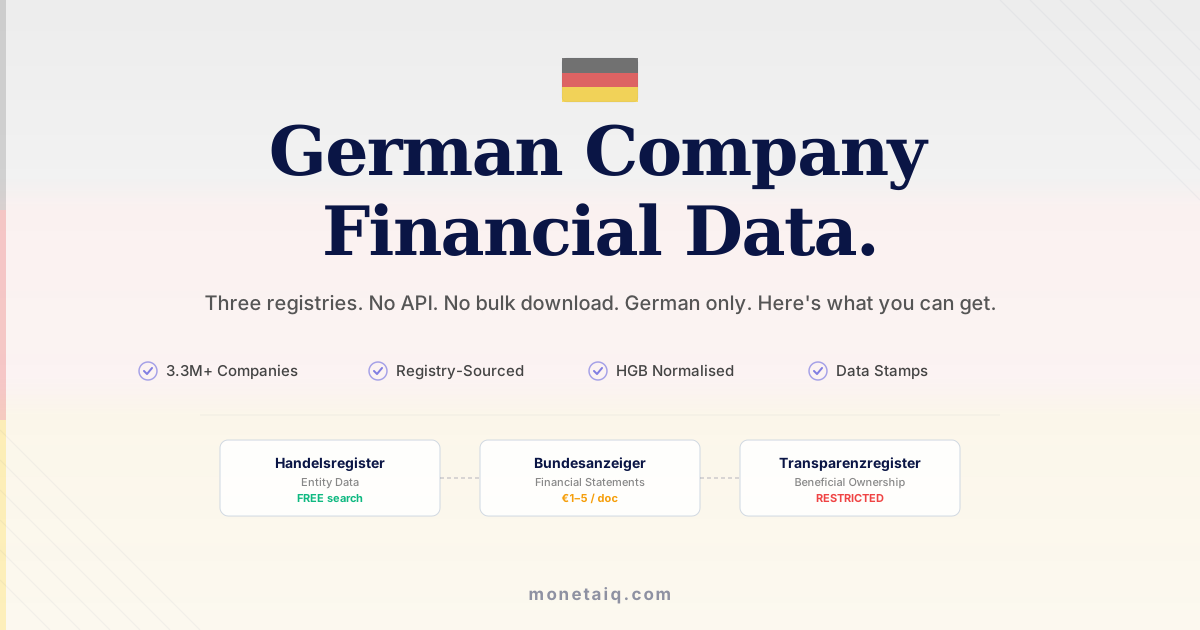
Germany is Europe's largest economy and home to over 3.3 million registered companies. Unlike the UK, where Companies House provides free, centralised access to everything, Germany's company data is split across three separate systems — none of which offer an official API, none of which are free for financial data, and all of which are in German only. If you need German company financials for credit risk, PE due diligence, transfer pricing, or compliance, this guide explains exactly where the data lives, what you'll get, what you won't, and why extracting it at scale is so difficult.
3.3M+Registered Companies
3 SystemsFragmented Registry
€1–5Per Document
No APINo Bulk Download
Three Systems, Not One
Germany does not have a single company registry. Company data is distributed across three separate platforms, each maintained by a different authority with different data, different access rules, and different interfaces. All three are in German only.
1. Handelsregister (Commercial Register)
URLhandelsregister.de
Maintained By150 local district courts (Amtsgerichte) across Germany's 16 federal states
What It ContainsEntity data: company name, legal form, registered address, managing directors (Geschäftsführer), share capital, authorised representatives, articles of association, shareholder lists
CostFree to search. Printouts (Abdruck) €4.50–€12.50 per document. Certified copies ~€20.
Does not contain financial statements. The Handelsregister is purely entity and corporate governance data. Annual accounts are published separately via the Bundesanzeiger.
2. Bundesanzeiger (Federal Gazette)
URLbundesanzeiger.de
Maintained ByFederal Ministry of Justice, operated by Bundesanzeiger Verlag
What It ContainsAnnual financial statements (Jahresabschluss): balance sheet, P&L, notes, management report, auditor's report — depending on company size. Also insolvency announcements and corporate governance notices.
Cost€1 for a deposited annual statement. €5+ for certified copies. Search is free.
This is where the financial data lives. All GmbH, AG, and KGaA companies must publish their annual accounts here. However, micro-entities may "deposit" (hinterlegen) rather than publish — meaning the statement is filed but not freely visible online.
3. Unternehmensregister (Company Register)
URLunternehmensregister.de
Maintained ByFederal Ministry of Justice — aggregates data from both Handelsregister and Bundesanzeiger
What It ContainsCombined access point: register entries, financial statements, capital market notifications, insolvency data. The closest thing Germany has to a "one-stop shop."
CostSearch is free. Financial statements: €1–€5 per document.
Often more complete and up-to-date than searching the Handelsregister directly. Financial statements available from 2006 onwards.
Key difference from the UK: In the UK, Companies House is one system, everything is free, and there's an API. In Germany, you navigate three separate platforms, pay per document, everything is in German, and there is no official API for any of them. This makes Germany one of the most data-rich but least accessible registries in Europe.
Who Files Financial Statements
All German corporations (Kapitalgesellschaften) are required to publish annual financial statements. This includes:
- GmbH (Gesellschaft mit beschränkter Haftung) — private limited liability company. The most common form. Over 1.2 million active GmbHs in Germany.
- UG (haftungsbeschränkt) — "mini-GmbH" with reduced capital. Same filing obligations as GmbH.
- AG (Aktiengesellschaft) — public limited company. ~435 listed on stock exchanges as of 2024.
- GmbH & Co. KG — limited partnership with a GmbH as general partner. Subject to same publication rules as corporations.
- KGaA (Kommanditgesellschaft auf Aktien) — partnership limited by shares.
Exempt from public financial filing: Sole proprietors (Einzelunternehmen) and general partnerships (OHG, KG) where at least one personally liable partner is a natural person — unless they exceed size thresholds under the Publicity Act (PublG: balance sheet >€65M, revenue >€130M, or >5,000 employees).
Understanding the GmbH & Co. KG
The GmbH & Co. KG is Germany's most confusing corporate form for non-German readers — and with ~350,000 active entities, it's also one of the most common. It's a limited partnership (Kommanditgesellschaft / KG) where the general partner with unlimited liability is not a natural person but a GmbH (limited liability company). This gives the structure the liability protection of a GmbH combined with the tax flexibility of a partnership.
Why it matters for financial data: A standard KG where a natural person is the general partner is exempt from public financial filing. But a GmbH & Co. KG — because no natural person bears unlimited liability — is treated like a corporation for disclosure purposes. It must publish annual financial statements on the Bundesanzeiger under the same rules as a GmbH. If you're searching for a company and the legal form says "GmbH & Co. KG," expect the same financial data availability as a regular GmbH of that size class. If the legal form says just "KG" or "OHG," the company is likely exempt from public financial disclosure.
Filing deadline: Annual financial statements must be published within 12 months after the end of the financial year. In practice, the most recent available accounts for a German company are typically 12–24 months old. This is significantly slower than the UK (9 months) or France (7 months).
Filing Timeline: How Old Is the Data?
The 12-month deadline is the legal maximum. Here's what happens in practice for a company with a 31 December year-end:
31 December
Financial year ends
January – March
Accounts prepared internally. Medium and large companies must complete within 3 months. Small companies have up to 6 months.
March – June
Audit completed (if required — medium and large companies only)
Within 12 months
Accounts published on Bundesanzeiger / deposited with Unternehmensregister. Listed companies: 4-month deadline.
Month 12+
Many companies file late. Federal Office of Justice issues fines from €2,500 but enforcement is slow. Late filers may not appear on the register for 15–24 months after year-end.
Once published
Filing is immediately searchable on the Bundesanzeiger and appears on the Unternehmensregister. No delay between publication and availability — unlike the UK where bulk XBRL has a one-day lag.
Bottom line: When you access a German company's most recent accounts, you are typically looking at financial data that is 12 to 24 months old. For small GmbHs that file late, it can be even older. There is no quarterly or interim reporting for private companies.
German Companies by Legal Form
GmbH
~1.2M+ (dominant)
GmbH & Co. KG
~350K
UG (haftungsb.)
~250K
KG / OHG
~170K (often exempt)
AG
~7K (435 listed)
Blue bars = required to publish financial statements. Grey = often exempt (natural person as liable partner).
What Financial Data Is Available
Like the UK, German filing requirements are tiered by company size. Unlike the UK, even small German companies must file a P&L — but micro-entities can "deposit" instead of "publish," making their data harder to access.
Company Size Thresholds (HGB §§267, 267a — updated 2024, +25%)
A company is classified based on meeting two of three criteria in two consecutive years:
| Category | Balance Sheet Total | Revenue | Employees |
|---|---|---|---|
| Micro | ≤ €450,000 | ≤ €900,000 | ≤ 10 |
| Small | ≤ €7,500,000 | ≤ €15,000,000 | ≤ 50 |
| Medium | ≤ €25,000,000 | ≤ €50,000,000 | ≤ 250 |
| Large | Above medium thresholds | Above medium thresholds | > 250 |
Thresholds raised by 25% effective for fiscal years starting after 31 December 2023. Many companies previously classified as medium have "fallen down" to small, reducing their audit and disclosure requirements.
Financial Data Available by Company Size
| Data Point | Large | Medium | Small | Micro |
|---|---|---|---|---|
| Balance sheet | Full | Full | Abridged | Abridged |
| P&L (income statement) | Full | Abridged (may start from gross profit) | Not required to publish | Not required |
| Revenue (Umsatzerlöse) | Yes | May omit | No | No |
| Notes (Anhang) | Full | Abridged | Abridged | Exempt |
| Management report (Lagebericht) | Yes | Yes | Exempt | Exempt |
| Cash flow statement | Listed only | No | No | No |
| Auditor's report | Yes | Yes | Exempt | Exempt |
| Employee count | In notes | In notes | Sometimes | No |
The micro-entity trap: German micro-entities (Kleinstkapitalgesellschaften) are allowed to "deposit" (hinterlegen) their accounts with the Bundesanzeiger instead of publishing them. Deposited accounts are filed but not freely visible online. They can only be retrieved through the Unternehmensregister for a fee. This means a significant portion of the smallest German companies have financial data that exists in the system but is not searchable or browsable publicly.
Data Availability at a Glance
Large
Full disclosure
Medium
P&L may omit revenue
Small
Balance sheet only
Micro
Deposited (hidden)
Available
Partial
Not published / hidden
Consolidated vs Individual Accounts
German groups (Konzern) may be required to file consolidated financial statements (Konzernabschluss) in addition to the individual entity accounts of each subsidiary. This distinction matters for anyone using German financial data for analysis:
- Individual accounts (Einzelabschluss) — filed by each legal entity (GmbH, AG, etc.) separately. Always under HGB. This is what you'll find on the Bundesanzeiger for most companies. Shows only that entity's own assets, liabilities, revenue, and expenses.
- Consolidated accounts (Konzernabschluss) — filed by the parent company of a group. May be under HGB or IFRS. Eliminates intra-group transactions and shows the group as a single economic unit. Required if the parent exceeds size thresholds (balance sheet >€25M, revenue >€50M, or >250 employees on a consolidated basis).
- Small group exemption — if the group as a whole falls below the consolidated size thresholds, the parent is exempt from filing consolidated accounts. This means many mid-sized German groups only publish individual entity accounts for each subsidiary, with no consolidated view.
Practical impact: If you're doing PE due diligence on a German group, the Bundesanzeiger may only show you individual GmbH accounts for each subsidiary — not a consolidated picture. You'd need to manually aggregate the subsidiaries and eliminate intercompany transactions yourself. For TP benchmarking, individual entity accounts are actually preferable (you want entity-level profitability, not group-level). Know which type you need before you start searching.
What Financial Data Is NOT Available
- Revenue for small and micro companies — small companies are exempt from publishing a P&L. You get balance sheet only. Same fundamental gap as the UK.
- Cash flow statement — only required for listed companies. Not available for private GmbHs regardless of size.
- Segment reporting — not required for private companies under HGB.
- Quarterly or interim data — only annual filings. Data is typically 12–24 months old.
- Beneficial ownership (public access) — the Transparenzregister exists but public access was restricted following the 2022 ECJ ruling. Only "obliged entities" (banks, insurers, regulated firms) can access UBO data. No public search for general users.
- English-language filings — all German registries and all filed documents are in German only. There is no English interface or translation.
How to Access German Company Financial Data
There is no official API, no bulk download, and no free access to financial statements. This is the core problem with German company data.
1. Unternehmensregister (Recommended Starting Point) €1–5
unternehmensregister.de
Search by company name or registration number. Aggregates data from Handelsregister and Bundesanzeiger. Financial statements available from 2006. €1 per deposited statement, €5+ for certified copies. German-only interface. No registration required for searching.
2. Bundesanzeiger (Direct Financial Statements) €1–5
bundesanzeiger.de
The official publication platform for annual accounts. Search is free. View published financial statements directly. Deposited (hinterlegt) micro-entity accounts are not visible here — they're only accessible via the Unternehmensregister for a fee.
3. Handelsregister (Entity Data Only) FREE search
handelsregister.de
Free to search for entity data: company name, legal form, directors, share capital, registered address. Printouts €4.50–€12.50. No financial data. Maintained by 150 local courts — data quality and update speed varies by court.
4. Transparenzregister (Beneficial Ownership) RESTRICTED
transparenzregister.de
UBO register. Access restricted to "obliged entities" under German Anti-Money Laundering Act (GwG). Requires justification of legitimate interest. Manual review process, potential delays. No public search available since the 2022 ECJ ruling. Foreign institutions face additional access hurdles.
How to Search the Bundesanzeiger (Step by Step)
For anyone trying this for the first time, here's what the process actually looks like:
Searching for Financial Statements on bundesanzeiger.de
1
Go to bundesanzeiger.de
Click "Suche" (Search). The English interface exists but is limited — switch to English via the top-right language toggle if needed.
2
Enter the company name
Use the exact registered name including legal form (e.g. "Siemens AG" not just "Siemens"). Pay attention to umlauts — "Müller" ≠ "Mueller" ≠ "Muller". Try variations if your first search returns no results.
3
Filter by "Rechnungslegung / Finanzberichte"
This is the financial reports section. Without this filter, you'll get all announcements including insolvency notices, corporate governance updates, and capital market notifications.
4
Click into the annual statement
Results show as a list of publications. The annual accounts (Jahresabschluss) will display as an HTML page with the balance sheet, P&L (if published), and notes. The format varies by company — there is no standardised layout.
!
Session expires in 30 minutes
You cannot bookmark a result — the URL is session-based and expires. Print or save the page immediately. If you navigate away and come back, you'll need to search again. CAPTCHAs may appear after multiple searches from the same IP.
For deposited micro-entity accounts (hinterlegt), the Bundesanzeiger search will show "keine Treffer" (no results) for financial data. You need to go to the Unternehmensregister instead, register an account, and pay €1+ per document to access the deposited filing.
No official API exists for any of these systems. The Bundesanzeiger and Unternehmensregister use CAPTCHAs, session limits, and IP-based rate limiting to prevent automated access. Scraping is prohibited under their terms of use. Search results are returned as unstructured HTML or PDF — not as machine-readable JSON, CSV, or XML. This makes it practically impossible to build a database of German company financials directly from government sources at scale.
Access Summary: Germany vs UK
| Feature | 🇩🇪 Germany | 🇬🇧 UK |
|---|---|---|
| Single registry | No — three systems | Yes — Companies House |
| Financial statements cost | €1–5 per document | Free |
| Official API | None | Free REST API |
| Bulk download | None | Free daily XBRL |
| Data format | PDF / HTML (unstructured) | iXBRL (structured tags) |
| Language | German only | English |
| Filing deadline | 12 months | 9 months (private) |
| UBO data public | Restricted (obliged entities only) | Fully public (PSC) |
Filing Deadline & Data Freshness Compared
0 mo
3 mo
6 mo
9 mo
12 mo
15 mo
18 mo
24 mo
🇬🇧 UK
9 mo deadline
🇫🇷 France
7 mo deadline
🇩🇪 Germany
12 mo deadline
+ late filers
Time from financial year-end to filing deadline. Hatched area = typical late filing zone. German data is typically 12–24 months old vs 6–15 months for the UK.
Accounting Standards: HGB vs IFRS
German companies file under HGB (Handelsgesetzbuch) — the German Commercial Code. This is Germany's local GAAP. It is fundamentally different from both UK GAAP (FRS 102) and IFRS in several ways that affect the financial data you'll see:
- Conservative bias — HGB prioritises creditor protection over investor information. Companies tend to understate assets and overstate provisions, resulting in lower reported profits compared to the same company under IFRS.
- Tax-driven accounting — unlike Anglo-Saxon systems where tax and accounting are separate, German HGB accounting directly links to tax calculations. Depreciation schedules and provisions are often set to minimise taxable income.
- Revenue recognition — typically later and more conservative than under IFRS 15.
- Lease accounting — differs from IFRS 16. Operating leases may remain off-balance-sheet under HGB.
IFRS is mandatory for consolidated financial statements of companies listed on a regulated market. Some large private companies voluntarily adopt IFRS for group reporting or when communicating with international investors. Individual entity financial statements must be prepared under HGB regardless.
Why this matters: If you're comparing a German GmbH (HGB) with a UK Ltd (FRS 102) or a French SAS (French GAAP), the numbers won't be directly comparable. Profitability will appear lower under HGB due to conservative provisioning. Cross-border TP benchmarking and credit analysis require normalisation — either manually or through a data provider that maps local GAAP to a standardised schema.
Data Quality and Compliance
Germany has a persistent non-compliance problem with financial statement publication. The Federal Office of Justice (Bundesamt für Justiz) enforces filing obligations and issues fines starting at €2,500 for failure to publish, with escalating penalties for continued non-compliance.
Despite this, many German companies — particularly smaller GmbHs — either file late or not at all. Estimates suggest that a significant minority of filing-obligated companies do not publish their annual accounts on time. The 2024 threshold increases, which reclassified many medium companies as small and reduced their disclosure obligations, are expected to worsen public data availability further.
Data quality caveats:
- Financial data is unstructured. Filings on the Bundesanzeiger are published as HTML or PDF. There is no standardised machine-readable format like XBRL. Every company's filing looks different depending on their accountant's formatting.
- No unique company identifier. Germany lacks a single standardised company number across registers. Each of the 150 local courts assigns its own Handelsregisternummer. The same company may have different identifiers across the Handelsregister, Bundesanzeiger, and Transparenzregister.
- Self-reported data. Like the UK, financial figures are self-reported. No validation against tax filings.
- Umlaut sensitivity. German registers require exact spelling including umlauts (ä, ö, ü) and ß. Searching for "Mueller" when the company is registered as "Müller" may return no results.
The E-Bilanz: Structured Data That Exists but Isn't Public
Since 2013, all German companies are required to submit a digital balance sheet (E-Bilanz) to tax authorities via the ELSTER portal in XBRL format. This means structured, machine-readable financial data exists for every German company that files taxes — including balance sheet, P&L, and detailed line items mapped to a standardised XBRL taxonomy.
However, the E-Bilanz is submitted to the tax office (Finanzamt), not to the Bundesanzeiger or Unternehmensregister. It is not publicly accessible. It cannot be searched, downloaded, or accessed via API by anyone other than the company itself and its tax advisors.
Why this matters: The irony of German company financial data is that the government already possesses structured, comprehensive financial data on virtually every company — it's just locked inside the tax system. The public-facing registries (Bundesanzeiger, Unternehmensregister) receive the same data in unstructured HTML/PDF format, stripped of the XBRL tags. If Germany ever made E-Bilanz data publicly accessible — even in aggregated or anonymised form — it would overnight become one of the most data-rich company registries in the world. Until then, the structured data exists in one system while the public sees a degraded version in another.
The Digitisation Gap
Germany's registry infrastructure was not built for data extraction at scale. The combination of unstructured document formats, no API, anti-scraping measures, per-document fees, German-only content, and the micro-entity deposit loophole creates a data access challenge that is fundamentally different from — and harder than — the UK's.
How MonetaIQ handles German company financial data
MonetaIQ connects directly to German government registries and processes every available filing — published and deposited — using OCR and AI-based extraction. Unstructured HTML and PDF filings are parsed into standardised financial line items, mapped to a normalised schema that allows direct comparison with UK, French, and other European company data. All records include a data stamp showing the source registry, filing date, financial year, and extraction method.
What You Can and Can't Do
Use Case Feasibility
| Use Case | Notes | |
|---|---|---|
| Check if a company exists | Yes | Free via Handelsregister. Entity data only. |
| View financial statements | Yes (paid) | €1–5 per document via Bundesanzeiger / Unternehmensregister |
| Balance sheet data | Yes | Available for all corporations. Abridged for small/micro. |
| Revenue and profitability | Partial | Medium + large only. Small/micro exempt from P&L publication. |
| Build a database at scale | Very difficult | No API. No bulk download. CAPTCHAs. Unstructured formats. |
| Cross-border comparison | Requires normalisation | HGB differs from UK GAAP and IFRS. Conservative bias. |
| TP benchmarking | Partial | Good pool of medium/large with P&L. Small excluded. HGB normalisation needed. |
| Credit risk | Partial | Balance sheet for all corporations. P&L ratios for medium+ only. |
| UBO / beneficial ownership | Restricted | Transparenzregister access limited to obliged entities since 2022. |
| KYB / compliance | Partial | Entity data free. Financial data paid. UBO restricted. |
Related Guides
For comparison with the UK and coverage across other countries:
UK Deep Dive
UK Company Financial Data from Companies House
What you actually get. Free API, bulk XBRL, the digitisation gap, and upcoming P&L reform.
Reference Guide
Company Financial Data by Country
What's publicly available, what it costs, and what's missing — across Europe, Asia-Pacific, Americas, and Middle East.
Structured German Company Financials — Extracted, Normalised, and API-Ready
Explore MonetaIQ Germany Coverage
Frequently Asked Questions
German company financial statements are published on the Bundesanzeiger (bundesanzeiger.de) and accessible through the Unternehmensregister (unternehmensregister.de). Search is free but downloading financial statements costs €1 for a deposited annual statement or €5+ for certified copies. All documents are in German only. There is no official API or bulk download option — each document must be searched and retrieved individually through the web portal.
The Handelsregister (handelsregister.de) is the commercial register maintained by 150 local courts — it contains entity data such as company name, legal form, directors, and share capital, but no financial statements. The Bundesanzeiger (bundesanzeiger.de) is the Federal Gazette where companies must publish their annual financial statements. The Unternehmensregister (unternehmensregister.de) is a central portal that aggregates data from both the Handelsregister and Bundesanzeiger into a single search interface. For financial data, start with the Unternehmensregister.
No. Small German companies (Kleine Kapitalgesellschaften — revenue under €15 million, balance sheet under €7.5 million, fewer than 50 employees) are exempt from publishing a profit and loss statement. They file only an abridged balance sheet and limited notes. Revenue, cost of sales, and profitability data are not publicly available. This is the same fundamental limitation as in the UK and most other European countries for small companies.
No official government API exists for any of Germany's three registry systems. The Bundesanzeiger and Unternehmensregister use CAPTCHAs, session limits, and IP-based rate limiting to prevent automated access. Scraping is prohibited under their terms of use. Third-party commercial providers such as handelsregister.ai and MonetaIQ offer structured API access to German company data by processing the unstructured government sources into machine-readable formats.
No. All German registry interfaces, search portals, and filed financial documents are in German only. There is no English-language version of the Handelsregister, Bundesanzeiger, or Unternehmensregister. Filed accounts use German accounting terminology (e.g. Bilanz for balance sheet, Gewinn- und Verlustrechnung for P&L). Data providers like MonetaIQ normalise German filings into structured, language-neutral formats with standardised English field names.
No, not since 2022. Germany's Transparenzregister records beneficial ownership data, but following the European Court of Justice ruling in November 2022, public access was restricted. Only "obliged entities" under the German Anti-Money Laundering Act — such as banks, insurers, and regulated financial institutions — can access UBO data, and they must demonstrate a legitimate interest. General public searches are no longer available. This is a significant limitation for compliance teams at non-regulated entities and for foreign due diligence workflows.
German companies have 12 months after their financial year-end to publish annual accounts — significantly longer than the UK's 9-month deadline. In practice, many companies file close to the deadline or late. The most recent financial data available for a typical German GmbH is 12 to 24 months old. There is no quarterly or interim reporting requirement for private companies. For time-sensitive use cases like credit monitoring or active deal due diligence, this data lag is a substantial constraint.
German companies prepare individual entity financial statements under HGB (Handelsgesetzbuch) — the German Commercial Code. HGB is Germany's local GAAP and differs significantly from both UK GAAP (FRS 102) and IFRS. It has a conservative bias driven by creditor protection and a direct link to tax calculations. Publicly listed companies must use IFRS for consolidated statements. Some large private companies voluntarily adopt IFRS for group reporting. When comparing German HGB figures with companies from other jurisdictions, accounting differences must be normalised to ensure accurate benchmarking.
The Federal Office of Justice (Bundesamt für Justiz) enforces publication obligations and issues fines starting at €2,500 for non-compliance, with escalating penalties for continued failure. Despite this, a significant number of German companies — particularly smaller GmbHs — file late or not at all. The 2024 threshold increases, which reclassified many medium companies as small, have reduced disclosure obligations for those companies and may further reduce the amount of publicly available financial data.
If a US or other foreign company operates a German subsidiary incorporated as a GmbH, that subsidiary must publish annual accounts under German HGB rules. You can search for the subsidiary on the Unternehmensregister by name and access its financial statements for €1–5 per document. If the subsidiary is medium or large, you'll get full balance sheet and P&L data. This is the same European subsidiary technique used with UK Companies House — the German subsidiary's filing provides a window into the foreign parent company's operations in Germany.