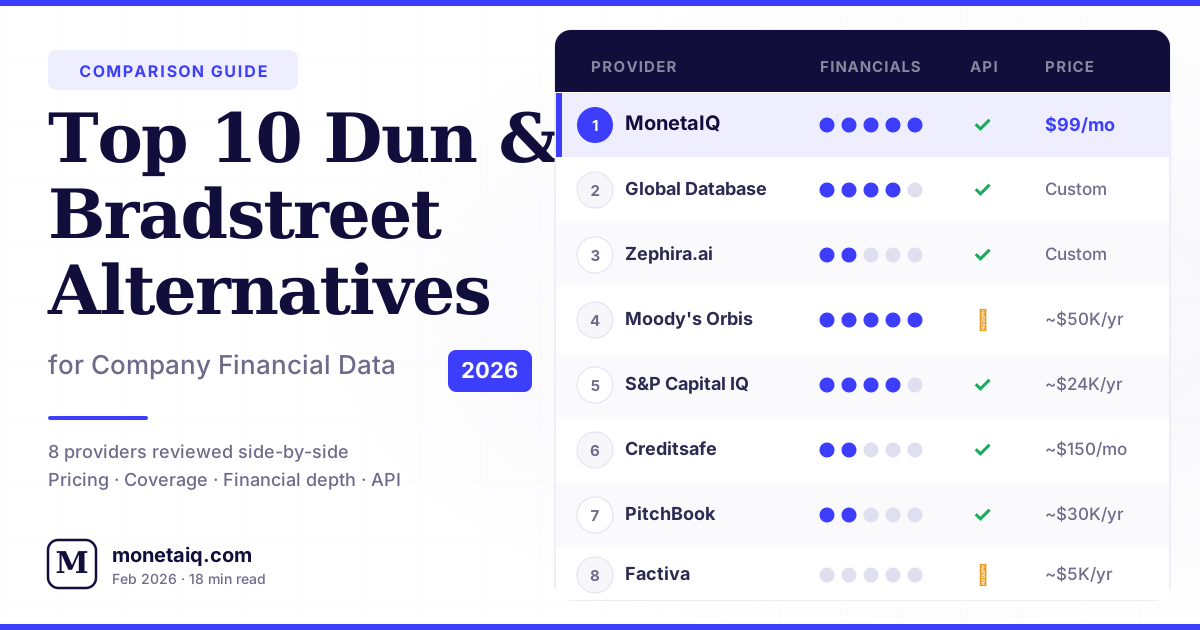
Top 10 Dun & Bradstreet Alternatives for Company Financial Data (2026)

D&B has been the default for business data since 1841. But after the $7.7B Clearlake take-private, rising prices, and growing frustration with data freshness — enterprise teams are actively looking for alternatives. This guide compares 8 providers that cover what D&B does, and in many cases, does it better.
Why Teams Are Moving Away from Dun & Bradstreet
Dun & Bradstreet has been a pillar of business intelligence for over 180 years. The D-U-N-S Number is embedded in government procurement workflows worldwide. D&B credit reports are a standard requirement for vendor onboarding at Fortune 500 companies.
But the market has shifted. Here's what's driving the search for alternatives:
The Clearlake Acquisition
In August 2025, Clearlake Capital completed its $7.7 billion take-private of Dun & Bradstreet. D&B was delisted from the NYSE. For enterprise customers locked into multi-year contracts, the shift to private equity ownership has raised questions about product investment, pricing trajectory, and long-term data strategy.
PE-backed data companies historically face pressure to optimize margins. For customers already frustrated with pricing, this adds uncertainty.
Pricing
D&B's enterprise contracts typically range from $15,000 to $50,000+ per year. The median contract value reported by buyers is approximately $37,500 annually. For mid-market companies or teams that only need financial data (not the full D&B suite), that's a hard number to justify — especially when alternatives now offer comparable or better financial coverage at a fraction of the cost.
Data Freshness and Source Transparency
D&B aggregates data from a wide range of sources: trade payment data, phone surveys, web scraping, self-reported filings, and third-party feeds. In many markets outside the US, the financial data is estimated rather than sourced directly from government registries.
That works for credit scoring. It's less reliable when you need audited balance sheets, verified revenue figures, or official filing data for compliance and due diligence.
Restrictive Licensing
D&B's data licensing terms are well-known for being restrictive. Redistribution is tightly controlled. Building derivative products from D&B data typically requires separate (and expensive) licensing agreements. For fintechs and data product teams that need to embed company data into their own platforms, this is often a dealbreaker.
The bottom line: D&B remains strong for US credit risk and government procurement workflows where the D-U-N-S Number is mandatory. But for financial data, global company intelligence, and API-first use cases, the market now has better options.
What to Look for in a D&B Alternative
Not every alternative covers the same ground. Before evaluating providers, clarify what you actually need from the switch:
- Financial data depth: Do you need full financial statements (balance sheets, income statements, cash flows) or just credit scores and risk indicators?
- Private company coverage: How many private companies does the provider cover — and how is the data sourced? Estimated revenue figures are useful but not the same as registry-filed accounts.
- Geographic reach: D&B claims 600M+ entities in 220+ countries. But financial depth varies wildly by market. Does the alternative cover the specific countries you care about?
- Data delivery: Do you need an API, bulk data feed, or a platform interface? Some alternatives are API-first. Others are built around desktop research tools.
- Licensing terms: Can you redistribute the data in your product? Can you build derivative analytics?
- Ownership and UBO data: If you need corporate structures and beneficial ownership, not all providers cover this.
- Pricing model: Self-serve monthly plans vs. annual enterprise contracts. The spread can be 10x-50x depending on the provider.
The 8 Best Dun & Bradstreet Alternatives (Reviewed)
MonetaIQ
monetaiq.com- Registry-sourced financial statements (not estimates)
- Balance sheets, P&L, cash flow for private companies
- Daily data updates from regulatory filings
- Self-serve pricing starting at $99/mo
- Flexible API with bulk data delivery
- No D-U-N-S Number equivalent
- Not designed for sales prospecting or marketing
- No real-time stock trading data
Global Database
globaldatabase.com- 400+ government registry sources (first-party data)
- Deep UBO and corporate ownership mapping
- KYB verification and compliance API
- Flexible licensing for data redistribution
- Clients include Uber, AWS, SAP, Mastercard
- No self-serve pricing (enterprise sales required)
- Not a market data or trading platform
- Financial statement depth varies by country
Zephira.ai
zephira.ai- AI-powered entity resolution and matching
- Purpose-built for UBO discovery and PEP screening
- Registry data aggregation across jurisdictions
- Developer-friendly API infrastructure
- Not a full financial data platform
- Limited public information on coverage depth
Moody's Orbis (Bureau van Dijk)
moodys.com/orbis- Deepest private company financial database globally
- Standardized cross-border financial comparisons
- Corporate ownership trees and UBO data
- Transfer pricing and compliance tools built-in
- Backed by Moody's institutional credibility
- Typically $50K+/year for enterprise access
- Complex UI with steep learning curve
- Restrictive bulk download and export policies
- Not API-first — built around desktop research
S&P Capital IQ Pro
capitaliq.com- Deep public company fundamentals and filings
- Excel plug-in for financial modeling
- Analyst estimates and consensus data
- M&A transaction data and deal screening
- $24K+/user/year — out of reach for most mid-market
- Private company depth is limited vs Orbis
- Not designed for compliance or KYB workflows
- Licensing restricts data redistribution
Dow Jones Factiva
dowjones.com/factiva- Unmatched news and media archive (30+ years)
- Strong for qualitative due diligence
- Adverse media screening for compliance
- Company snapshots with basic financial profiles
- Not a financial data provider — no balance sheets or P&L
- Company financials are basic and secondary-sourced
- Complements, not replaces, a data provider
Creditsafe
creditsafe.com- Closest functional replacement for D&B credit reports
- Proprietary credit scores with payment monitoring
- Good Salesforce and CRM integrations
- Lower pricing than D&B for comparable data
- Strong in Europe and North America
- Financial statement depth is thinner than Orbis or MonetaIQ
- Less global coverage in emerging markets
- No D-U-N-S Number (uses own identifiers)
- UBO and ownership data is limited
PitchBook
pitchbook.com- Best-in-class PE/VC and M&A deal data
- Funding round tracking and investor mapping
- Company valuations and financial estimates
- Strong for deal sourcing and competitive landscape
- $30K+/user/year pricing
- Focused on VC/PE-backed companies, not broad coverage
- No credit scores or compliance data
- Not suitable for KYB, supplier checks, or credit risk
Side-by-Side Comparison Table
A quick-scan view across all 8 providers.
| Provider | Private Co. | Financials | Credit | UBO | API | Self-Serve | From | Best For |
|---|---|---|---|---|---|---|---|---|
| MonetaIQ | 400M+ | ✓ Full | ✓ | ◐ | ✓ | ✓ | $99/mo | Financial statements |
| Global Database | 600M+ | ✓ Registry | ✓ | ✓ | ✓ | ✗ | Custom | KYB, compliance |
| Zephira.ai | Varies | ◐ | ✗ | ✓ | ✓ | ✗ | Custom | UBO, PEP screening |
| Moody's Orbis | 600M+ | ✓ Full | ✓ | ✓ | ◐ | ✗ | ~$50K/yr | Transfer pricing |
| Capital IQ | 60M+ | ✓ Public+ | ✓ | ◐ | ✓ | ✗ | ~$24K/user | Investment research |
| Factiva | N/A | ✗ | ✗ | ✗ | ◐ | ✗ | ~$5K/yr | News, due diligence |
| Creditsafe | 365M+ | ◐ Basic | ✓ | ◐ | ✓ | ✓ | ~$150/mo | Credit reports |
| PitchBook | 3.5M+ | ◐ Est. | ✗ | ◐ | ✓ | ✗ | ~$30K/user | PE/VC deals |
Key: ✓ Full support ◐ Partial ✗ Not available
Which Alternative Is Right for You?
There's no single "best" alternative. The right choice depends on what you're replacing D&B for.
Quick Decision Framework
A note on switching costs: If your organization uses D-U-N-S Numbers as the primary company identifier in your CRM, ERP, or compliance systems, switching providers requires a mapping exercise. Most alternatives listed here support cross-referencing via company name, registration number, VAT ID, or LEI — but you'll need to plan for identifier migration.
Try MonetaIQ Free
Access financial statements for 400M+ private companies. Registry-sourced. API-ready. Starting at $99/month.
Start Free Trial →Frequently Asked Questions
The best D&B alternative depends on your use case. For registry-sourced financial statements on 400M+ private companies, MonetaIQ is the strongest option. For enterprise compliance and ownership data, Global Database offers direct government registry access in 195 countries. For investment research with modeling tools, S&P Capital IQ provides the deepest analyst coverage. For a direct credit report replacement, Creditsafe is the closest functional match.
Common reasons include restrictive data licensing terms that limit redistribution, high enterprise pricing (median contract approximately $37,500/year), limited transparency into how data is sourced in non-US markets, financial data that is often estimated rather than registry-verified, and uncertainty following Clearlake Capital's $7.7 billion acquisition in August 2025.
D&B Hoovers Essentials starts at $49/month with 150 credits. Enterprise packages are custom-priced and typically range from $15,000 to $50,000+ per year depending on data volume, modules selected, and number of user seats. Credit monitoring products like CreditBuilder Plus start around $149/month.
No. Clearlake Capital completed its $7.7 billion acquisition of Dun & Bradstreet in August 2025. D&B stockholders received $9.15 per share. The company was delisted from the New York Stock Exchange and is now privately held under Clearlake's ownership.
D&B focuses on credit scoring, payment behavior tracking, and the D-U-N-S Number identifier system. Moody's Orbis (formerly Bureau van Dijk) focuses on standardized financial statements, corporate ownership structures, and UBO data sourced from 170+ providers. Orbis is stronger for cross-border financial analysis and regulatory compliance. D&B is stronger for US-centric credit decisioning and government procurement.
A D-U-N-S Number is a unique nine-digit identifier assigned by D&B to individual business entities. It remains required for US federal government contracting, some Apple and Google developer programs, and certain EU public procurement processes. However, alternatives like LEI (Legal Entity Identifier) numbers, national company registration numbers, and VAT IDs are increasingly accepted for international business verification and compliance workflows.
For sheer depth and global coverage, Moody's Orbis leads with 48 million companies having detailed financial information. MonetaIQ covers 400M+ private companies with registry-sourced financial statements (balance sheets, income statements, cash flows) and offers more accessible pricing starting at $99/month. Both source from official filings rather than relying on estimates.
Yes. MonetaIQ, Global Database, Creditsafe, and Zephira.ai all offer RESTful APIs for company financial data retrieval. MonetaIQ starts at $99/month for API access. These API-first alternatives are often preferred by fintechs, data product builders, and compliance teams automating KYB workflows.
MonetaIQ offers the lowest entry point at $99/month for its Starter plan, which includes API access and company financial profiles. Creditsafe typically starts around $100-200/month for credit reports. D&B Hoovers Essentials is $49/month but only includes 150 credits for prospecting data, not full financial statements.
Clearlake Capital completed its $7.7 billion acquisition in August 2025. D&B was valued at 9.8x EBITDA. The company is now privately held, delisted from the NYSE, and operating under private equity ownership. Enterprise customers have reported uncertainty about product roadmap changes, potential pricing increases, and long-term data strategy under the new ownership structure.
How We Evaluated These Alternatives
This comparison was built by reviewing each provider's public documentation, pricing pages, data dictionaries, and API specifications. We also analyzed customer reviews, licensing terms, and coverage claims.
Our evaluation criteria focused on five dimensions:
- Data sourcing transparency: Does the provider disclose where its data comes from? Registry-sourced data scored highest. Estimated or undisclosed data sources scored lowest.
- Financial statement depth: Does it provide full balance sheets, income statements, and cash flows — or just revenue estimates and credit scores?
- Private company coverage: How many private companies are covered with actual financial data, not just firmographic profiles?
- Accessibility: Is the data available through a self-serve API with transparent pricing, or does it require a sales call and six-figure contract?
- Licensing flexibility: Can you redistribute the data, build products with it, or embed it into customer-facing applications?
We intentionally excluded sales prospecting tools (ZoomInfo, Apollo, Lusha) from this comparison because they serve a different use case. This guide focuses specifically on company financial data — the financial statements, credit indicators, and registry data that D&B's enterprise customers actually use for credit risk, compliance, and due diligence.
Disclosure: MonetaIQ is the publisher of this article. We've included competitors that outperform us in specific areas (Orbis for cross-border standardization, Capital IQ for investment research, Creditsafe for credit reports) because an honest comparison serves buyers better than a biased one.