How to Evaluate Private Company Financials: The Complete Guide for PE, Credit Risk, and Compliance Teams

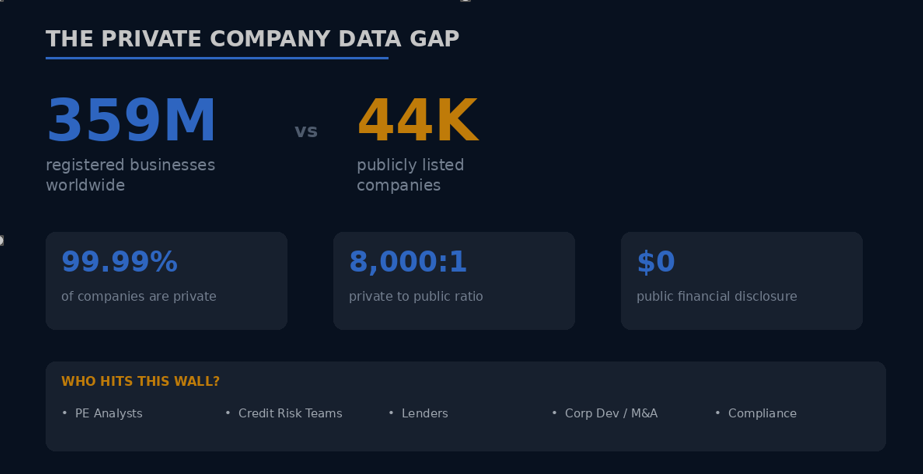
99.99% of the world’s 359 million companies are private. They don’t file 10-Ks. They don’t host earnings calls. And if your job requires evaluating their financial health, you’re working with a massive data gap.
There are roughly 44,000 publicly listed companies worldwide. The SEC, stock exchanges, and regulators force them to disclose everything—revenue, margins, debt, executive pay—on a quarterly basis. Any analyst can pull up a balance sheet in seconds.
Now consider the other side. There are an estimated 359 million registered businesses globally. That’s a ratio of roughly 8,000 private companies for every one public company. And the overwhelming majority of them file zero public financial disclosures.
This isn’t a minor inconvenience. It’s a structural blind spot that affects every professional who touches private company data: PE analysts running due diligence, credit risk teams assessing counterparty exposure, lenders underwriting loans, and corporate development teams scoping M&A targets.
They all hit the same wall. The company they need to evaluate doesn’t publish its financials.
This guide breaks down exactly how to evaluate private company financials—where to find the data, what to look for, and how to avoid the most common mistakes.
Why Private Company Financial Data Is So Hard to Find
Public companies live under a microscope. Quarterly filings, annual reports, earnings calls, and analyst coverage create a continuous stream of financial transparency.
Private companies have none of that. Most are under no legal obligation to disclose revenue, profitability, or debt levels to anyone outside their immediate stakeholders.
The OECD reports that approximately 44,000 companies were publicly listed at the end of 2024, with a combined market capitalisation of $125 trillion. Meanwhile, roughly 359 million businesses are registered worldwide. The math is simple: the vast majority of economic activity happens inside companies that most professionals can’t financially evaluate.
This gap creates real consequences. PE firms can’t source deals efficiently. Lenders make decisions on incomplete information. Compliance teams can’t properly assess counterparty risk.
Who Needs Private Company Financial Data (and Why It Matters Now)
The demand for private company financials cuts across multiple industries.
Private Equity and Venture Capital
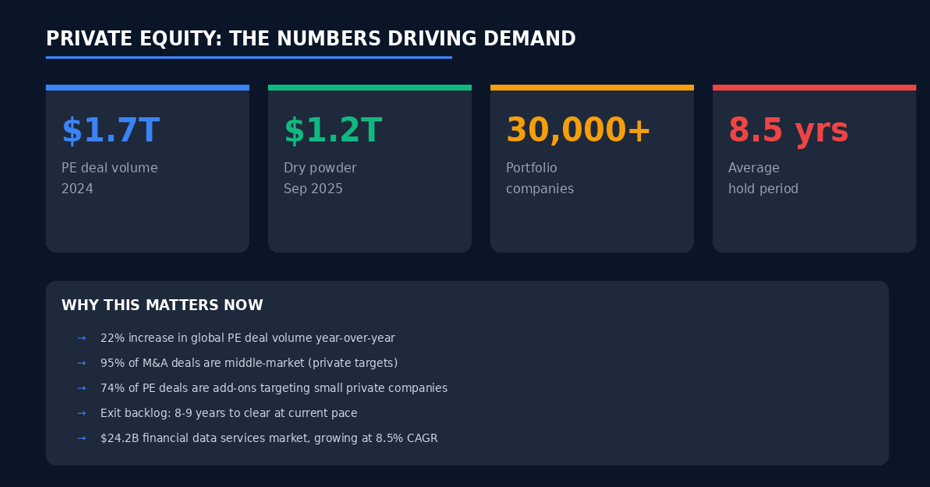
Global PE deal volume hit $1.7 trillion in 2024, up 22% from the prior year. Buyout investment value alone rose 37% year over year to $602 billion, excluding add-ons. PE firms currently hold over 30,000 portfolio companies. Nearly half were acquired since 2020.
Every one of these deals required financial due diligence on a private target. Revenue trends, EBITDA margins, working capital cycles, debt structures—none of it is available through public filings.
PE dry powder stands at roughly $1.2 trillion as of September 2025. That capital needs to be deployed. And deployment requires financial data on targets that don’t publish financials.
Credit Risk and Lending
Banks and alternative lenders evaluate thousands of private borrowers every year. A commercial lender underwriting a $10 million facility needs the borrower’s profit and loss statements, balance sheet, and cash flow history.
Without standardised reporting, lenders either rely on self-reported figures (unreliable) or third-party financial data providers that can trace their data back to official filings.
Corporate Development and M&A
95% of all M&A deals in 2024 were middle-market transactions. These deals almost exclusively involve private targets. Corporate buyers use private company financials to build target lists, estimate valuations, and model synergies.
Middle-market add-ons accounted for 74% of all PE deals. These are small private companies being bolted onto existing portfolio companies. Each one requires financial evaluation.
Compliance and Counterparty Risk (KYB / AML)
Regulated industries—banking, insurance, asset management—must assess the financial health of their counterparties. Financial statements are a core input to Know Your Business (KYB) and Anti-Money Laundering (AML) risk assessments.
Regulatory pressure is tightening globally. Compliance teams need verified, traceable financial data with a clear audit trail—not estimates or models.
Where Does Private Company Financial Data Come From?
Before evaluating any private company, you need to understand where financial data actually originates and why each source has limitations.
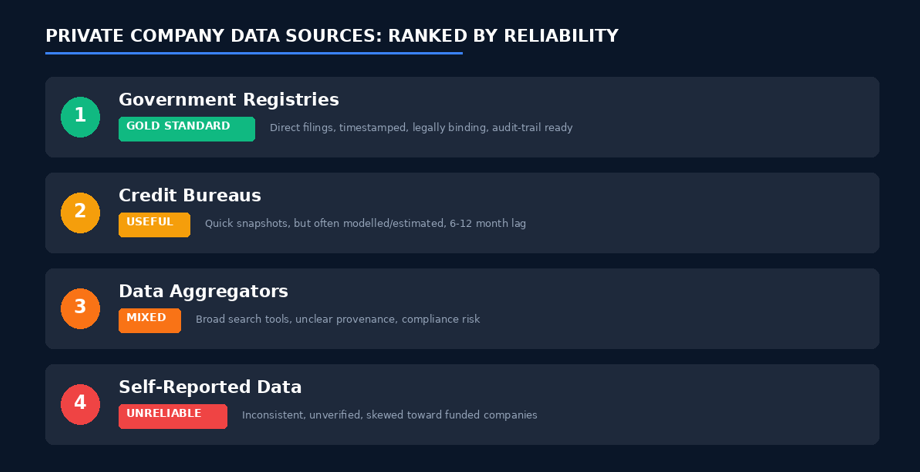
1. Government Registries and Corporate Filings
In many jurisdictions, private companies are legally required to file financial statements with their national business registry. The UK’s Companies House, France’s INPI, Germany’s Bundesanzeiger, and dozens of other registries hold profit and loss statements, balance sheets, and annual accounts for millions of companies.
This is the gold standard. The data comes directly from the company’s own filings to a government body. It’s timestamped, traceable, and carries legal weight.
The challenge is access and scale. There are over 200 corporate registries worldwide. Each has its own format, language, filing cadence, and data structure. Doing this across 200+ registries and normalising the output is a data engineering problem most organisations can’t solve in-house.
2. Credit Bureaus
Companies like Experian, Equifax, and Creditsafe compile financial data on private companies and package it into credit reports. These reports often include estimated revenue ranges, credit scores, and payment behaviour data.
Credit bureaus are useful for a quick snapshot. But the underlying data is often modelled or estimated rather than directly sourced from filings. Coverage varies widely by country. And the data can lag behind actual performance by 6–12 months.
3. Data Aggregators
Platforms like PitchBook, Capital IQ, and Bloomberg Terminal aggregate private company financials from various sources—press releases, self-reported surveys, filings, and news articles.
These platforms offer broad search tools. But data provenance is often unclear. You may not know whether a revenue figure came from an audited filing, a press release, or an estimate. For compliance-sensitive use cases, that ambiguity is a problem.
4. Self-Reported Data
Some private companies voluntarily share financials with platforms like Crunchbase or industry databases. This data is valuable when available, but it’s inconsistent, unverified, and skewed toward companies seeking funding or partnerships.
What Financial Statements Tell You About a Private Company
Once you have a private company’s financials, here’s what each statement reveals:
| Statement | What It Shows | Key Metrics |
| Profit & Loss | Revenue, COGS, operating expenses, net income over a period | Revenue growth rate, gross margin, EBITDA margin, net profit margin |
| Balance Sheet | Assets, liabilities, and equity at a point in time | Current ratio, debt-to-equity, working capital, total assets |
| Cash Flow | Cash generated and spent across operating, investing, and financing activities | Operating cash flow, free cash flow, cash burn rate, capex-to-revenue |
For PE due diligence, the profit and loss statement is the starting point. Analysts want to see whether revenue is growing, whether margins are stable, and whether earnings quality is consistent over time.
For credit risk, the balance sheet matters most. Lenders need to see the asset base, the debt load, and the liquidity position. A company with growing revenue but deteriorating working capital is a red flag.
For counterparty risk and KYB, all three statements are relevant. Compliance teams need a complete picture of financial health to assess whether a counterparty is a going concern or a potential default risk.
A 5-Step Framework for Evaluating Private Company Financials
Whether you’re evaluating an acquisition target, a new supplier, or a borrower, this framework provides a structured approach.
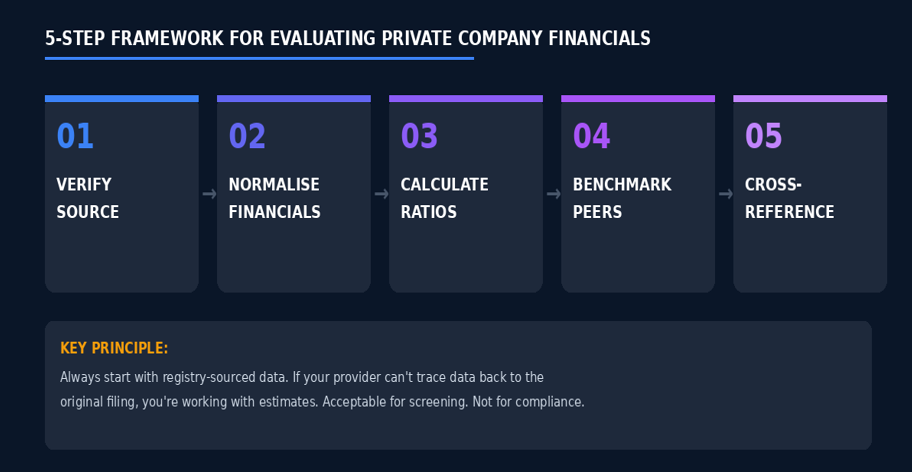
Step 1: Verify the Source
Start with the most authoritative data available. Government registry filings are the gold standard—they’re legally submitted, timestamped, and tied to a specific company identifier (like a UK company number or French SIREN).
If you’re using third-party data, ask one question: Can the provider trace this data back to its original filing?
If the answer is no, you’re working with estimates. That may be acceptable for screening. It’s not acceptable for compliance or due diligence.
Step 2: Normalise the Financials
Private companies report in different formats, currencies, and accounting standards (IFRS, local GAAP, etc.). Before you can compare companies, you need to normalise the data into a common structure.
This means converting currencies, standardising line items, and aligning reporting periods. At scale—across 200+ jurisdictions—it’s a significant data engineering challenge.
Step 3: Calculate Core Financial Ratios
Once the data is normalised, calculate the ratios that matter for your use case:
| Ratio | Formula | Why It Matters |
| Revenue Growth Rate | (Current Rev – Prior Rev) / Prior Rev | Shows momentum. Declining growth is a deal-killer for PE. |
| Gross Margin | (Revenue – COGS) / Revenue | Indicates pricing power and cost structure. |
| EBITDA Margin | EBITDA / Revenue | Core operating profitability. Most common PE valuation input. |
| Current Ratio | Current Assets / Current Liabilities | Short-term liquidity. Below 1.0 signals cash stress. |
| Debt-to-Equity | Total Debt / Total Equity | Leverage indicator. Critical for credit analysis. |
| Free Cash Flow | Operating Cash Flow – Capex | Cash available for growth, debt paydown, or distributions. |
Step 4: Benchmark Against Peers
A private company’s financials are meaningless in isolation. A 12% EBITDA margin could be excellent or mediocre depending on the industry, geography, and company stage.
Scale matters here. If your data provider covers 10,000 companies, your peer set is thin. If they cover 400+ million, you can build statistically meaningful benchmarks across any industry vertical and geography.
Step 5: Cross-Reference with Non-Financial Data
Financial statements don’t tell the whole story. Cross-reference them with:
- Corporate structure data — Who owns the company? What’s the group hierarchy?
- Director and officer information — Any recent changes in leadership?
- Digital footprint signals — Is the company growing or contracting online?
- Adverse media — Any lawsuits, sanctions, or regulatory actions?
A company with strong margins but a recent change in directors and a spike in adverse media may not be as healthy as the P&L suggests.
The Market for Private Company Financial Data Is Growing Fast
Several macro trends are making this data more valuable—and more urgent—than at any point in the past decade:
- PE dry powder: $1.2 trillion as of September 2025. That capital needs financial data on private targets to deploy.
- Longer hold periods: Average PE holding period reached 8.5 years in 2024, more than double the 4.1 years in 2007.
- Exit backlog: 30,000+ PE portfolio companies waiting for exit. Current pace: 8–9 years to clear.
- M&A rebound: Global PE deal volume rose 22% in 2024. US deal value climbed another 8% in H1 2025.
- Financial data market: Valued at $24.2 billion in 2024, growing at 8.5% CAGR. Record $44.3 billion in spending on financial market data.
- Regulatory tightening: AML/KYB regulations expanding globally. Compliance teams need verified, traceable data.
How to Choose a Private Company Financial Data Provider
Before committing to any data provider, ask these questions:
| Question | Why It Matters |
| Where does the financial data come from? | Registry-sourced data is verifiable. Modelled data is not. |
| How many companies are covered? | Benchmarking requires scale. 400M+ is enterprise-grade. |
| Are full financial statements available? | Summaries hide red flags. You need full P&L, balance sheet, and cash flow. |
| How is the data delivered? | API, bulk feed, and platform access cover different workflows. |
| Does the provider include ownership data? | Financial data without ownership context is incomplete. |
| How current is the data? | Stale financials create false confidence. Check update frequency. |
| Can you trace data back to the original filing? | Compliance teams require an audit trail. Provenance is non-negotiable. |
MonetaIQ: Private Company Financial Data at Scale
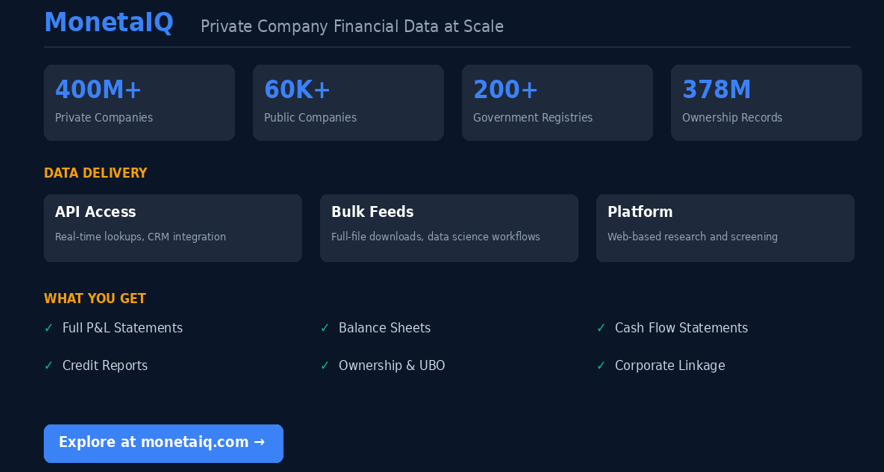
MonetaIQ is a financial data platform built to solve the private company data gap at global scale. It provides financial data on over 400 million private companies and 60,000 public companies worldwide—sourced directly from stock exchanges, government registries, and regulatory filings.
Here’s what separates MonetaIQ from legacy providers and data aggregators.
Full Financial Statements, Not Estimates
MonetaIQ delivers complete profit and loss statements, balance sheets, and cash flow statements. Not estimated ranges. Not modelled outputs. Actual filed financials, normalised into a consistent structure.
That means you can compare a German Mittelstand company to a UK limited company to a Brazilian LTDA using the same data framework.
Direct Registry Coverage Across 200+ Jurisdictions
MonetaIQ connects directly to over 200 government registries worldwide. This includes not just well-covered markets (UK, France, Germany) but jurisdictions across Latin America, Asia, and the Middle East that most data providers miss entirely.
For PE firms sourcing deals in emerging markets or compliance teams evaluating counterparties in less-transparent jurisdictions, this coverage is a competitive advantage.
Flexible Data Delivery
- API access — Real-time lookups for on-demand financial profiles and credit reports. Integrates into CRM, risk engines, or deal pipelines.
- Bulk data feeds — Full-file downloads for analytics teams, data science workflows, or proprietary databases.
- Platform access — Web-based interface for one-off research, screening, and company profiling.
Ownership and Corporate Linkage
MonetaIQ provides corporate ownership structures and group linkage data covering 378 million entities. Critical for UBO (Ultimate Beneficial Owner) identification and consolidated financial analysis—both increasingly required under AML and KYB regulations.
Credit Reports
Beyond raw financials, MonetaIQ provides credit reports that synthesise financial data into actionable risk assessments. These reports combine financial ratios, payment behaviour, and registry data into a single view of counterparty risk.
Who Uses MonetaIQ
- Private equity firms — Due diligence, portfolio monitoring, peer benchmarking.
- Banks and lenders — Credit underwriting, counterparty risk, loan portfolio monitoring.
- Compliance teams — KYB verification, AML screening, UBO identification.
- Corporate development — M&A target screening, valuation modelling, competitive intelligence.
- Data platforms and fintechs — Embedding financial data into products via API.