How to Assess Supplier Financial Health Using Registry-Verified Data

A practical guide for procurement and risk teams building supplier risk assessments on verified financial data — not credit score estimates.
Your largest supplier just filed for insolvency. You found out from a news article — not from your risk management system. The contract was seven figures. The replacement will take months. And when leadership asks how this happened, the honest answer is: nobody was watching the financials.
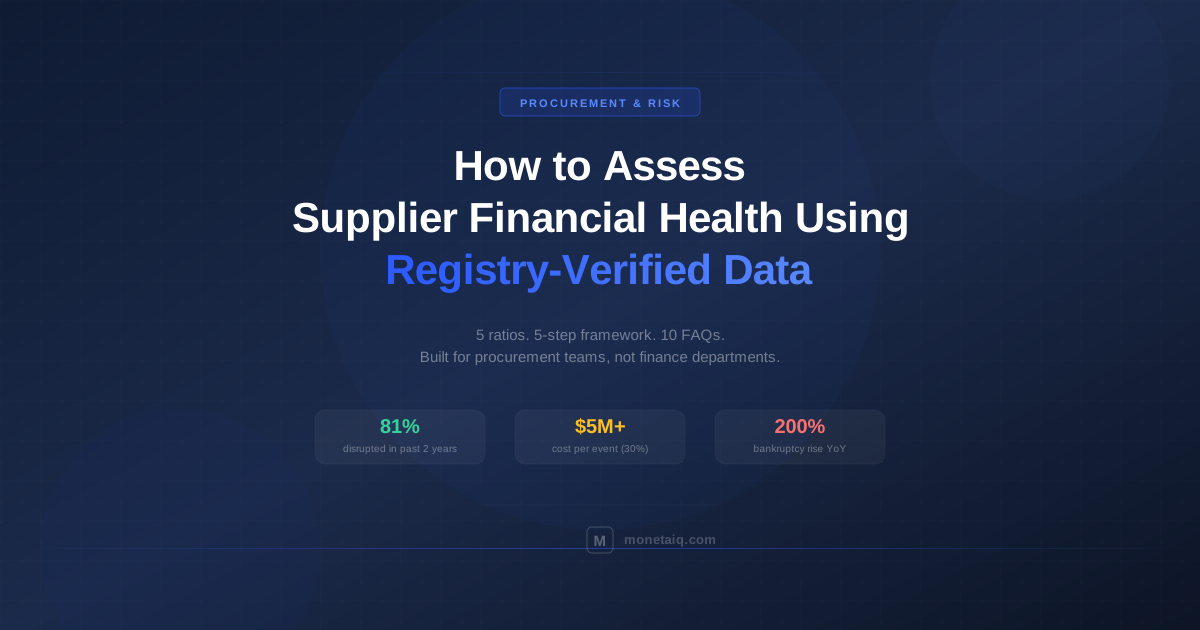
This is not a hypothetical. The RapidRatings 2025 Risk Survey found that 81% of supply chain professionals had their business impacted by supplier disruption in the past two years. Nearly 30% of those disruption events cost the affected company more than $5 million each. And Resilinc's 2024 mid-year analysis revealed a 200% year-over-year increase in supplier bankruptcies — driven by high interest rates, inflation, and shifting consumer demand.
Moody's puts it bluntly: a supplier's financial weakness is the single best predictor of supplier performance risk. Not delivery metrics. Not quality scores. Not questionnaire responses. Financials.
Yet most procurement teams still assess supplier risk using surface-level indicators: composite credit scores, self-reported questionnaires, and annual check-ins. These approaches share a common flaw — they rely on data that is estimated, self-reported, or months out of date.
There is a better way. Government registries in over 100 countries require companies to file annual financial statements. These filings — balance sheets, profit and loss statements, cash flow data — are submitted under legal obligation, timestamped, and traceable. Registry-verified financial data gives procurement teams the same quality of information that PE firms use for due diligence and banks use for underwriting.
This guide shows you how to use that data to build a supplier risk assessment process that catches problems before they become crises.
Why Traditional Supplier Risk Methods Fall Short
Most supplier risk assessments follow a familiar pattern. A new vendor completes an onboarding questionnaire. Someone checks a credit score. The supplier gets approved. Then nothing happens until something goes wrong.
The problem is structural. The data sources most teams rely on have fundamental limitations that become dangerous at scale.
Credit Scores: A Snapshot, Not a Story
Commercial credit scores from providers like Experian or Creditsafe give you a single number. That number is useful for a quick screen. But it tells you almost nothing about why a supplier is risky or how their financial position is changing.
A credit score does not show you whether a supplier's revenue declined 30% last year. It does not tell you their debt-to-equity ratio tripled. It does not reveal that their working capital turned negative two quarters ago. These are the signals that predict failure — 4 to 6 months before a credit score catches up.
Worse, commercial credit scores for private companies are often based on modelled or estimated data. The bureau may not have the supplier's actual filed accounts. They may be extrapolating from payment behaviour, trade references, or industry averages. For a quick screen of a £10,000 vendor, that is acceptable. For a critical supplier with a six or seven-figure contract, it is not.
Self-Reported Questionnaires: Unreliable by Design
Supplier questionnaires ask vendors to self-report financial information. The incentive problem is obvious: no supplier will voluntarily disclose financial stress when a contract is on the line.
Even when suppliers report in good faith, the data is inconsistent. Different suppliers use different accounting standards, report in different currencies, and present financial statements in different formats. Comparing a UK limited company's filed accounts to a German GmbH's Bundesanzeiger filing to a French SAS's INPI submission requires normalisation that most procurement teams are not equipped to do — especially across 50, 100, or 500+ vendors.
Point-in-Time Assessments: The Onboarding Trap
The most dangerous gap is temporal. Most organisations assess supplier risk at onboarding and then review it annually — at best. But supplier financial health changes continuously. A supplier that was stable 12 months ago may be 90 days from insolvency today.
BCI's Supply Chain Resilience Report 2024 found that 80% of organisations experienced at least one supply chain disruption in the prior 12 months. Yet only 17% of respondents were mapping their suppliers beyond Tier 1. If you are only checking financial health once a year, you are not managing risk. You are hoping nothing goes wrong.
Regulatory reality check: The EU's Corporate Sustainability Due Diligence Directive (CSDDD), now being transposed into national law with a compliance start date of July 2028 for the largest companies, explicitly requires ongoing due diligence across the value chain — not just at onboarding. Germany's LkSG is already in force. Nacha's 2026 ACH rules require identity and account verification for supplier payments. Annual reviews will not meet these standards.
What Registry-Verified Financial Data Tells You That Credit Scores Cannot
In over 100 jurisdictions worldwide, private companies are legally required to file annual financial statements with their national business registry. The UK's Companies House, France's INPI, Germany's Bundesanzeiger, Italy's Registro delle Imprese, Romania's ONRC, and dozens more hold filed accounts for millions of businesses.
This data is fundamentally different from credit bureau estimates or self-reported questionnaires:
| Dimension | Credit Bureau Score | Self-Reported Questionnaire | Registry-Verified Financials |
|---|---|---|---|
| Data source | Modelled estimates, payment behaviour, trade references | Supplier's own submissions | Government registry filings under legal obligation |
| Provenance | Unclear. Often aggregated. | Self-reported. No verification. | Full audit trail to official filing with timestamp. |
| Depth | Single composite score | Varies. Often incomplete. | Full P&L, balance sheet, cash flow statements |
| Trend analysis | Score changes lag real performance by 4–6 months | None unless multi-year data requested | Multi-year historical data standard |
| Compliance suitability | May not meet audit requirements for regulated industries | Difficult to defend to auditors | Meets KYB, AML, CSDDD documentation standards |
| Global coverage | Strong in major markets. Weak in emerging economies. | Depends on supplier willingness | 100+ countries via direct registry connections |
For supplier risk assessment, registry-verified financials give you three things credit scores cannot:
Trend analysis. Filed financials cover multiple years. You can track whether a supplier's revenue is growing or shrinking, whether margins are stable or eroding, and whether their debt load is manageable or accelerating. A credit score tells you where they are today. Filed financials tell you where they are heading.
Ratio-level detail. With balance sheet and P&L data, you can calculate the specific ratios that matter for supplier risk: current ratio, debt-to-equity, working capital, gross margin. These ratios reveal different dimensions of risk that a composite score compresses into a single digit and strips of context.
Audit trail. Every data point traces back to an official government filing. For regulated industries — banking, insurance, defence, pharma — this provenance matters. Compliance teams need data they can defend to auditors and regulators. Registry-sourced data meets that standard. Estimated data does not.
5 Financial Ratios Every Procurement Team Should Track
You do not need a finance degree to assess supplier financial health. These five ratios — all calculable from standard filed financial statements — cover the core risk dimensions that predict supplier failure.
| Ratio | What It Measures | Formula | Red Flag Threshold |
|---|---|---|---|
| Current Ratio | Short-term liquidity. Can the supplier pay its bills over the next 12 months? | Current Assets ÷ Current Liabilities | Below 1.0 = liabilities exceed assets. Below 0.8 is urgent. |
| Debt-to-Equity | Leverage. How much debt relative to equity? | Total Debt ÷ Total Equity | Above 3.0 = heavy leverage. Above 5.0 = high risk for most industries. |
| Revenue Growth | Trajectory. Is the business growing or contracting? | (Current Rev – Prior Rev) ÷ Prior Rev | Negative growth for 2+ consecutive years triggers deeper review. |
| Gross Margin | Pricing power. Healthy core operations? | (Revenue – COGS) ÷ Revenue | Declining margins year-over-year signals competitive or cost pressure. |
| Working Capital | Operational buffer. Enough cash for day-to-day operations? | Current Assets – Current Liabilities | Negative working capital = operations funded by debt. Immediate review. |
Why ratios beat scores: A supplier with a healthy current ratio but rapidly declining revenue and shrinking margins is heading toward failure — even if their credit score has not caught up yet. In Resilinc's H1 2024 data, supplier bankruptcies rose 200% year-over-year while many of those companies still carried "satisfactory" credit ratings. Filed financials let you see the trajectory. Credit scores only show the current position.
A 5-Step Framework for Registry-Based Supplier Risk Assessment
Here is a structured approach for procurement and risk teams to build supplier financial monitoring using registry-verified data.
Segment Your Supplier Base by Financial Criticality
Not every supplier needs deep financial monitoring. Start by categorising your supplier base into three tiers based on contract value, dependency, and replaceability:
Tier 1 — Critical suppliers: High contract value (£500K+), difficult to replace, or sole-source. Full financial statement analysis with quarterly or semi-annual review. Typically 5–15% of your supplier base but 60–80% of your spend.
Tier 2 — Important suppliers: Moderate contract value (£50K–£500K), alternatives exist but switching has cost. Annual financial review with automated monitoring for material changes.
Tier 3 — Routine suppliers: Low value, easily replaceable. Credit score screening at onboarding is sufficient. Flag for deeper review only if monitoring triggers an alert.
Source Registry-Verified Financial Statements
For Tier 1 and Tier 2 suppliers, pull their filed financial statements from government registries. This includes the profit and loss statement, balance sheet, and where available, cash flow statement.
The challenge is scale. There are over 200 corporate registries worldwide, each with different formats, languages, filing cadences, and data structures. Manually pulling and normalising financial statements from Companies House, Bundesanzeiger, INPI, ONRC, and dozens of other registries is not practical at scale.
Financial data platforms like MonetaIQ connect directly to government registries across 100+ countries and normalise the data into a standardised format. This means you can compare a UK supplier's filed accounts to a German supplier's Bundesanzeiger filing to a Romanian supplier's ONRC submission using the same data structure — without manual translation or reformatting.
Calculate and Benchmark Financial Ratios
Once you have normalised financial statements, calculate the five core ratios for each Tier 1 and Tier 2 supplier. Then benchmark them in two dimensions:
Industry benchmarks: A current ratio of 1.2 might be healthy for a logistics company but concerning for a SaaS business that should be generating cash. MonetaIQ's database of 400M+ company profiles enables statistically meaningful benchmarking across any industry vertical and geography.
Historical comparison: A supplier whose current ratio dropped from 2.5 to 1.2 in two years is on a different trajectory than one that has held steady at 1.2 for five years. The absolute number is identical. The risk profile is not.
Set Automated Monitoring Triggers
Static assessments decay the moment they are completed. In the RapidRatings survey, 39% of respondents reported increased disruption frequency in 2024 alone. Financial health changes between review cycles.
Set triggers for the conditions that matter: new filings showing a ratio breach, a change in corporate status (winding-up petition, administration notice), a significant ownership change, or a credit score downgrade.
MonetaIQ's Watch API provides real-time alerts when a monitored company's financials, status, or filings change. This converts your supplier risk process from periodic review to continuous monitoring — which is exactly what the CSDDD, LkSG, and emerging supply chain regulations require.
Build Financial Health Into Procurement Decisions
Financial data is only valuable if it feeds into actual decisions. The final step is integrating supplier financial health into your procurement workflows: sourcing decisions, contract renewals, vendor scorecards, and escalation protocols.
Define clear policies. For example:
• Any Tier 1 supplier whose current ratio falls below 1.0 triggers a review meeting within 30 days.
• Any supplier with two consecutive years of revenue decline requires a risk mitigation plan before contract renewal.
• Any supplier entering administration or insolvency proceedings triggers immediate activation of a secondary supplier.
• Any supplier with debt-to-equity above 5.0 requires a performance bond or shortened payment terms.
When financial data is embedded in procurement workflows — not siloed in a risk team's spreadsheet — it becomes an operational tool, not a compliance checkbox.
Three Scenarios Where Registry Data Changes the Outcome
Scenario 1: Critical Supplier Contract Renewal (£2.5M/year)
Your largest raw materials supplier is up for a three-year renewal worth £2.5 million annually. Their credit score is "satisfactory." But when you pull their last three years of filed financial statements through MonetaIQ, you find: revenue declined 18% year-over-year, gross margins compressed from 34% to 22%, and debt-to-equity increased from 1.8 to 4.1.
The credit score has not caught up yet. The filed financials tell you this supplier is under significant financial stress. You negotiate shorter payment terms, require a performance bond, and activate a secondary supplier qualification process. If the credit score was your only input, you would have renewed without conditions.
Scenario 2: New Supplier Onboarding in an Emerging Market
You are onboarding a technology supplier registered in Romania. Your credit bureau has no coverage for this entity. A self-reported questionnaire shows healthy financials, but there is no way to verify the numbers independently.
Through MonetaIQ, you access the supplier's filed accounts from Romania's ONRC (National Trade Register Office). The normalised financial statements show a current ratio of 2.3, positive working capital of €840K, and steady revenue growth of 15% CAGR over four years. The data comes from the government registry with a clear audit trail. You onboard the supplier with confidence — and with documented evidence for your compliance file.
Scenario 3: Continuous Monitoring Catches Early Warning
A Tier 1 logistics supplier files their annual accounts six months into your contract year. Your automated monitoring triggers an alert: current ratio dropped below 1.0, working capital turned negative (–£320K), and revenue declined 12%. No credit score change has been issued yet.
Your procurement team initiates a review within two weeks, meets the supplier, and begins qualifying an alternative as contingency. Three months later, the supplier announces restructuring. By then, your backup plan is already in place. RapidRatings data shows this type of proactive response can avoid the $5M+ cost that 30% of disruption events generate.
The Regulatory Landscape Is Moving Fast
Supplier financial risk assessment is moving from best practice to regulatory requirement. Here is what procurement teams need to track:
| Regulation | Scope | Key Requirement | Timeline |
|---|---|---|---|
| EU CSDDD | EU + non-EU companies with €1.5B+ turnover, 5,000+ employees | Ongoing due diligence across value chain including supplier financial stability | Transposition by July 2027. First compliance July 2028. |
| Germany LkSG | Companies with 1,000+ employees in Germany | Supply chain risk assessment including financial health of suppliers | Already in force since Jan 2024 |
| Nacha 2026 ACH Rules | All US organisations using ACH payments | Verify supplier identity and account ownership for payments | Taking effect 2026 |
| UK Modern Slavery Act | UK companies with £36M+ turnover | Supply chain due diligence including financial counterparty risk | In force. Enforcement tightening. |
| US UFLPA | All US importers | Supply chain due diligence on forced labour risks including supplier verification | In force. Active enforcement by CBP. |
The direction is clear. Regulators increasingly expect organisations to know who their suppliers are, whether they are financially stable, and whether they pose operational or compliance risk. Annual credit score checks will not meet this standard.
Frequently Asked Questions
Supplier financial risk assessment is the process of evaluating a supplier's financial health to determine whether they pose a risk to your supply chain continuity. It involves analysing financial statements — balance sheets, profit and loss statements, and cash flow data — to calculate ratios like current ratio, debt-to-equity, and working capital that predict a supplier's ability to meet their obligations. The goal is to identify financially unstable suppliers before they cause disruptions.
Credit scores compress complex financial data into a single number, stripping out the context that procurement teams need. They lag real-world performance by 4 to 6 months, are often based on modelled or estimated data rather than actual filings, and do not show trends like declining revenue, margin compression, or deteriorating working capital. In Resilinc's 2024 data, supplier bankruptcies rose 200% while many of those suppliers still carried satisfactory credit ratings. For critical suppliers with high-value contracts, filed financial statements provide the depth and timeliness that credit scores cannot.
Registry-verified financial data refers to financial statements — balance sheets, income statements, cash flow statements — that companies file with their national business registry under legal obligation. Examples include filings to the UK's Companies House, France's INPI, Germany's Bundesanzeiger, and Romania's ONRC. This data is timestamped, tied to a specific company registration number, and carries legal weight. It is the same data companies provide to tax authorities and auditors, making it the most authoritative source of private company financial information available.
Five ratios cover the core risk dimensions: current ratio (short-term liquidity — below 1.0 is a red flag), debt-to-equity (leverage — above 3.0 signals heavy debt), revenue growth (trajectory — two consecutive years of decline warrants review), gross margin (pricing power — declining margins signal stress), and working capital (operational buffer — negative working capital means debt-funded operations). The power is in combination and trend: track these ratios over 3 to 5 years to see where a supplier is heading, not just where they stand today.
It depends on the supplier's criticality. Tier 1 (critical, high-value) suppliers should be reviewed quarterly or semi-annually, with continuous automated monitoring for material changes like new filings, status changes, or ownership events. Tier 2 suppliers need annual reviews with event-triggered alerts. Tier 3 suppliers need credit screening at onboarding only. The EU's CSDDD and Germany's LkSG are pushing the standard toward continuous monitoring rather than periodic assessment — especially for Tier 1 and Tier 2 suppliers.
MonetaIQ provides registry-verified financial data on 400M+ private and 60,000+ public companies across 100+ countries. For procurement teams, this means access to filed financial statements (P&L, balance sheet, cash flow), credit reports, and historical financial trends — all normalised into a comparable format. MonetaIQ's Watch API enables continuous monitoring with alerts when a supplier's financials, status, or filings change. Data is accessible via API for integration into procurement systems, bulk data feeds for analytics teams, or platform access for one-off research.
Yes. Over 100 countries require companies to file financial statements with government registries — not just the UK. Germany (Bundesanzeiger), France (INPI), Italy (Registro delle Imprese), Romania (ONRC), Spain, Netherlands, and dozens more all mandate financial filings. The challenge is accessing and normalising data across 200+ registries with different formats, languages, and structures. MonetaIQ connects directly to these registries and standardises the output, so you can compare suppliers across jurisdictions using the same data framework.
The EU's Corporate Sustainability Due Diligence Directive (CSDDD), adopted in 2024, requires large companies to conduct ongoing due diligence across their value chains — including assessing supplier financial stability and operational risks. Following the Omnibus I amendments approved in December 2025, the transposition deadline was extended to July 2027, with the first compliance obligations starting July 2028 for companies with 5,000+ employees and €1.5B+ turnover. For procurement teams, this means supplier financial health monitoring will shift from voluntary best practice to regulatory requirement within the next two to three years.
According to the RapidRatings 2025 Risk Survey, nearly 30% of supplier disruption events cost the affected company more than $5 million each, and 16% cost more than $10 million per event. The 2025 global supply chain data shows disruptions cost companies an average of 8% of their annual revenue. The most affected business areas are operational costs, revenue targets, productivity, and inventory management. For context, 81% of supply chain professionals reported their business was impacted by supplier disruption in the past two years — and that was before the tariff turbulence of 2025.
Yes. MonetaIQ offers multiple integration options designed for enterprise procurement workflows. The REST API enables real-time lookups that can be embedded into ERP systems, procurement platforms (like SAP Ariba or Coupa), or custom risk dashboards — pulling financial statements, credit reports, and monitoring alerts on demand. Bulk data feeds deliver full datasets in JSON, CSV, or custom formats for analytics teams building internal risk models. The Watch API provides webhook-style alerts that can trigger automated workflows when a supplier's financial data changes. This means procurement teams can embed supplier financial health checks directly into onboarding, renewal, and monitoring workflows without manual intervention.
Stop Guessing. Start Verifying.
MonetaIQ provides registry-verified financial data on 400M+ private and public companies across 100+ countries. Access financial statements, credit reports, and monitoring alerts via API or bulk data feed.
Access financial statements, credit reports, and monitoring alerts via API, bulk data feed, or platform access across 100+ countries.
Start Free Trial →