Company Financial Data for AI & LLM Applications: What Data Teams Need

LLMs don't understand finance. They predict the next token. Feed them bad data, they'll produce bad outputs with full confidence. Here's what data teams actually need to fix that.
The AI Data Quality Problem
Hallucination rates across leading LLMs on financial tasks
Every AI model has a ceiling. That ceiling is set by data quality. McKinsey estimates generative AI could unlock $200–340 billion in annual value for banking alone — but only if the underlying data is accurate.
Large language models don't understand finance. They predict the next token. Feed them outdated revenue figures, unverified balance sheets, or incomplete filings — and they'll generate answers that sound authoritative but are wrong.
For data teams building AI products — credit risk engines, compliance tools, financial research copilots, KYB automation — the quality of company financial data isn't a nice-to-have. It's the foundation everything else sits on.
This guide breaks down what data teams actually need when sourcing company financials for AI and LLM applications. Not theory. Not buzzwords. The practical requirements that separate reliable AI outputs from expensive hallucinations.
LLMs Hallucinate Company Financials — It's a Data Problem
Ask any leading LLM for the revenue of a mid-size private company. You'll get a confident answer. A specific number. Maybe even a growth trend.
The problem: that number is fabricated.
According to Vectara's hallucination leaderboard (April 2025), hallucination rates across leading models range from 0.7% (Google Gemini Flash) to 29.9% (Falcon 7B). On financial data specifically, average hallucination rates hit 2.1% for top-tier models and climb to 13.8% across all models. A Deloitte survey found 38% of executives reported making incorrect business decisions based on hallucinated AI outputs.
That's not a rounding error. At enterprise scale, a 2% hallucination rate across 10,000 daily financial queries means 200 wrong answers per day — any one of which could cascade into a flawed credit decision, a missed compliance flag, or a bad investment thesis.
This isn't a model problem. It's a data problem. LLMs fill knowledge gaps with statistically plausible text. When they lack reliable financial data for a specific company, they generate numbers that look right — but have no factual basis. The fix isn't better prompting. It's better data.
Most company financial data available to AI teams today is aggregated — collected from third-party sources, scraped from websites, pulled from secondary databases. By the time it reaches an AI pipeline, the data has passed through multiple hands. Each handoff introduces lag, errors, and gaps.
A company files updated financials with a government registry in January. The aggregator picks it up in March. The data vendor updates their feed in April. Your AI model trains on it in May. That's 4 months of latency on a single data point — and the model has no way to flag it as stale. Now multiply that across millions of companies.
Why Financial Data Hallucinations Are Worse Than Other Domains
LLMs hallucinate across all domains. But the data shows financial data is uniquely vulnerable. General knowledge hallucination rates average 9.2%. Legal queries hit 6.4% even for top models. Financial data sits at 2.1%–13.8% — but the cost per error is disproportionately higher.
Entity-specific. There's no general knowledge about what "revenue" should be. It's different for every company, every quarter, every jurisdiction. A model can't generalize — it has to know the specific number or it's guessing. An analysis of 50,000+ production queries found most LLM-generated SQL queries execute successfully and return data — but the numbers are silently wrong.
Time-sensitive. Last year's revenue is wrong if someone asks for this year's. Financial data decays fast. A model trained on 2023 data will produce 2023 answers to 2025 questions — without flagging the gap. Public company data updates quarterly. Private company data can lag by 6–18 months through aggregated channels.
Private companies are invisible. There are over 600 million registered businesses worldwide. The vast majority are private. They don't file with the SEC. LLMs trained on the open web have near-zero exposure to private company financials. Ask for the revenue of a private German manufacturer and the model has nothing to work with except its imagination.
Confidence without evidence. LLMs don't hedge. They deliver a fabricated revenue figure with the same confidence as a verified one. One documented case: an AI system claimed "Company X had a net profit of $500 million in 2024" — entirely fabricated, but formatted identically to a real data point. In financial contexts — where 92% of Fortune 500 companies now use AI tools — that confidence is dangerous.
RAG Alone Doesn't Fix It
Retrieval-augmented generation is the standard answer to LLM hallucinations. Instead of relying on the model's training memory, you retrieve relevant documents at query time and feed them as context. Gartner predicts 70% of enterprise AI tools will use RAG by 2025. When done right, RAG can cut hallucination rates by up to 71%. One healthcare deployment reduced hallucinations from 12% to 0.8%.
But here's the catch most teams learn the hard way: RAG doesn't solve the financial data problem on its own.
The RAG paradox: Your retrieval layer is only as good as the data in your knowledge base. If that data is scraped, stale, or aggregated from unknown sources — you're grounding your LLM in someone else's errors. Stanford's 2025 legal RAG study found that even well-curated retrieval pipelines still hallucinated 17%–34% of the time with domain-specific tools.
Common failure patterns in financial RAG implementations:
- Stale data. Revenue figures from 2-year-old web scrapes sit in the vector store and get treated as current. The model has no way to flag them as outdated — it serves them with full confidence.
- Missing coverage. Most knowledge bases only contain ~60,000 public companies. That leaves 600M+ private companies completely uncovered. Any query about a private entity falls back to the model's imagination.
- Inconsistent formats. UK Companies House, German Bundesanzeiger, and France's INPI all use different schemas and line items. When your retrieval pulls from multiple jurisdictions, the results don't align — and the model papers over the gaps.
- No source metadata. Retrieved chunks carry no provenance. There's no way to tell if a revenue figure came from an official registry filing or a blog post. This is why 75% of financial firms still revalidate AI-sourced data manually.
RAG is necessary but not sufficient. The quality, recency, and provenance of your underlying financial data determine whether RAG actually reduces hallucinations or just makes them more convincing.
What Data Teams Actually Need From a Financial Data Source
AI applications have requirements that go beyond what a traditional BI dashboard needs. Here's the minimum spec for financial data feeding an AI pipeline:
Core financial metrics. Revenue, net income, EBITDA, operating margins, growth rates. Balance sheet: total assets, liabilities, equity, debt ratios. Cash flow statements. These are the foundational inputs for any financial reasoning model.
Filing metadata. When was the statement filed? For which period? Under which accounting standard (IFRS, local GAAP, US GAAP)? Without this, the model can't distinguish between current and historical figures or compare across jurisdictions.
Entity identifiers. Registration numbers, LEI codes, tax IDs — so the model reliably matches financial data to the right company. Without clean identifiers, entity resolution fails and the model conflates companies with similar names.
Source provenance. Every data point should carry metadata showing: the original source, filing date, reporting period, extraction date, and verification status. This is the audit trail that regulators and enterprise buyers will ask about.
Machine-readable delivery. JSON, CSV, or Parquet — formats that plug directly into data pipelines. Not PDFs. Not dashboard-only access.
Bulk access. You can't train a model or build a knowledge base one API call at a time. Data teams need full datasets delivered for ingestion — millions of records across jurisdictions.
How to Integrate Financial Data Into Your LLM Pipeline
There are three primary patterns for using company financial data in AI applications:
Pattern 1: RAG Grounding
Ingest verified financial data into a vector store or search index. At query time, retrieve relevant records and pass them to the LLM as context. The model generates answers grounded in real data instead of its training memory. When done correctly with verified data, this approach has been shown to reduce hallucination rates from 15% down to 1.45% in production deployments.
Pattern 2: Fine-Tuning Datasets
Use bulk verified financial statements as training data. Teach the model what real company financials look like — correct value ranges by industry, relationships between metrics, standard reporting patterns. This reduces hallucination at the model level.
Pattern 3: Evaluation & Benchmarking
Use verified financials as ground truth to measure your model's accuracy. Ask the model about companies where you know the real numbers. Compare outputs against verified data. Track hallucination rates over time.
Registry-Sourced vs. Aggregated: Why the Source Matters
There are two fundamentally different approaches to sourcing company financial data. For AI applications, the difference has direct implications for model reliability.
| Registry-Sourced | Aggregated | |
|---|---|---|
| Origin | Direct from government registries | Compiled from third-party sources |
| Verification | Traceable to original filing | Source often unknown |
| Freshness | Updated when company files | Depends on aggregator's schedule |
| Audit trail | ✓ Full provenance | ✗ Usually opaque |
| AI suitability | Verifiable ground truth | Black box inputs |
| Regulatory compliance | Meets EU AI Act provenance requirements | May not satisfy data lineage mandates |
For AI teams that care about model reliability, registry-sourced data gives you a verifiable foundation. Aggregated data gives you a black box. This matters more now than ever — the EU AI Act (effective August 2025) explicitly requires data provenance documentation for high-risk AI systems. Financial AI in credit scoring, insurance, and compliance falls squarely under high-risk classification. Fines for non-compliance reach up to €35 million or 7% of global turnover.
The Private Company Gap
Most financial data APIs cover public companies well. SEC filings, stock exchange data, and earnings transcripts are structured and accessible. But publicly listed companies represent roughly 0.01% of the global business landscape.
There are over 600 million registered businesses worldwide. In the EU alone, directives require millions of private companies to file annual accounts. The UK's Companies House holds financial data on 4.8+ million active companies. Germany, France, India, Singapore — all have registries with millions more.
This gap has direct consequences for AI products:
- A KYB verification tool that only checks public companies misses 99.9% of the entities it needs to screen.
- A credit risk model trained only on public company financials can't score the private supplier your client is onboarding — and private companies represent the majority of global supply chains.
- A market intelligence copilot that only knows listed companies gives an incomplete picture. In most industries, 80–95% of competitors are private.
The gap isn't just coverage. Private companies behave differently — revenue patterns, capital structures, and growth trajectories don't mirror public markets. Training an AI model exclusively on public data introduces structural bias into every output. A model that's only seen $500M+ revenue companies will systematically misjudge a $5M private firm.
Data teams need a source that covers both public and private companies, with financials sourced directly from the registries where those companies file.
Evaluating a Financial Data Provider for AI Workloads
Not every financial data provider is built for AI. Most were designed for human analysts querying a dashboard. Here's the evaluation checklist:
| Criteria | What to Ask |
|---|---|
| Bulk data access | Can you download full datasets, or only query individual records? |
| Incremental updates | Do they offer delta feeds or change logs for ongoing refreshes? |
| Source transparency | Can you trace every data point back to the original registry filing? |
| Private company coverage | Do they cover private companies, or only public/listed? |
| Structured formats | Is data available in JSON, CSV, Parquet — or only via dashboard? |
| Global coverage | How many registries do they source from? How many countries? |
| Schema consistency | Is data normalized across jurisdictions, or do you map each country separately? |
| Freshness | How quickly after a company files does the data appear in their system? |
| OCR accuracy | How do they extract data from non-digital filings? What's the accuracy rate? |
| Audit metadata | Does each record carry source, filing date, reporting period, and last verified? |
If a provider checks all ten boxes, they're built for AI workloads. If they check five or six, you'll spend more time cleaning data than building your product.
How MonetaIQ Solves This
Everything described above — the data quality challenges, coverage gaps, delivery requirements — is what MonetaIQ was built to address.
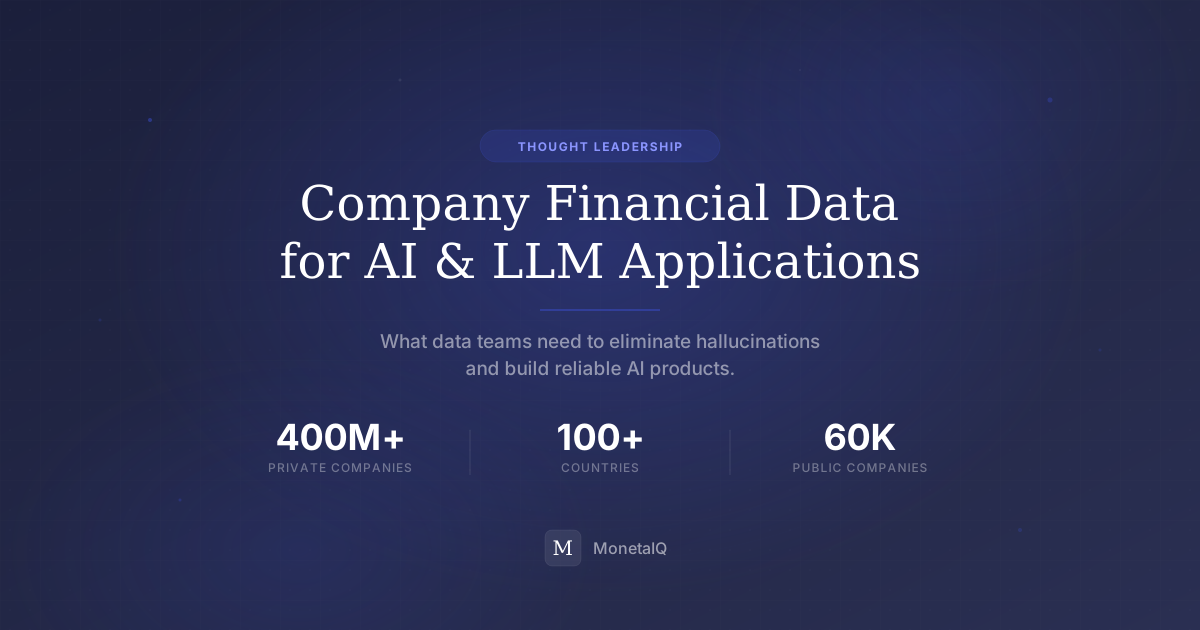
MonetaIQ provides structured financial data for 400+ million private companies and 60,000 publicly listed companies across 100+ countries. Income statements, balance sheets, cash flow statements, P&L breakdowns, and key financial ratios.
- API and bulk data feeds. Scalable API for real-time lookups. Bulk feeds for large-scale ingestion. JSON, CSV, XML, and custom formats.
- Private and public coverage. 400M+ private companies sourced from government filings. Public data from stock exchanges and regulatory filings, updated quarterly.
- Registry-sourced. Data from official stock exchange filings, regulatory bodies, and government registries. Every data point traceable to its origin.
- Validated and structured. All data undergoes validation and quality control. Non-digital filings are extracted, verified, and structured.
- Flexible delivery. Customizable by metrics, companies, industries, or regions. Daily, weekly, or monthly frequency.
MonetaIQ sources company data directly from 400 government registries worldwide. That registry-sourced foundation means AI teams get financial data with the accuracy, freshness, and audit trail that production AI systems demand.
Build AI Products on Verified Financial Data
400M+ companies. Registry-sourced. API and bulk delivery. Start with a free trial.
Frequently Asked Questions
LLMs predict the next token based on training patterns. When they lack reliable financial data for a specific company — which is common for private companies — they fill the gap with statistically plausible numbers. The output looks authoritative but has no factual basis. This is especially pronounced for entity-specific data like revenue, profit margins, and balance sheet items.
RAG is an architecture where the AI retrieves relevant financial records from a knowledge base before generating a response. Instead of relying on training memory, the model references actual data. This reduces hallucination — but only if the knowledge base contains verified, current, and well-sourced financial data.
Core requirements include income statements, balance sheets, cash flow statements, profitability metrics (EBITDA, operating margins), filing metadata (dates, reporting periods, accounting standards), and entity identifiers (registration numbers, LEI codes). All data must be structured, machine-readable, and traceable to its original source.
Over 400 million registered businesses worldwide are private. AI products for KYB verification, credit risk, supply chain monitoring, and market intelligence are incomplete without private company coverage. Models trained only on public company data develop structural biases and can't serve the majority of real-world use cases.
Registry-sourced data comes directly from government business registries — the official repositories where companies file their accounts. Aggregated data is compiled from multiple third-party sources, introducing lag, opacity, and potential errors. For AI applications, registry-sourced data provides verifiable ground truth with full audit trails.
Yes, but not all providers support it. Many only offer API or dashboard access. For AI workloads — model training, fine-tuning, RAG knowledge bases — you need bulk delivery of full datasets in machine-readable formats (JSON, CSV, Parquet). MonetaIQ offers both API access and customizable bulk data feeds.
The EU AI Act requires data provenance documentation for high-risk AI systems. Financial AI applications in credit, insurance, and compliance likely fall under high-risk classification. This means teams need to document data sources, collection methods, and quality measures — making registry-sourced data with full audit trails a practical necessity.
It depends on the use case. Monthly refreshes are a baseline for general intelligence. Weekly or more frequent updates are needed for credit risk and compliance monitoring. MonetaIQ offers flexible delivery frequency — daily, weekly, or monthly — with incremental updates so you're not re-ingesting entire datasets.
MonetaIQ provides financial data for over 400 million private companies and 60,000 publicly listed companies across 100+ countries. Data is sourced from government registries, stock exchange filings, and regulatory bodies — and delivered via scalable API or bulk data feeds.
MonetaIQ data is available in JSON, CSV, XML, and custom formats. For RAG: ingest bulk data into your vector store, then query via API for real-time updates. For training: use bulk feeds as fine-tuning datasets. For evaluation: use verified financials as ground truth benchmarks. The API supports company name search, registration number lookup, website URL, and LinkedIn URL matching.