
Every AI model has a ceiling. And that ceiling is set by data quality.
Large language models don’t understand finance. They predict the next token. Feed them outdated revenue figures, unverified balance sheets, or incomplete filings — and they’ll generate answers that sound authoritative but are wrong.
For data teams building AI-powered products — credit risk engines, compliance tools, financial research copilots, KYB automation — the quality of company financial data isn’t a nice-to-have. It’s the foundation everything else sits on.
This guide breaks down what data teams actually need when sourcing company financials for AI and LLM applications. Not theory. Not buzzwords. The practical requirements that separate reliable AI outputs from expensive hallucinations.
LLMs Trained on Unverified Financials Hallucinate — And It’s Well-Documented
In 2024, researchers at Purdue University tested leading LLMs on financial reasoning tasks. The result? Models frequently generated plausible-sounding financial figures that had no basis in reality. Revenue numbers were invented. Profit margins were fabricated. Dates were wrong.
This isn’t a bug in the model architecture. It’s a data problem.
Most company financial data available to AI teams is aggregated. It’s collected from third-party sources, scraped from websites, pulled from secondary databases, and repackaged. By the time it reaches an AI pipeline, the data has passed through multiple hands. Each handoff introduces lag, errors, and gaps.
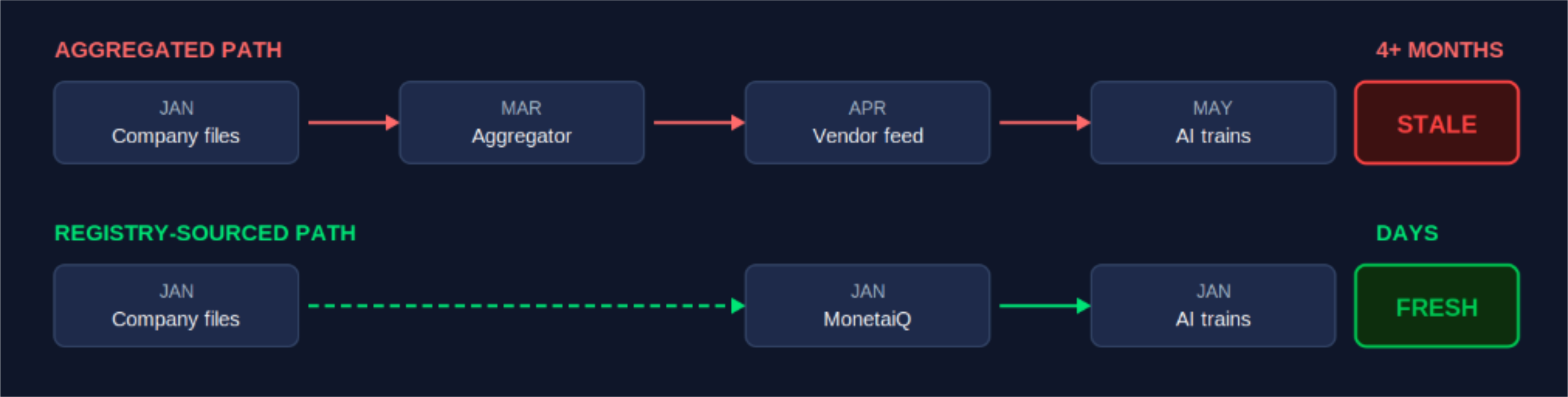
A company files updated financials with a government registry in January. The aggregator picks it up in March. The data vendor updates their feed in April. Your AI model trains on it in May. That’s four months of latency on a single data point.
Now multiply that across millions of companies. The model doesn’t know the data is stale. It treats a Q2 2024 revenue figure the same way it treats a Q4 2024 figure. And when a user asks a question, the model generates an answer based on whatever it was trained on — with full confidence.
The result is hallucination. Not because the model is broken, but because the training data was never verified against the original source.
For data teams building production AI systems, this creates a serious liability. A compliance tool that flags the wrong entity. A credit risk model that approves based on outdated revenue. A research copilot that cites financials from two years ago as current.
The fix isn’t better prompting. It’s better data.
What Financial Data Do AI Applications Actually Need?
Not all financial data is created equal. AI applications have specific requirements that go beyond what a traditional BI dashboard needs.
At minimum, data teams building AI products need access to:
Revenue and profitability metrics. This includes annual and quarterly revenue, net income, EBITDA, operating margins, and growth rates. These are the core inputs for any financial analysis model — whether it’s powering a chatbot, a risk engine, or an automated report generator.
Balance sheet data. Total assets, liabilities, equity, debt ratios, and liquidity metrics. Credit risk models and compliance screening tools depend on accurate, current balance sheet data to function.
Filing metadata. When was the financial statement filed? For which reporting period? Under which accounting standard (IFRS, local GAAP, US GAAP)? This metadata is critical for AI models that need to compare across companies and jurisdictions.
Company identifiers. Consistent entity identification — registration numbers, LEI codes, tax IDs — so the AI can reliably match financial data to the right company. Without clean identifiers, entity resolution fails and the model conflates companies with similar names.
The key requirement across all of these: the data needs to be structured, machine-readable, and traceable back to its original source.
Public AND Private Company Data: Why AI Needs Both
Most financial datasets available to AI teams are skewed heavily toward public companies. SEC filings, stock exchange data, earnings call transcripts — these are easy to access and well-structured.
But public companies represent a tiny fraction of the global business landscape.

There are over 600 million registered businesses worldwide. The vast majority are private. They don’t file with the SEC. They don’t have earnings calls. But many of them do file financial statements with their local government registries — in the UK, Germany, France, India, Singapore, and dozens of other jurisdictions.
A KYB verification tool that only checks public companies misses most of the entities it needs to screen. A credit risk model trained exclusively on public company financials can’t score the private supplier your client is about to onboard. A market intelligence copilot that only knows about listed companies gives an incomplete picture.
The gap isn’t just about coverage numbers. Private company financials behave differently. Revenue patterns, capital structures, growth trajectories — they don’t mirror what public markets show. Training an AI model only on public data introduces structural bias into every output.
Data teams need a source that covers both public and private companies, with financial data sourced directly from the registries where those companies file.
Bulk Data Access: Why API-Only Isn’t Enough for AI Workloads
APIs are great for real-time lookups. A user searches for a company, your app calls the API, returns the financial profile. That’s a standard integration pattern.
But AI workloads don’t operate like that.
Training an LLM or fine-tuning a model requires bulk data. Millions of records. Complete financial statements across jurisdictions. You can’t train a model one API call at a time.
Even for retrieval-augmented generation (RAG) architectures — where the AI queries a knowledge base at inference time rather than training on the data directly — you still need bulk ingestion to build that knowledge base in the first place.
Bulk data delivery. Full datasets delivered as structured files — JSON, CSV, Parquet, or similar formats that plug directly into data pipelines. Not just API access, but the ability to download entire datasets for a country, region, or industry.
Incremental updates. A mechanism to receive only the records that changed since the last pull, so you’re not re-downloading millions of records every time. Delta feeds or change logs are critical for keeping AI training data current without burning compute.
Consistent schema. Financial data from 50 different countries needs to arrive in a normalized format. If every jurisdiction uses a different schema, data engineers spend more time on transformation than on building the AI product.
Source Transparency & Audit Trails: Non-Negotiable for AI Data Teams
When an AI model produces a financial figure, someone will eventually ask: where did that number come from?
For regulated industries — banking, insurance, financial services — this isn’t optional. The EU AI Act explicitly requires data provenance documentation for high-risk AI systems. Financial regulators in the US, UK, and Singapore are moving in the same direction.
Debugging. When a model produces a wrong output, data teams need to trace the error back to its source. Was it a model problem or a data problem? Without an audit trail, you’re guessing.
Confidence scoring. If you know a revenue figure came directly from the UK Companies House filing, you can assign it higher confidence than a figure sourced from an unknown aggregator.
Client trust. Enterprise buyers of AI products want to know the data is clean. Telling them the financials are sourced from government registries with full audit trails is a fundamentally different conversation than we aggregate from various sources.
Every financial data point should carry metadata showing: the original registry source, the filing date, the reporting period, when it was last verified, and a direct link or reference to the original document. This is the audit stamp.
OCR & Digitization Accuracy: The Hidden Quality Problem
A huge portion of company financial statements filed with government registries around the world are not digital-native. They’re PDFs. Scanned documents. Sometimes handwritten forms that were photographed and uploaded.
To turn these into structured data that an AI can use, someone has to digitize them. That means OCR (Optical Character Recognition) and increasingly, AI-based extraction models.
When this process works well, you get clean, structured financial data that matches what’s in the original filing. When it doesn’t, you get:

For AI teams, digitization quality is a first-order data quality concern. If the financial data feeding your model was extracted incorrectly from the original filing, every output your model produces inherits that error.
When evaluating a data provider, ask specifically: how do you extract financial data from non-digital filings? What’s your accuracy rate? Do you validate OCR outputs against the original document? Is there a human-in-the-loop review process for edge cases?
Registry-Sourced vs. Aggregated Data: Why the Source Matters for AI
There are fundamentally two approaches to sourcing company financial data.
Aggregated data. Collected from multiple third-party sources — news articles, web scraping, secondary databases, partner feeds — and compiled into a single dataset. This is how most traditional data vendors operate.
Registry-sourced data. Collected directly from the government registries where companies are legally required to file their financial statements. This is first-party data from the authoritative source.
For AI applications, the difference is not academic. It has direct implications for model performance.
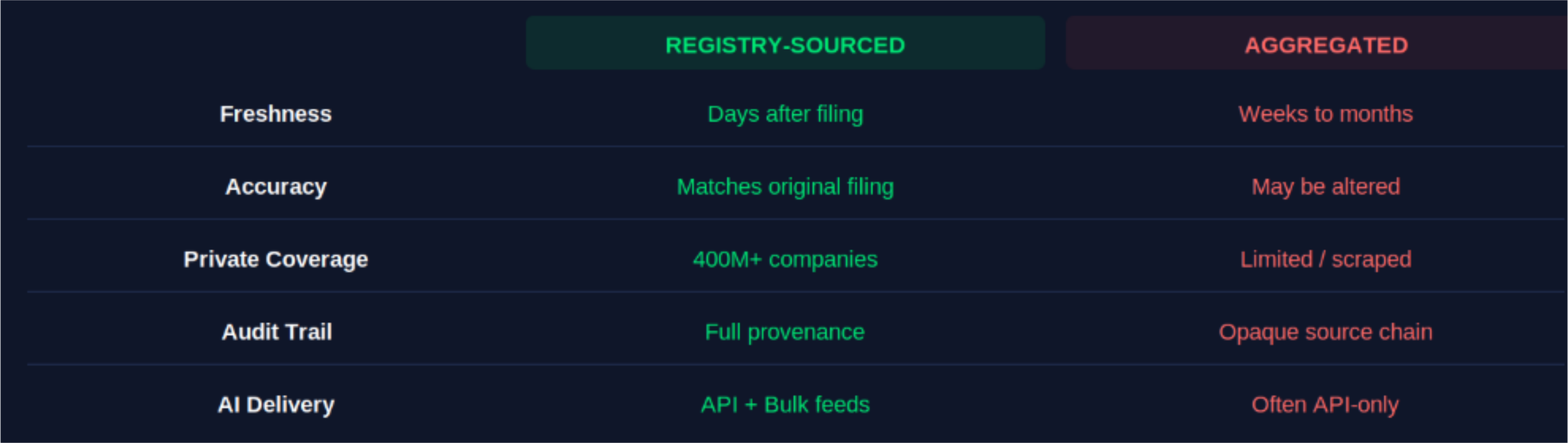
For AI teams that care about model reliability, the choice is clear. Registry-sourced data gives you a verifiable foundation. Aggregated data gives you a black box.
This doesn’t mean aggregated data has no uses. For enrichment, context, and signals, it can add value. But as the foundational financial dataset for AI training and inference? The audit trail and accuracy requirements point to registry-sourced data as the standard.
How MonetaiQ Solves the Financial Data Problem for AI Teams
Everything described in this article — the data quality challenges, the coverage gaps, the delivery requirements — is exactly what MonetaiQ was built to address.
MonetaiQ provides structured financial data for over 400 million private companies and 60,000 publicly listed companies across 100+ countries. The data covers the full spectrum: income statements, balance sheets, cash flow statements, profit and loss breakdowns, and key financial ratios.

Both API and bulk data feeds. MonetaiQ offers a scalable API for real-time lookups and bulk data feeds for large-scale ingestion. Data is available in JSON, CSV, XML, and custom formats — ready for direct pipeline integration.
Private and public company coverage. While most financial data providers skew toward public companies, MonetaiQ covers 400 million+ private companies sourced from government filings and verified databases worldwide. Public company data is sourced directly from global stock exchanges and regulatory filings, updated quarterly.
Source transparency and reliable origins. MonetaiQ sources data from official stock exchange filings, regulatory bodies, government registries, and verified financial reporting agencies. Every data point is traceable to its origin.
Rigorous data validation. All data undergoes validation and quality control processes before delivery. Financial data sourced from non-digital filings is extracted, verified, and structured to maintain accuracy.
Flexible delivery for AI workloads. Bulk data feeds can be customized by financial metrics, companies, industries, or regions. Delivery frequency is flexible — daily, weekly, or monthly.
MonetaiQ is built by Global Database, which sources company data directly from 400 government registries worldwide. That registry-sourced foundation means AI teams get financial data with the accuracy, freshness, and audit trail that production AI systems demand.
5 Ways Data Teams Use Company Financials in AI Pipelines
- Training LLMs on Verified Company Financials
Fine-tuning large language models on domain-specific financial data improves their accuracy on financial reasoning tasks. Data teams use bulk datasets of verified financial statements to teach models the patterns of real company financials. The key requirement: the training data must be verified and current. - RAG for Financial Analysis & Research
Retrieval-augmented generation is the dominant architecture for AI products that need to reference real-world financial data at query time. The system retrieves relevant financial records from a structured knowledge base and feeds them to the model as context. This dramatically reduces hallucination — but only if the knowledge base contains accurate, sourced data. - Automated KYB & Compliance Screening
Know Your Business automation is one of the fastest-growing use cases for AI in financial services. AI models ingest company registration data, financial statements, and ownership structures to automatically verify business entities. The data requirements are strict: regulators expect audit trails, source documentation, and freshness guarantees. - Real-Time Company Monitoring & Alerts
AI systems that monitor companies for material changes — new filings, revenue drops, insolvency signals — need continuous data feeds. The data provider needs to support both bulk historical data for training and incremental feeds for production monitoring. - How to Evaluate a Financial Data Provider for AI Workloads
Not every financial data provider is built for AI. Most were designed for human analysts querying a dashboard, not for data engineers feeding pipelines. Here’s what to check:
| Criteria | What to Ask |
| Bulk data access | Can you download full datasets, not just query individual records? |
| Incremental updates | Do they offer delta feeds or change logs for ongoing refreshes? |
| Source transparency | Can you trace every data point back to the original registry filing? |
| Audit stamps | Does each record carry metadata: source, filing date, reporting period, last verified? |
| Private company coverage | Do they cover private companies, or only public/listed? |
| OCR/digitization quality | How do they extract data from non-digital filings? What’s the accuracy rate? |
| Structured formats | Is data available in JSON, CSV, Parquet — or only via API/dashboard? |
| Global coverage | How many registries do they source from? How many countries? |
| Schema consistency | Is data normalized across jurisdictions, or do you need to map every country separately? |
| Freshness | How quickly after a company files does the data appear in their system? |
If a provider checks all ten boxes, they’re built for AI workloads. If they only check five or six, you’ll spend more time cleaning and transforming data than building your product.
50 Frequently Asked Questions
Financial Data for AI — General
1. What is financial data for AI applications?
Financial data for AI refers to structured company financial information — revenue, profit, assets, liabilities, and other metrics — formatted for use in machine learning training, inference, and analysis pipelines.
2.Why do AI models need company financial data?
AI models need financial data to perform tasks like credit risk scoring, compliance screening, financial research, and company analysis. Without real financial inputs, models rely on pattern recall and frequently hallucinate numbers.
3. What types of financial data are used in AI and machine learning?
Common types include income statements, balance sheets, cash flow statements, filing metadata, company identifiers, and derived metrics like growth rates, debt ratios, and profitability margins.
4. How is financial data used to train large language models?
Data teams use bulk financial datasets to fine-tune LLMs on domain-specific patterns — teaching models how real financial statements look, typical value ranges by industry, and correct relationships between financial metrics.
5. What is the difference between structured and unstructured financial data for AI?
Structured data is organized in consistent fields and formats (JSON, CSV, database tables). Unstructured data includes raw PDF filings, scanned documents, and free-text disclosures that require extraction before AI can use them.
6. Can AI models analyze financial statements automatically?
Yes. AI models can extract, compare, and summarize financial statements — but accuracy depends entirely on the quality and recency of the underlying data they’re working with.
7. What financial data formats work best for AI pipelines?
JSON, CSV, and Parquet are the most common. These formats integrate directly with data engineering tools, vector databases, and ML training frameworks without manual conversion.
8. How much financial data do you need to train an AI model?
It depends on the use case. Fine-tuning a model for financial reasoning typically requires hundreds of thousands to millions of financial records. RAG systems need comprehensive coverage of the entities the AI will be asked about.
9. What is AI-ready financial data?
AI-ready financial data is structured, machine-readable, sourced from verified origins, carries audit metadata, and is available in bulk formats that plug directly into data pipelines — not just API or dashboard access.
10. Why is data quality critical for AI financial analysis?
Bad data produces bad outputs. An AI model trained on stale, inaccurate, or incomplete financials will generate wrong answers with high confidence — creating liability for any application that relies on it.
LLMs & Financial Data
11. Can LLMs understand company financial statements?
LLMs can process and reason about financial statements to a degree, but they don’t truly understand them. They predict plausible outputs based on patterns. Accuracy depends on whether they have access to verified data at inference time.
12. What happens when LLMs are trained on bad financial data?
The model learns incorrect patterns and reproduces them confidently. It might generate plausible-looking revenue figures that are entirely fabricated, cite outdated financials as current, or confuse metrics between companies.
13. How do LLMs hallucinate financial information?
LLMs hallucinate when they lack reliable data for a query. They fill gaps by generating statistically plausible text based on training patterns — producing numbers that look right but have no factual basis.
14. What is retrieval-augmented generation (RAG) for financial data?
RAG is an architecture where the AI retrieves relevant financial records from a knowledge base before generating a response. This grounds outputs in real data rather than relying on the model’s training memory.
15. How do you build a RAG pipeline with company financials?
Ingest structured financial data into a vector database or search index. At query time, retrieve relevant records and pass them to the LLM as context. The model generates answers grounded in the retrieved data instead of guessing.
16. Can LLMs replace financial analysts?
Not yet. LLMs can automate data retrieval, summarization, and routine analysis — but complex judgment calls, relationship context, and strategic reasoning still require human expertise.
17. What is the best way to feed financial data into an LLM?
For real-time queries, use RAG with a structured financial knowledge base. For training and fine-tuning, use bulk verified datasets. For both, ensure data carries source metadata for traceability.
18. How do you prevent LLM hallucination with financial data?
Use RAG to ground responses in verified data. Include source citations in outputs. Validate model responses against known financial records. And most importantly — start with high-quality, verified training and reference data.
19. What is grounding in the context of AI financial analysis?
Grounding means connecting an AI model’s outputs to verifiable facts. In financial analysis, this means linking generated figures to specific filings, registries, and reporting periods rather than letting the model generate from memory.
20. Can GPT-4 or Claude analyze company financials accurately?
Both models can analyze financials when provided with accurate data as context. Without it, they’ll generate plausible but potentially wrong answers. Accuracy is a function of data quality, not model capability alone.
Public vs. Private Company Data
21. Why is private company financial data harder to find than public?
Public companies disclose financials through securities regulators like the SEC. Private companies file with local government registries, fragmented across hundreds of jurisdictions worldwide.
22. Where does private company financial data come from?
Private company financials primarily come from government business registries — UK Companies House, German Bundesanzeiger, France’s INPI, and similar bodies globally.
23. Can AI models access private company financials?
Yes — through data providers like MonetaiQ who source directly from government registries. The data needs to be structured and normalized for AI ingestion.
24. What is the difference between public and private company financial data?
Public company data comes from securities regulators in standardized formats. Private company data comes from local registries and varies in format, depth, and availability by country.
25.Why do AI applications need private company data?
Private companies represent the vast majority of businesses globally. AI tools for KYB, credit risk, and market intelligence are incomplete and structurally biased without private company coverage.
26. How many private companies file financial statements with government registries?
Hundreds of millions worldwide. In Europe alone, directives require millions of private companies to file annual accounts. Many Asian and Latin American jurisdictions have similar requirements.
27. What countries require private companies to file financial data?
Most EU member states, the UK, India, Singapore, Australia, and many others. Requirements vary by country and company size.
28. Is private company financial data reliable for AI training?
When sourced directly from government registries, yes. Registry filings are legal documents submitted by the companies themselves with inherent authority.
29. How do you source verified private company financials at scale?
Through providers like MonetaiQ who maintain direct connections to government registries across multiple countries with bulk delivery and audit trails.
30. What industries benefit most from private company financial data in AI?
Financial services, supply chain management, insurance underwriting, private equity due diligence, and any AI application assessing companies beyond the public universe.
Bulk Data & Delivery
31. What is bulk financial data?
A large-scale dataset delivered as a complete file or data feed — covering thousands to millions of companies — rather than accessed one record at a time through an API.
32. Why is bulk data access important for AI training?
AI model training requires ingesting large volumes efficiently. API-only access creates bottlenecks: rate limits, latency, and the impracticality of millions of individual requests.
33. What is the difference between API access and bulk data delivery?
API access retrieves individual records on demand. Bulk delivery provides entire datasets at once — essential for training, fine-tuning, and populating RAG knowledge bases.
34.What file formats are best for bulk financial data delivery?
JSON and CSV are universally supported. Parquet is preferred for large datasets. The right format depends on your pipeline.
35. How often should bulk financial datasets be refreshed for AI models?
Monthly is a baseline. Weekly is better for credit risk and compliance. MonetaiQ offers flexible frequency — daily, weekly, or monthly.
36.Can I download company financial data in bulk for machine learning?
Yes — but not all providers support it. Many only offer API or dashboard access. Look for providers advertising bulk delivery and data licensing for ML.
37. What is a data feed vs. a data dump?
A data dump is a one-time full delivery. A data feed is ongoing incremental delivery on a schedule. AI teams typically need both.
38. How do data teams ingest bulk financial data into AI pipelines?
Standard patterns: load into data lakes, process with Spark or dbt, store in vector databases for RAG, feed into training frameworks.
39. What size datasets do AI models need for financial analysis?
Coverage matters more than raw volume. 10 million companies with verified financials across 100 countries beats 100 million unverified records.
40.Is bulk financial data available for all countries?
Coverage varies by provider. Registry-sourced providers can offer bulk data for any country where they have direct registry access.
Source Transparency & Audit Trails
41. What is data provenance in financial data?
The documented chain of custody — where data originated, how it was collected, when verified, and what transformations it underwent.
42. Why do AI data teams need audit trails for financial data?
Audit trails enable debugging, regulatory compliance, and trust — proving AI outputs are grounded in verified facts.
43. What is an audit stamp on financial data?
Metadata showing: original source registry, filing date, reporting period, extraction date, and verification status.
44. How do you verify the source of company financial data?
Check if the provider can point each record back to a specific government registry filing. If they can, it’s verifiable. If not, it’s aggregated.
45. What is registry-sourced financial data?
Financial data collected directly from government business registries — the official repositories where companies file their accounts.
46. How does source transparency reduce AI model risk?
Traceable data lets you fix errors before they compound. You can also demonstrate to regulators that your AI is built on verified foundations.
47. What regulations require audit trails for financial data used in AI?
The EU AI Act requires data provenance for high-risk AI. Financial regulators (FCA, MAS, OCC) increasingly expect data lineage in AI decisions.
48. What is the difference between first-party and third-party financial data?
First-party comes directly from the source (registry). Third-party has been collected and redistributed by intermediaries — adding lag and opacity.
49. How do government registries verify company financial filings?
Registries are official record-keepers. While they don’t audit content, filings carry legal weight as the company’s official reported financials.
50.What is the EU AI Act’s requirement for data provenance?
Providers of high-risk AI must document data sources, collection methods, and quality measures. Financial AI in credit, insurance, and compliance likely falls under high-risk.