Best Yahoo Finance Alternatives for Financial Data in 2026

Yahoo Finance was once the default source of free financial data for everyone from retail investors to developers building trading bots. That era is over.
The official API was shut down in 2017. What remains is a patchwork of unofficial Python libraries, third-party scrapers, and workaround endpoints that break without warning. Yahoo Finance still works as a basic stock quote and news portal. But if you need reliable financial statement data, real-time market feeds, or production-grade API access, you need something else.
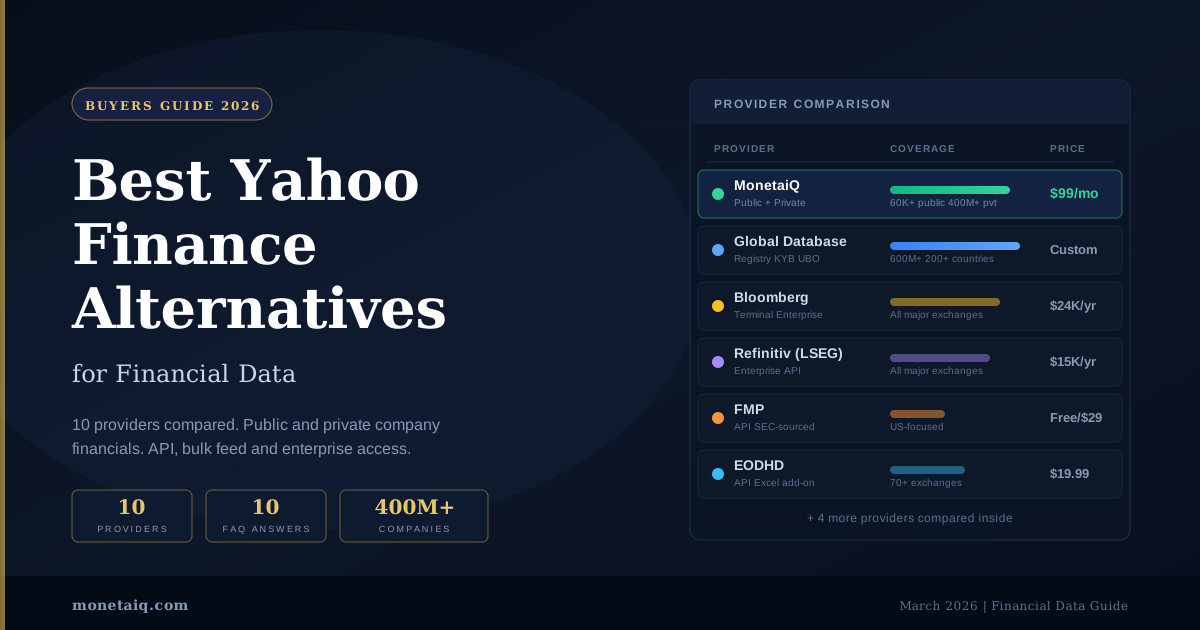
This guide compares the 10 best Yahoo Finance alternatives for accessing public company financial data in 2026. Each provider is evaluated on four criteria that matter most: data coverage, API reliability, financial statement depth, and pricing transparency.
Yahoo Finance is fine for checking a stock price. It is not fine for building products, running analysis pipelines, or making investment decisions at scale. The providers below are.
What Is Yahoo Finance?
Yahoo Finance launched in 1997 as part of the Yahoo web portal. Over nearly three decades, it became one of the most widely used free financial information platforms in the world. At its peak, Yahoo Finance attracted over 150 million monthly users — a mix of retail investors, financial advisors, students, and developers who relied on it for everything from quick stock quotes to building automated data pipelines.
The platform was originally owned by Yahoo Inc., which was acquired by Verizon in 2017. Verizon later sold Yahoo's media assets to Apollo Global Management in 2021, and today Yahoo Finance operates under the Yahoo brand within Apollo's portfolio.
What Yahoo Finance Offers
Yahoo Finance provides a broad set of features designed primarily for retail investors and casual market watchers:
Real-time stock quotes and market data. Live prices for US equities, with delayed data for many international exchanges. You can look up any public ticker and see current price, volume, market cap, and basic stats.
Portfolio tracking. Users can create watchlists and portfolios to monitor holdings, track gains/losses, and set custom price alerts. The portfolio tool syncs across web and mobile.
Financial news and analysis. Yahoo Finance aggregates market news from its own editorial team, wire services, and partner publications. It also hosts original video content, podcasts, and market commentary.
Basic financial statements. For public companies, Yahoo Finance shows income statements, balance sheets, and cash flow statements — typically covering the last 4 years of annual data and recent quarterly results.
Stock screeners. Users can filter stocks by criteria like market cap, P/E ratio, dividend yield, and sector. The screener is functional but limited compared to specialized tools.
Downloadable CSV data. Historical price data can be downloaded as CSV files directly from any stock's historical data page. This is one of the few data export options still available without a paid subscription.
Yahoo Finance Premium Plans
Yahoo Finance now offers tiered premium subscriptions beyond its free tier. The Bronze plan adds performance tracking and subscriber-only newsletters. The Silver plan includes professional analyst ratings, premium news from the Financial Times and The Information, and model portfolio strategies. The Gold plan — the most expensive at roughly $50/month — unlocks institutional-level financial data downloads, including detailed income statements, balance sheets, and years of historical end-of-day data.
Key Limitations of Yahoo Finance
Despite its brand recognition and large user base, Yahoo Finance has significant gaps that push professional users to look elsewhere:
No official API. The biggest limitation. Yahoo Finance shut down its public API in 2017. There is no supported, stable way to access Yahoo Finance data programmatically. The unofficial Python libraries (yfinance, yahoo_fin) are community-maintained scrapers that break regularly.
Shallow financial statement history. Free users get limited access to financial statements. Even premium users are restricted to a few years of data. Serious financial analysis — trend modeling, long-term benchmarking, industry comparisons — requires 10–20+ years of historical fundamentals.
No private company data. Yahoo Finance only covers publicly traded companies. If you need financials on private firms — for credit assessment, supplier evaluation, or M&A research — you need a different provider entirely.
No bulk data access. You can't export financial statements for hundreds of companies at once. Everything is one-ticker-at-a-time through the web interface, or through unreliable scraping methods.
Ad-heavy experience. The interface has become increasingly cluttered with display ads, sponsored content, and pop-ups. Several user reviews cite slower load times and buried data as reasons for switching.
Inconsistent data quality. Users report occasional glitches including missing historical data points, broken charts, and delayed updates after platform redesigns.
No real-time streaming for developers. Even with a premium subscription, Yahoo Finance doesn't offer WebSocket streaming or low-latency data feeds. It's designed for human users browsing a website, not machines consuming data.
In short: Yahoo Finance is a solid free tool for checking stock prices and reading market news. It is not a financial data platform. For anyone who needs reliable, structured, programmatic access to company financial data, the alternatives below deliver what Yahoo Finance cannot.
Why Yahoo Finance No Longer Cuts It
Yahoo Finance still attracts hundreds of millions of monthly visitors. It's a household name. But behind the familiar interface, the platform has been hollowed out for professional use.
The original API — once the most widely used free financial data endpoint on the internet — was discontinued in 2017 following Verizon's acquisition of Yahoo. Developers who relied on it were left scrambling. In the years since, the unofficial ecosystem that filled the gap has grown, but it hasn't matured.
Libraries like yfinance and yahoo_fin scrape Yahoo Finance's front-end. When Yahoo changes a URL format, renames a table header, or restructures its HTML, these tools break silently. Your pipeline returns empty columns. Your spreadsheet throws errors. There's no changelog, no warning, and no support channel.
Beyond the API issue, Yahoo Finance has several structural limitations for professional users:
No bulk data access. You can't download financial statements for 500 companies at once without scraping. Limited historical depth. Financial statement history is often restricted to 4–5 years, even on premium plans. No real streaming. Real-time quotes are delayed unless you pay for Yahoo Finance Plus, and even then the data is not designed for programmatic consumption. Ad-heavy interface. The platform has become increasingly cluttered with ads, pop-ups, and sponsored content — frustrating users who just want data.
The bottom line: Yahoo Finance is a consumer financial portal. If you need financial data as a building block — for products, models, compliance, or research — you need a provider built for that purpose.
What to Look for in a Yahoo Finance Alternative
Not every alternative is a fit for every use case. Before diving into the list, here are the five criteria that separate serious financial data providers from glorified stock tickers:
1. Financial statement depth. Income statements, balance sheets, and cash flow reports — standardized, structured, and going back at least 10 years. If a provider only gives you price data, it's not a Yahoo Finance replacement. It's a different product entirely.
2. API quality and reliability. Clean REST endpoints, well-documented parameters, consistent uptime. Can you build a production application on top of it without worrying about random breakages? This is the bar that unofficial Yahoo Finance tools fail to clear.
3. Global coverage. Yahoo Finance covers US exchanges reasonably well but gets thin internationally. If you work with European, Asian, or emerging market equities, you need a provider with genuine global reach.
4. Data delivery options. API is the baseline. But enterprise teams often need bulk data feeds, Excel integrations, or database exports. The best providers offer multiple delivery formats.
5. Pricing transparency. Bloomberg charges $24,000+/year and makes you call sales. Some newer providers publish their pricing on their website. Transparency matters — especially when you're evaluating multiple tools.
The 10 Best Yahoo Finance Alternatives for Financial Data
1. MonetaiQ
Best for Financial StatementsMonetaiQ is a financial data platform built for teams that need structured company financials — not just stock prices. It covers 60,000+ publicly listed companies across major global exchanges, with quarterly updates sourced directly from stock exchanges and regulatory filings. What sets it apart from most Yahoo Finance alternatives is its depth on the fundamentals side: full income statements, balance sheets, cash flow reports, financial ratios, and historical data going back over 20 years.
Unlike providers that focus exclusively on public companies, MonetaiQ also covers 400 million+ private companies with registry-sourced financial data. That makes it one of the few platforms where you can benchmark a public company against private competitors in the same industry.
- 20+ years of historical financial statements
- Both public and private company coverage
- API and bulk data feed delivery
- Registry-sourced data with audit trail
- Quarterly updates from exchanges
- No real-time tick-by-tick market data
- Focused on fundamentals, not charting
2. Global Database
Best for Global Company IntelligenceGlobal Database is a B2B company intelligence platform that sources data directly from over 400 government registries worldwide, covering 600 million+ companies across 200+ countries. For users who've outgrown Yahoo Finance and need more than just stock prices, Global Database delivers a complete company profile: registry data, financial statements, ownership structures, UBO (Ultimate Beneficial Owner) information, corporate linkage, and KYB verification data.
Where Yahoo Finance is limited to publicly traded companies, Global Database covers both public and private firms at scale. Financial data is sourced directly from official filings — not scraped or estimated — which makes it particularly valuable for compliance, risk, and due diligence teams. The platform also offers firmographic data, contact information, and digital insights, making it useful beyond pure financial analysis.
- First-party data from 400+ government registries
- 600M+ companies across 200+ countries
- Ownership structures, UBO, and corporate linkage
- API, bulk data feeds, and web platform
- Flexible licensing with reseller rights
- Not a real-time stock market data feed
- Enterprise-focused pricing
3. Bloomberg Terminal
EnterpriseBloomberg is the gold standard for institutional financial data. The Terminal provides real-time market data, financial statements, earnings estimates, analyst ratings, and news for virtually every listed security globally. It's the most comprehensive single source of public company financial data available today.
The catch is the price and the delivery model. Bloomberg is designed for human users sitting at a terminal — not developers building API integrations. The Bloomberg Data License product exists for enterprise data feeds, but it's priced for banks and asset managers, not startups or independent analysts.
- Unmatched breadth and depth of data
- Real-time market data across all asset classes
- Decades of financial statement history
- Integrated news, analytics, and trading
- $24,000+/year per user
- Terminal-centric — not API-first
- No private company financial data
- Overkill for most non-institutional users
4. Refinitiv (LSEG)
EnterpriseRefinitiv, now part of the London Stock Exchange Group, is Bloomberg's closest competitor in the institutional data space. Its flagship product, Refinitiv Eikon, provides real-time market data, financial fundamentals, earnings estimates, and analytics across global markets. The platform covers equities, fixed income, commodities, FX, and derivatives.
Refinitiv tends to be priced below Bloomberg but still targets institutional buyers. It offers stronger API capabilities than Bloomberg for developers who need programmatic data access, and its data feed products (Refinitiv Data Platform) are more modern than Bloomberg's equivalent.
- Comprehensive global market and fundamental data
- Better API infrastructure than Bloomberg
- Strong fixed income and FX coverage
- LSEG backing adds regulatory data
- Enterprise pricing — not accessible for small teams
- Complex product portfolio and licensing
- Integration can require significant dev effort
5. S&P Capital IQ
EnterpriseS&P Capital IQ is the weapon of choice for investment bankers and equity researchers. Its strength lies in granular financial data scrubbing, comparable company analysis (comps), and transaction screening. The platform standardizes financial statements across companies, making it easy to compare fundamentals across sectors and geographies.
The Excel plugin is particularly powerful — analysts can pull live financial data directly into models without leaving their spreadsheet. Compustat, S&P's historical financial database, provides decades of standardized data for academic research and backtesting.
- Best-in-class financial data scrubbing
- Click-through audit to source documents
- Powerful Excel plugin for modeling
- Compustat for deep historical data
- Expensive — priced for institutions
- Web-based portal can feel dated
- API access is limited compared to newer providers
6. Financial Modeling Prep (FMP)
Best Budget OptionFMP is one of the most popular direct replacements for Yahoo Finance's deprecated API. It provides financial statements, real-time quotes, historical prices, economic indicators, and SEC filings through a clean REST API. Data is sourced from SEC filings for US companies, which means accuracy on US equities is strong.
The free tier is generous enough for experimentation, and paid plans start low enough for indie developers and small teams. FMP is particularly well-suited for building stock screeners, financial models, and investment research tools.
- Free tier with usable data access
- Clean REST API with good documentation
- SEC-sourced US financial statements
- Affordable paid plans for developers
- International coverage is weaker
- Data quality outside US is inconsistent
- No bulk data feed option
7. EODHD (EOD Historical Data)
Best Value for CoverageEODHD positions itself as the closest full replacement to Yahoo Finance for data-first users. It covers 70+ global stock exchanges, supports stocks, ETFs, mutual funds, forex, indices, options, bonds, and crypto. The API provides end-of-day prices, intraday data, financial statements, dividends, splits, and earnings.
At $19.99/month for historical data access, EODHD is significantly cheaper than Yahoo Finance's premium Gold plan ($49.95/month) while offering more data and proper API access. The documentation is clean, and they provide Excel and Google Sheets add-ons for non-developers.
- 70+ exchanges, 150,000+ tickers globally
- 30+ years of historical price data
- Excel and Google Sheets add-ons
- Straightforward, transparent pricing
- Financial statement depth is moderate
- Real-time data only on higher plans
- No private company data
8. Polygon.io
Best for Real-Time US DataPolygon.io specializes in real-time and historical market data for US equities and options. It's known for low-latency data delivery, making it a go-to for algorithmic traders and fintech platforms that need tick-level market data. The platform provides stock quotes, trades, aggregates, and options data with fast and reliable infrastructure.
Polygon is not a financial statement provider. If you need balance sheets and income statements, look elsewhere. But if you need the fastest, cleanest market data feed for US stocks, it's one of the best options available.
- Real-time US equity and options data
- Low-latency WebSocket streaming
- Clean, well-documented REST API
- Competitive pricing for market data
- US-focused — limited international coverage
- No financial statements or fundamentals
- Not a full Yahoo Finance replacement
9. Alpha Vantage
Best for BeginnersAlpha Vantage is often the first API that developers try after leaving Yahoo Finance. It offers stock data, forex, crypto, and basic fundamentals through a simple API. The free tier is easy to start with, and the learning curve is minimal — which makes it popular for educational projects, university courses, and first-time API users.
However, the free tier is capped at 5 API requests per minute and 500 per day, which is restrictive for any real application. Data quality and coverage, particularly for international markets and financial statements, falls behind dedicated providers like FMP or EODHD.
- Simple API, easy to learn
- Free tier for experimentation
- Covers stocks, forex, crypto
- Good for educational projects
- Strict rate limits (5 req/min free)
- Limited financial statement depth
- Data inconsistencies reported by users
- Not reliable for production use
10. FactSet
EnterpriseFactSet is a premium financial data and analytics platform used primarily by portfolio managers, equity researchers, and investment banks. Its strength is in analyst workflow tools: the Excel plugin, screening capabilities, and the ability to audit data back to source documents are particularly well-regarded in the investment community.
FactSet integrates traditional financial data with alternative data sources, providing a comprehensive research environment. However, like Bloomberg and Refinitiv, it's priced for institutions and may be inaccessible for smaller teams or independent analysts.
- Best-in-class Excel integration
- Data audit trail to source documents
- Strong screening and analytics tools
- Alternative data integration
- Enterprise pricing, not publicly listed
- Complex integration for developers
- Better suited for analysis than data feeds
Side-by-Side Comparison
| Provider | Financial Statements | Global Coverage | API Access | Private Companies | Starting Price |
|---|---|---|---|---|---|
| MonetaiQ | 20+ years, quarterly | 60,000+ public companies | REST API + bulk feed | Yes (400M+) | From $99/mo |
| Global Database | Registry-sourced | 600M+ companies, 200+ countries | REST API + bulk feed | Yes (600M+) | Custom |
| Bloomberg | Comprehensive | All major exchanges | Terminal + Data License | No | ~$24,000/yr |
| Refinitiv | Comprehensive | All major exchanges | REST API + feeds | Limited | ~$15,000/yr |
| S&P Capital IQ | Deep (Compustat) | Global | Excel plugin + portal | Limited | Custom |
| FMP | Good (SEC-sourced) | US-focused | REST API | No | Free / $29/mo |
| EODHD | Moderate | 70+ exchanges | REST API + Excel | No | $19.99/mo |
| Polygon.io | None | US equities + options | REST + WebSocket | No | Free / $29/mo |
| Alpha Vantage | Basic | Limited international | REST API | No | Free / $49.99/mo |
| FactSet | Deep | Global | Excel + API | Limited | Custom |
Which Provider Fits Your Use Case
Building a fintech product or data pipeline? MonetaiQ and FMP give you structured API access to financial statements and market data at a price that doesn't require institutional budgets. MonetaiQ is the strongest option if you need both public and private company financials in a single feed.
Running investment research or portfolio analysis? EODHD and FMP offer the best balance of coverage and affordability for individual analysts. If budget allows, S&P Capital IQ and FactSet provide the deepest fundamental data with best-in-class Excel integration.
Need real-time market data for trading? Polygon.io is the clear choice for US equities. Bloomberg and Refinitiv are the enterprise-grade options if you need multi-asset, multi-region real-time feeds.
Just learning or building a side project? Alpha Vantage or FMP's free tier will get you started. Move to a paid provider once you hit rate limits or need production-grade reliability.
Need private company financial data alongside public? This is where most Yahoo Finance alternatives fall short. MonetaiQ covers both public and private companies with structured financial statement data. Global Database goes even further — offering registry-sourced company data from 400+ government registries, including ownership structures, UBO data, and KYB verification across 200+ countries.
Compliance, KYB, or due diligence use cases? Global Database is purpose-built for this. First-party registry data, corporate linkage, and ownership graphs give compliance teams the verified intelligence they need — far beyond anything Yahoo Finance was ever designed to provide.
Frequently Asked Questions
Yahoo Finance officially shut down its public API in 2017 as part of cost-cutting measures following Verizon's acquisition of Yahoo. Since then, the only ways to access Yahoo Finance data programmatically are through unofficial Python libraries like yfinance (which rely on web scraping) or third-party API wrappers on platforms like RapidAPI. These methods are unreliable and can break without warning when Yahoo changes its website structure.
For free access to public company financials, Financial Modeling Prep (FMP) and Alpha Vantage both offer free tiers with basic stock data, financial statements, and historical prices. EODHD also provides a free plan with limited end-of-day data. However, free tiers typically come with strict rate limits (as low as 5 requests per minute) and limited data coverage. For production use or serious analysis, a paid plan from a provider like MonetaiQ, Polygon.io, or EODHD will deliver more reliable and comprehensive results.
For developers building financial applications, Polygon.io and FMP are widely regarded as the most developer-friendly options, offering clean REST APIs, WebSocket streaming (Polygon), and well-documented endpoints. MonetaiQ also provides a REST API with comprehensive financial statement data. The best choice depends on your use case: Polygon.io excels at real-time market data, while MonetaiQ and FMP are stronger on fundamental financial data like income statements, balance sheets, and cash flow reports. For global company intelligence beyond stock data, Global Database offers API access to registry-sourced data from 200+ countries.
Technically yes, through the unofficial yfinance Python library. However, yfinance relies on scraping Yahoo Finance's website, which means it can break at any time without warning. Many developers have experienced silent data failures, missing columns, and rate limiting. For any production application, automated pipeline, or serious research project, a dedicated financial data API from a provider like MonetaiQ, EODHD, or FMP is more reliable.
Yahoo Finance offers real-time stock quotes, basic charts, portfolio tracking, news, and downloadable CSV files for historical prices. Its premium plans (starting at $25/month) add enhanced charting, research reports, and financial statements. Paid alternatives like MonetaiQ, Bloomberg, and Refinitiv go significantly further — offering structured API access, decades of historical financial statements, global exchange coverage, real-time streaming, screening tools, and bulk data delivery for enterprise applications.
Pricing varies widely depending on the provider and use case. Budget options like EODHD start at $19.99/month for historical data. Mid-range providers like FMP start at $29/month for comprehensive API access. MonetaiQ starts at $99/month with plans scaling to $499/month for higher-volume needs. Enterprise-grade platforms like Bloomberg Terminal cost $24,000+ per user per year. Global Database offers custom enterprise pricing for bulk data and API access.
For sheer breadth of exchange coverage, Bloomberg leads with data from virtually every major and minor exchange worldwide. Among more accessible alternatives, EODHD covers 70+ stock exchanges globally, and MonetaiQ covers 60,000+ publicly listed companies from major global exchanges. For total company coverage beyond stock exchanges, Global Database leads with 600 million+ companies from 200+ countries sourced directly from government registries. Polygon.io is more limited, focusing primarily on U.S. equities and options.
Market data refers to real-time or historical stock prices, trading volumes, bid/ask spreads, and options chain data — everything related to what happens on the exchange. Fundamental financial data refers to a company's financial statements: income statements, balance sheets, cash flow reports, financial ratios, and earnings data. Some providers like Polygon.io specialize in market data, while others like MonetaiQ focus on fundamental financial data. Platforms like Bloomberg and Refinitiv cover both comprehensively.
Most Yahoo Finance alternatives focus exclusively on publicly listed companies. However, MonetaiQ covers both public and private company financial data, sourcing private company financials from government registries and verified filings. Global Database and Bureau van Dijk (Moody's) also provide extensive private company financial data. If your analysis requires visibility into privately held firms — for credit risk, supplier evaluation, or M&A due diligence — you need a provider that goes beyond exchange-listed data.
Yahoo Finance remains a useful free resource for casual investors who need quick stock quotes, basic charts, and market news. However, it has become increasingly limited for professional use. The official API is gone, the platform is cluttered with ads, and premium pricing has risen. For developers, data analysts, fintech teams, or anyone building products that rely on financial data, a dedicated provider like MonetaiQ, EODHD, FMP, or Global Database will deliver better data quality, reliability, and flexibility.
Need Reliable Financial Data?
MonetaiQ provides structured financial statements for 60,000+ public companies and 400M+ private companies — via API or bulk feed.
Explore MonetaiQ →