
This creates a real problem. Analysts need accurate private company financials to build models. Compliance officers need verified entity data for KYB checks. Data procurement teams need reliable sources they can embed into products. And the provider you choose determines whether you’re working with verified first-party data or recycled information that’s already months out of date.
The financial data services sector was valued at $24.2 billion in 2024, growing at roughly 8.5% annually. New entrants are challenging legacy platforms on price, flexibility, and data freshness. The choices can feel overwhelming.
This guide compares eight leading private company data providers side by side. For each provider, we cover a full description, main features, key limitations, and the five most common buyer questions. At the end, you’ll find a master FAQ section covering the questions enterprise buyers ask most often.
How to Choose a Private Company Data Provider: 5 Evaluation Criteria
Before diving into individual platforms, enterprise buyers should evaluate five factors:
1. Data Sourcing: Registry-Verified vs. Aggregated Company Data
Where does the data come from? Providers that source directly from government registries — Companies House (UK), Handelsregister (Germany), the SEC (US) — deliver verifiable, audit-ready information. Providers that aggregate from third-party databases add a layer of risk: you can’t always trace data back to its original filing, and freshness depends on the intermediary’s update schedule.
2. Private Company Coverage: Total Entities vs. Financial Depth
A database might claim 500 million entities. But how many include actual financial statements? Ownership structures? Revenue figures? Coverage breadth (total entities) matters less than coverage depth (financial detail per entity) for most professional use cases.
3. Company Data API: RESTful Access and Integration Options
Modern data teams need RESTful APIs with clean documentation, standardized response formats, and low latency. If you’re embedding private company data into a product — a credit scoring engine, a compliance workflow, a CRM enrichment layer — the API is the product.
4. Private Company Database Pricing: Transparent vs. Enterprise-Only
Legacy providers are notorious for opaque pricing. Annual contracts starting at $20,000+ per seat, no public pricing pages, mandatory sales calls. Newer platforms offer self-serve tiers, pay-as-you-go billing, and published rate cards.
5. Data Licensing and Redistribution Rights for Private Company Data
Can you redistribute the data to your clients? Embed it in a product? Most legacy providers restrict redistribution entirely or charge significant premiums. For platform builders and data resellers, licensing terms are often the dealbreaker.
1. MonetaIQ — Best Private Company Financial Data API and Bulk Feed Provider
What Is MonetaIQ and What Financial Data Does It Provide?
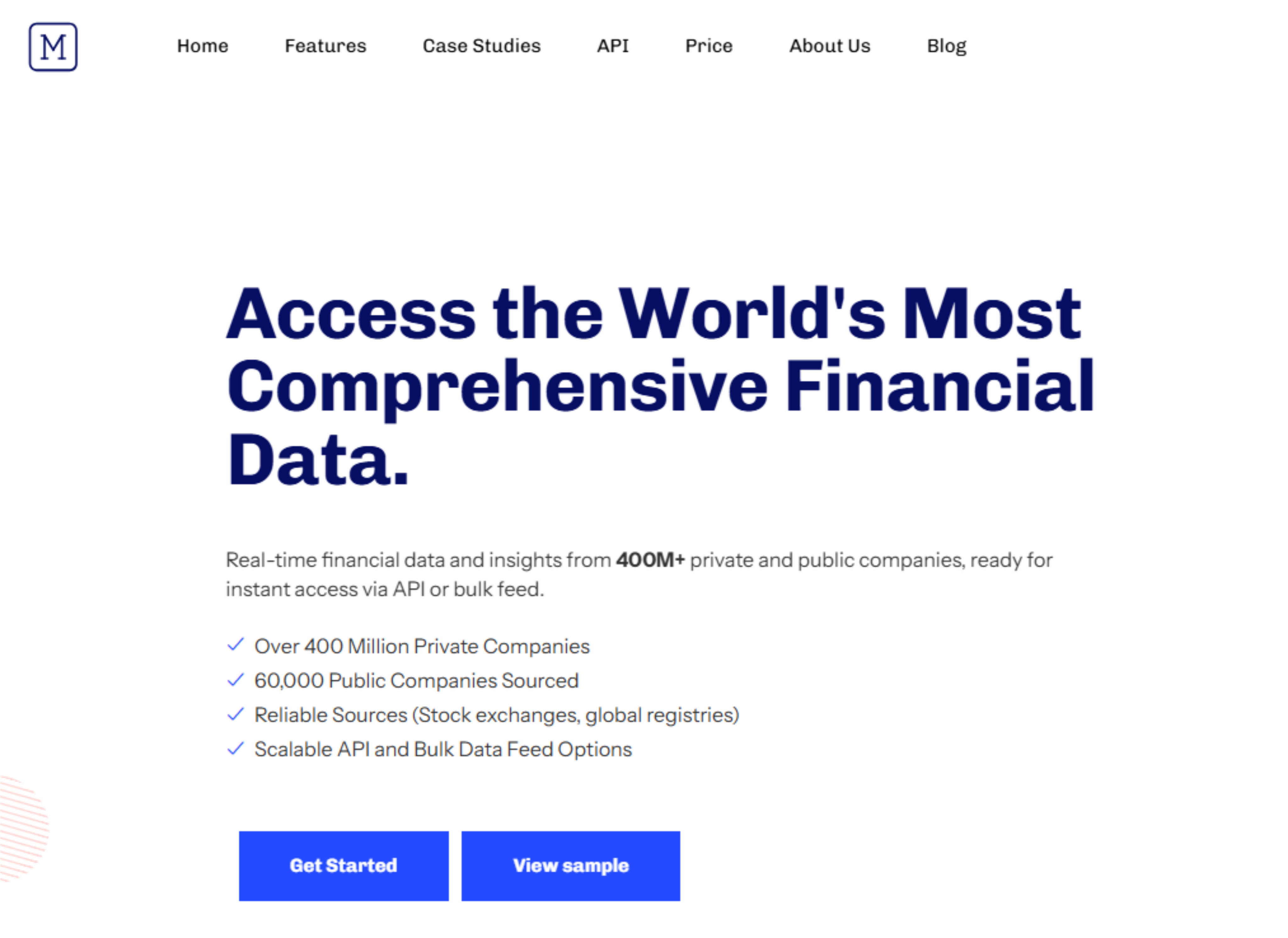
MonetaIQ is a specialist financial data platform covering 400+ million private companies and 60,000+ public companies. The platform focuses specifically on financial depth: balance sheets, income statements, cash flow data, credit risk metrics, and historical financials sourced from stock exchanges, government registries, and regulatory filings across 100+ countries.
MonetaIQ is built for teams that need financial data as a raw input rather than a dashboard experience. It offers both API access for real-time lookups and bulk data feeds for teams that need to ingest company financials at scale — a dual delivery model that’s rare among providers focused on registry-sourced data. Clients include Statista, Experian, and Finquest.
MonetaIQ: Key Features for Financial Statements, Credit Reports, and Bulk Data
- Financial statement depth: Full P&L, balance sheet, and cash flow data for private companies. Up to 10 years of historical financials in standardized format.
- Credit reports: Registry-sourced credit risk data including payment behavior indicators and financial strength metrics.
- Bulk data feeds: Full dataset delivery for teams that need to ingest financials at scale. Rare among registry-sourced providers.
- Watch API: Real-time monitoring and alerts for changes in company financials, status, or filings.
- Digital insights: Website technology data, traffic metrics, and digital footprint analysis alongside financial data.
MonetaIQ Limitations: Coverage Breadth and Brand Recognition
- Coverage of 400M+ private companies is large but not the broadest in the market. Global Database covers 600M+ entities.
- The platform is financially focused. Teams needing sales intelligence or contact data will need a complementary product.
- As a newer brand, MonetaIQ has less institutional recognition than legacy providers like Orbis or D&B.
- Depth of coverage varies by jurisdiction. Countries with weaker mandatory disclosure requirements have thinner financial data.
MonetaIQ Financial Data API and Bulk Feeds — Frequently Asked Questions
Q: What data does MonetaIQ provide?
A: MonetaIQ provides financial statements (balance sheet, income statement, cash flow), credit reports, ownership data, digital insights, and historical financials for 400M+ private companies and 60K+ public companies across 100+ countries.
Q: How much does MonetaIQ cost?
A: MonetaIQ offers transparent self-serve pricing. Starter plan at $49/month (50 company profiles). Pro at $99/month (150 profiles). Business at $199/month (400 profiles). Enterprise custom pricing for high-volume API and bulk data access.
Q: Does MonetaIQ offer bulk data feeds?
A: Yes. MonetaIQ offers bulk data feeds for teams that need to ingest company financials at scale. This is rare among registry-sourced providers and makes MonetaIQ particularly suited for data engineering teams and platform builders.
Q: Can I redistribute MonetaIQ data?
A: Yes. Both API and bulk feed plans include redistribution rights. MonetaIQ is built for data product teams from the start. You can embed the data in your own products and pass it through to your clients.
Q: How does MonetaIQ relate to Global Database and Zephira.ai?
A: MonetaIQ, Global Database, and Zephira.ai operate on the same foundation of direct government registry connections. Each serves a different buyer: Global Database is the broad B2B intelligence platform, Zephira.ai is the API-first KYB layer for developers, and MonetaIQ is the specialist financial data layer for analysts and data teams.
2. Global Database — Best Registry-Sourced Private Company Data with Redistribution Rights
What Is Global Database and How Does It Source Registry Data?
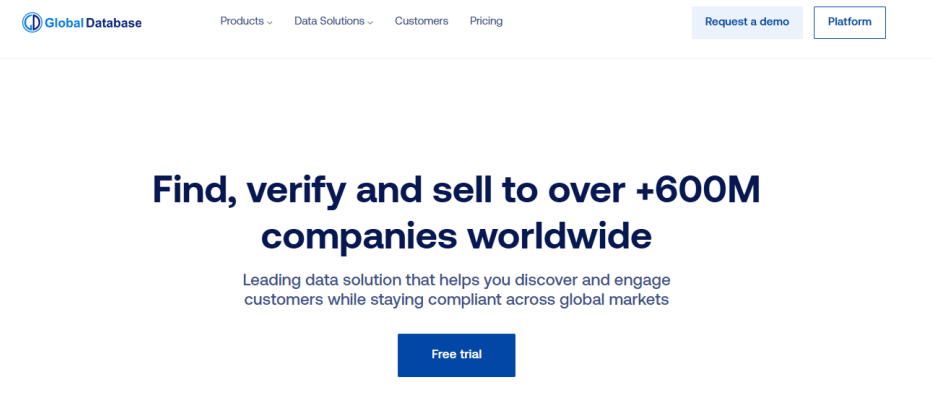
Global Database is a B2B intelligence platform that connects directly to 200+ official government registries worldwide. The platform covers 600+ million companies with a focus on first-party data sourcing: rather than licensing data through intermediaries, Global Database pulls information straight from the filing authority in each jurisdiction.
This registry-first approach gives the platform strong coverage across both private and public companies, with particular depth in Europe, Asia, and emerging markets where mandatory filing requirements create rich data pools. The product suite spans financial statements, ownership structures (including UBO identification through a proprietary Ownership Graph), credit reports, digital insights, and contact data. Enterprise clients include Uber, AWS, WeWork, SAP, and LSEG.
Global Database: Key Features for B2B Intelligence and Compliance
- Registry connections: Direct connections to 200+ government registries worldwide. Data provenance is fully traceable for audit and compliance purposes.
- Ownership Graph: Proprietary corporate linkage covering 378M+ entities. Maps UBO structures through multi-layered ownership chains.
- Financial depth: Standardized financial statements, credit reports, and key financial ratios across private and public companies.
- Redistribution rights: Flexible licensing included in most plans. Built for resellers, platform builders, and data product teams from day one.
- Multi-use platform: Combines financial data with sales intelligence, compliance tools, digital insights, and browser extension for prospecting.
Global Database Limitations: Jurisdiction Depth and Brand Awareness
- Financial depth depends on the filing requirements of each jurisdiction. Countries with weaker mandatory disclosure have thinner data.
- The platform covers many use cases (sales, compliance, finance) which means it’s broader than a pure financial data specialist.
- Real-time API latency can vary by registry source, as some government systems update on their own schedules.
- Brand recognition is lower than legacy incumbents like Orbis or D&B among traditional banking compliance teams.
Global Database Registry-Sourced Company Data — Frequently Asked Questions
Q: How many companies does Global Database cover?
A: Global Database covers 600+ million companies worldwide, sourced from direct connections to over 200 government registries. Coverage spans both private and public companies across Europe, North America, Asia, Latin America, and other regions.
Q: What makes Global Database different from Orbis or D&B?
A: Global Database sources data directly from government registries rather than licensing from intermediary data providers. This first-party approach means every data point is traceable back to its official filing source. The platform also includes redistribution rights in most plans — a significant differentiator for teams building data products.
Q: Does Global Database offer redistribution rights?
A: Yes. Redistribution rights are included in most Global Database plans. The platform is specifically designed for resellers, platform builders, and data product teams that need to pass company data through to their own clients.
Q: What is the Global Database Ownership Graph?
A: The Ownership Graph is a proprietary corporate linkage dataset covering 378M+ entities. It maps ownership chains through multiple layers to identify ultimate beneficial owners (UBOs), group structures, and subsidiary relationships.
Q: How much does Global Database cost?
A: Global Database offers transparent tiered pricing with self-serve options. API access is available with pay-as-you-go and subscription models. Enterprise custom plans are available for high-volume users. Contact the team for specific pricing based on your use case.
3. S&P Capital IQ Pro — Best Private Company Database for Investment Banking
What Is S&P Capital IQ Pro and What Private Company Data Does It Cover?
S&P Capital IQ Pro is the enterprise standard for financial research and market intelligence. Owned by S&P Global, it covers 109,000+ public companies with current financials and maintains a database of over 60 million private company records. The platform is a staple on every investment banking desk, combining deep analyst estimates, M&A intelligence, Excel integration, and screening tools in a single interface.
For private companies, Capital IQ reports 14 million+ entities with recent financials. Coverage is strongest for larger private firms, PE-backed companies, and entities involved in M&A transactions. Small and mid-sized private companies outside the US and Western Europe have limited financial detail. The platform also integrates Preqin data for 90,000+ PE/VC funds.
S&P Capital IQ Pro: Key Features for Private Company Research
- Company coverage: 109,000+ public companies. 60M+ private entities. 14M+ private companies with recent financials.
- Financial depth: Standardized financial statements, 140+ estimates metrics, valuation multiples, and comparable company analysis.
- Excel plugin: Industry-leading Excel integration for financial modeling, allowing direct data pulls into spreadsheets.
- Screening tools: Advanced filtering across hundreds of financial metrics, industry codes, geography, and ownership type.
- M&A intelligence: Deal tracking, transaction comps, and advisor league tables with global coverage.
S&P Capital IQ Limitations: Private Company Data Gaps and Pricing
- Private company financial depth varies significantly by region. Coverage outside the US and Western Europe is inconsistent.
- Pricing is enterprise-only. Industry reports suggest $14,000–$20,000+ per user per year with no self-serve option.
- API access is available but not the platform’s primary delivery model. The product is built around the desktop terminal.
- Redistribution requires a separate OEM licensing agreement at premium cost. Not built for data product builders.
S&P Capital IQ Private Company Data — Frequently Asked Questions
Q: How many private companies does S&P Capital IQ cover?
A: S&P Capital IQ lists over 60 million private company records in its database. However, only around 14 million of those have recent financial data attached. The rest are basic entity records with limited detail.
Q: How much does S&P Capital IQ cost per year?
A: S&P Capital IQ uses custom enterprise pricing. Based on industry reports, costs range from $14,000 to $20,000+ per user per year depending on the modules and number of seats. There is no public pricing page or monthly plan.
Q: Does S&P Capital IQ have an API?
A: Yes. S&P offers API access to its datasets, but the platform is primarily designed as a desktop research terminal. API integration requires a separate licensing discussion and is more common for large institutional clients.
Q: Can I redistribute S&P Capital IQ data in my product?
A: Not without a separate OEM licensing agreement. Standard licenses restrict data use to internal analysis. Redistribution to end users or embedding in third-party products requires additional negotiation and cost.
Q: How does S&P Capital IQ compare to Bloomberg for private company data?
A: Capital IQ offers significantly better private company coverage than Bloomberg. Bloomberg focuses almost entirely on public market data and real-time trading intelligence. If your primary need is private company financials, Capital IQ is the stronger choice between the two.
4. Bureau van Dijk (Moody’s Orbis) — Best for Cross-Border Compliance and KYC Due Diligence
What Is Orbis by Moody2019s and How Does It Source Private Company Data?
Orbis is the legacy leader in private company intelligence. Originally built by Bureau van Dijk and acquired by Moody’s in 2017, the platform covers over 600 million entities globally. Orbis sources data from 170+ information providers and standardizes it into comparable formats across jurisdictions — making it possible to analyze a German GmbH alongside a UK Ltd using the same financial template.
The platform is especially strong in European markets where mandatory filing requirements create rich data pools. Ownership structures, corporate hierarchies, and beneficial ownership data are deeply covered. Banks, insurance companies, and compliance teams use Orbis extensively for KYC/KYB due diligence, sanctions screening, and transfer pricing analysis.
Orbis (Bureau van Dijk): Key Features for Private Company Intelligence
- Entity coverage: 600M+ entities worldwide. Strongest private company depth in Europe, with growing coverage in Asia and Latin America.
- Data standardization: Financial statements normalized across jurisdictions. Same chart-of-accounts format regardless of the source country.
- Ownership intelligence: Corporate hierarchies, beneficial ownership chains, and group structure mapping across multi-layered entities.
- Compliance tools: Integrated KYC/KYB screening, sanctions matching, and PEP identification. Widely used by banks for regulatory compliance.
- Country-specific products: Regional databases (Amadeus for Europe, Osiris for global listed/unlisted) provide tailored access to local data.
Orbis Limitations: Cost, API Flexibility, and Data Licensing Restrictions
- High cost and rigid delivery models. Annual contracts typically start at $15,000–$30,000+ depending on modules and user count.
- Limited API-first architecture. The platform was built for desktop research. Modern API integration can feel bolted on.
- Redistribution rights are restricted. Standard licenses limit data use to internal analysis.
- Update cycles depend on 170+ source providers, meaning freshness varies by jurisdiction and data type.
Moody’s Orbis (Bureau van Dijk) Private Company Data — Frequently Asked Questions
Q: How many companies does Orbis cover?
A: Orbis covers over 600 million entities globally, sourced from more than 170 information providers. Coverage depth varies: European companies typically have the richest financial data, while emerging market coverage may be limited to basic firmographics.
Q: Is Orbis the same as Bureau van Dijk?
A: Yes. Bureau van Dijk (BvD) was acquired by Moody’s in 2017. Orbis was BvD’s flagship product and continues under the Moody’s brand. You may still see both names used interchangeably in the market.
Q: How much does Orbis cost?
A: Orbis uses enterprise pricing with no public rate card. Based on market reports, annual contracts range from $15,000 to $30,000+ depending on the number of users, modules selected, and geographic coverage required.
Q: Does Orbis offer an API for private company data?
A: Orbis offers API access, but the platform was originally designed as a desktop research tool. API integration is available for enterprise clients and is improving, though it lacks the developer-first design of newer entrants.
Q: What is Orbis best used for?
A: Orbis is strongest for compliance due diligence (KYC/KYB), cross-border financial analysis, corporate ownership mapping, and transfer pricing research. Banks and multinational compliance teams are its core users.
5. Zephira.ai — Best API-First KYB Verification and Company Data for Developers
What Is Zephira.ai and How Does Its KYB API Work?
Zephira.ai is an API-first company data platform designed for developers, fintechs, and regtech platforms. It provides real-time access to company registry data, KYB verification, UBO identification, and sanctions screening through a single REST API. Where traditional providers require annual contracts and complex onboarding, Zephira offers pay-per-call pricing and documentation that lets developers start integrating within hours.
The platform sources data from 100+ official government registries, sharing the same first-party data infrastructure as Global Database. But the delivery model is entirely different. Zephira is built for machines, not analysts. It’s designed to be embedded in automated compliance workflows, neobank onboarding processes, and fintech products that need to verify businesses programmatically at scale.
Zephira.ai: Key Features for API-First Company Verification
- API-first design: Clean REST API with comprehensive documentation. Pay-per-call pricing starting at $0.02 per request.
- KYB verification: Real-time entity confirmation, status checks, and business identity verification against registry sources.
- UBO identification: Beneficial ownership data resolved through multi-layered corporate structures.
- Sanctions screening: Integrated screening against global sanctions lists, PEP databases, and adverse media.
- Developer experience: Fastest time-to-integration in the market. SDKs, webhook support, and sandbox environment for testing.
Zephira.ai Limitations: Coverage Scope and Financial Data Depth
- Not a research platform. No desktop interface or analyst dashboards. The product is an API, not a terminal.
- Coverage of 100M+ companies is smaller than Global Database or Orbis, though growing through expanding registry connections.
- Financial statement depth is lighter than MonetaIQ. Zephira focuses on verification and identity data rather than deep financial analysis.
- Brand awareness is still building. Newer entrant compared to established names in the compliance data space.
Zephira.ai KYB Verification API and Company Data — Frequently Asked Questions
Q: What is Zephira.ai used for?
A: Zephira.ai is primarily used for KYB (Know Your Business) verification, UBO identification, entity verification, and sanctions screening. It’s designed for developers and product teams that need to embed company verification data directly into their applications via API.
Q: How much does Zephira.ai cost?
A: Zephira.ai uses pay-per-call pricing starting at $0.02 per request. Custom monthly plans are available for high-volume users. There is no minimum annual commitment or seat-based licensing.
Q: Is Zephira.ai connected to Global Database?
A: Zephira.ai shares the same first-party registry data infrastructure as Global Database. Both source information directly from government registries. Zephira.ai is the API-first, developer-focused product. Global Database is the broader B2B intelligence platform.
Q: Can I embed Zephira.ai data in my product?
A: Yes. Zephira.ai is designed specifically for embedding. There are no restrictions on passing data through to end users in your product. The pay-per-call model scales with your usage rather than seat count.
Q: Does Zephira.ai provide financial statements?
A: Zephira.ai provides basic financial data as part of its company profiles. For deep financial analysis — full balance sheets, income statements, cash flow data, and credit reports — MonetaIQ is the dedicated financial data layer within the same product ecosystem.
6. PitchBook — Best Private Company Data for Venture Capital and PE Deal Intelligence
What Is PitchBook and What Private Company Data Does It Provide?
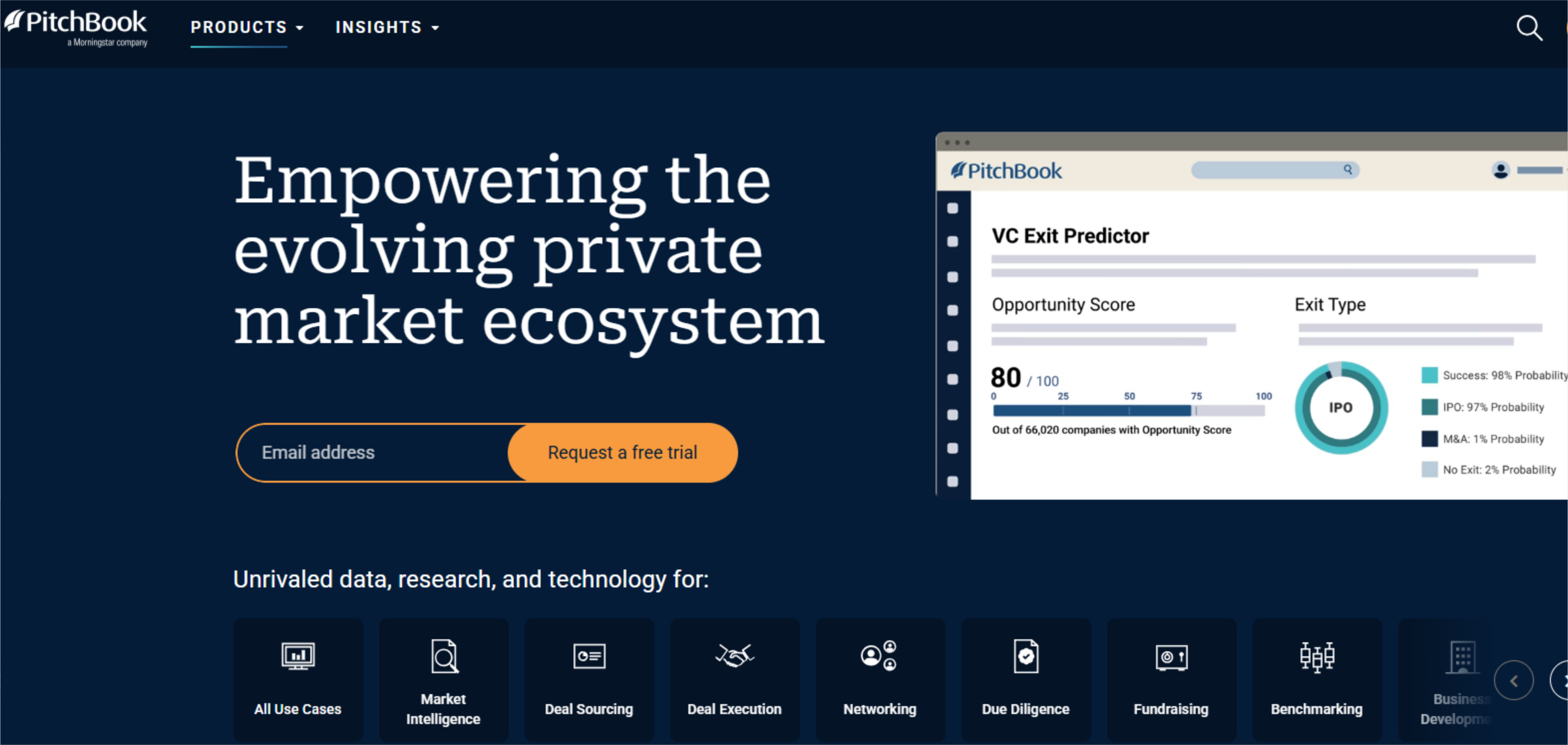
PitchBook is the go-to platform for venture capital, private equity, and M&A deal intelligence. Owned by Morningstar, it focuses on tracking funding rounds, investor activity, deal multiples, exit outcomes, and fund performance. A team of 1,800+ data operations professionals manually curates and verifies information, giving the platform strong accuracy on deal-level data.
PitchBook doesn’t aim to cover every private company in the world. It focuses on companies actively involved in PE/VC transactions, M&A activity, or public market events. If a company hasn’t raised funding or been part of a deal, PitchBook likely has minimal data on it. That makes it a specialist tool for capital markets professionals rather than a general-purpose private company database.
PitchBook: Key Features for Private Equity and VC Data
- Deal intelligence: Comprehensive tracking of PE, VC, and M&A transactions globally. Deal multiples, valuations, and advisor data.
- Fund performance: Benchmarking data across PE/VC funds. LP commitments, IRR metrics, and fund-level analytics.
- Investor profiles: Detailed records on investors, including investment preferences, portfolio companies, and co-investment networks.
- Research Center: Analyst-written reports on private market trends, emerging technologies, and sector dynamics.
- Workflow integrations: Syncs with Salesforce, HubSpot, and DealCloud. Excel and PowerPoint plugins for direct data pulls.
PitchBook Limitations: Coverage Gaps Beyond the Deal Ecosystem
- Not a general-purpose private company database. Coverage is skewed toward PE/VC-backed companies and M&A targets.
- Limited financial statement coverage for companies outside the deal ecosystem. Balance sheets and income statements are sparse for non-funded entities.
- Expensive. Starts around $20,000/year for a single user. Multi-seat enterprise deals range from $45,000 to $70,000+ per year.
- No pay-as-you-go API option. Data licensing for integration (Direct Data) is a separate premium product.
PitchBook Private Company Data and Deal Intelligence — Frequently Asked Questions
Q: Does PitchBook cover all private companies?
A: No. PitchBook focuses on companies involved in PE/VC funding rounds, M&A transactions, and public market events. It does not aim to be a comprehensive database of all private companies globally.
Q: How much does PitchBook cost?
A: PitchBook starts around $20,000/year for a single-user license. Multi-seat enterprise deals range from $45,000 to $70,000+ per year depending on team size and additional modules like Direct Data or CRM integration.
Q: Can I use PitchBook data in my own product?
A: Standard PitchBook licenses restrict data to internal use. The Direct Data product allows integration into workflows and third-party systems, but it carries additional licensing fees and requires a separate agreement.
Q: Is PitchBook better than Capital IQ for private company data?
A: They serve different needs. PitchBook is stronger for deal intelligence, investor tracking, and fund performance. Capital IQ is stronger for broad financial data across both public and private companies. Most PE firms use both.
Q: Does PitchBook have financial statements for private companies?
A: PitchBook provides some financial data on private companies, particularly those involved in funding rounds and M&A. However, it does not offer the depth of registry-sourced financial statements (balance sheets, income statements, cash flow) that specialist providers deliver.
7. FactSet — Best Financial Data Platform for Public Market Analytics and Modeling
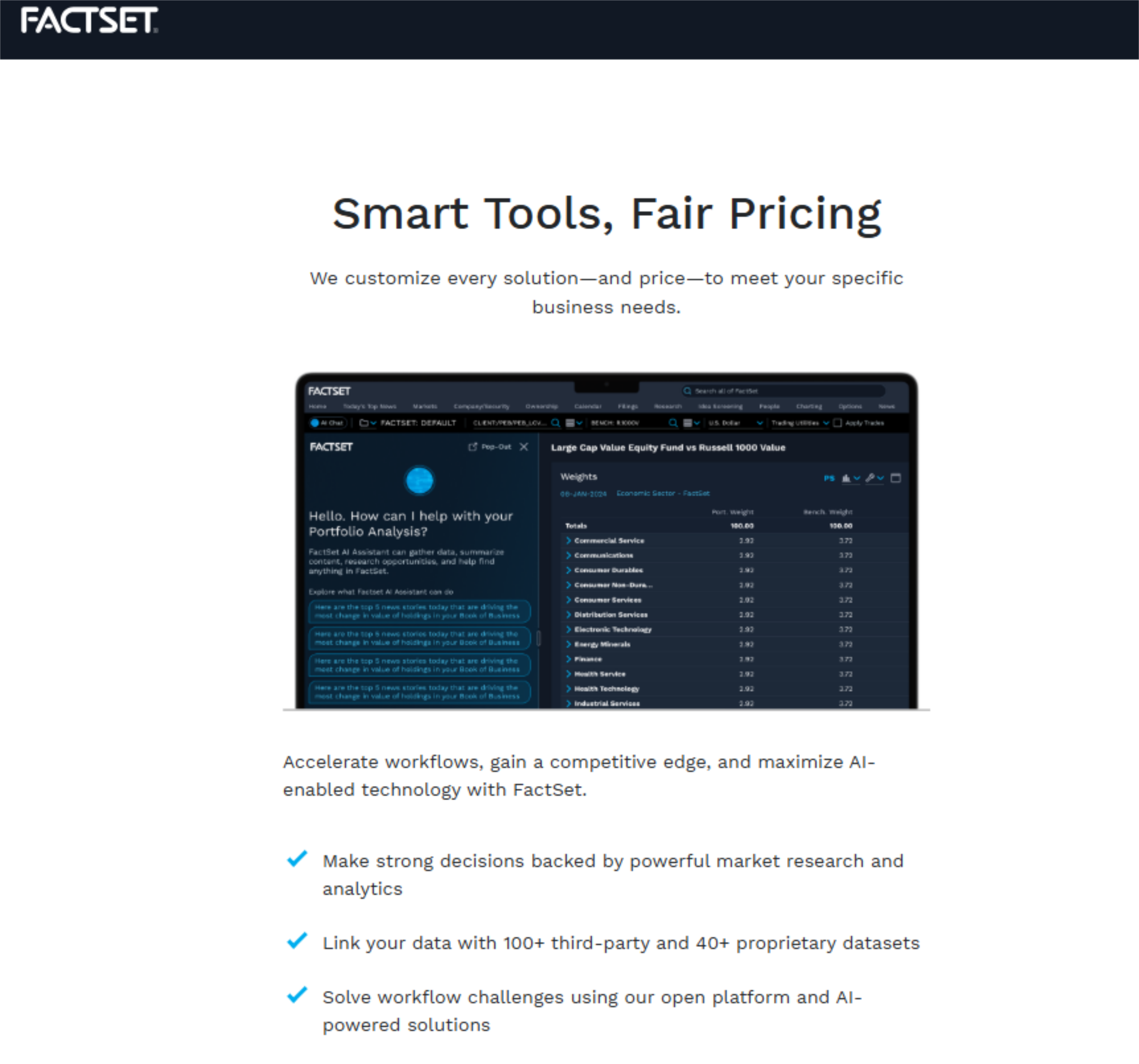
What Is FactSet and How Does It Handle Private Company Data?
FactSet is a $2.3 billion financial data company serving over 8,800 institutional clients and 220,000+ individual users worldwide. The platform’s strength is public market data: financial statements, analyst estimates, real-time pricing, portfolio analytics, and risk modeling. Its Excel plugin is widely considered the best in the industry for financial modeling.
On the private company side, FactSet offers coverage of roughly 75,000 reporting entities with detailed financials. The company has been expanding private market coverage — recently adding 70,000+ private company profiles in India, Malaysia, and Vietnam. FactSet also partnered with Arcesium in late 2025 to integrate front-to-back office workflows across public, private, and alternative asset classes.
FactSet: Key Features for Financial Modeling and Company Analysis
- Public market depth: Financial data on 70,000+ public and private companies with historical coverage reaching back to the 1980s for developed markets.
- Excel integration: Best-in-class Excel plugin that allows direct data pulls, custom formulas, and automated model updates.
- Portfolio analytics: Risk modeling, performance attribution, and portfolio optimization tools used by asset managers globally.
- Screening tools: Universal screening across 2,000+ financial metrics for companies, indices, and fixed income instruments.
- Private market expansion: Growing private company coverage including CUSIP identifiers for PE/VC-backed companies through a collaboration with Aumni.
FactSet Limitations: Private Company Depth and Enterprise Pricing
- Private company data is a secondary feature, not the core product. Registry-based financial coverage is limited compared to specialized providers.
- Enterprise pricing starting at $12,000–$24,000+ per user per year depending on modules.
- Redistribution requires OEM licensing with a complex negotiation process.
- Private company coverage of 75,000 detailed entities is small compared to registry-first databases covering hundreds of millions.
FactSet Private Company Coverage and Financial Data — Frequently Asked Questions
Q: How many private companies does FactSet cover?
A: FactSet provides detailed financial data on approximately 75,000 reporting entities globally. The company is actively expanding coverage, particularly in Asian markets, but its private company depth is smaller than registry-first providers.
Q: Is FactSet good for private company research?
A: FactSet is excellent for public market research and mixed public/private analysis. For pure private company data needs — especially at scale across jurisdictions — registry-first providers offer broader and deeper coverage.
Q: How much does FactSet cost?
A: FactSet uses enterprise pricing. Costs typically range from $12,000 to $24,000+ per user per year depending on the modules and data feeds selected. There is no self-serve or monthly pricing option.
Q: Does FactSet have an API?
A: Yes. FactSet offers APIs for data access. The platform also provides strong Excel integration. However, its API is primarily designed for institutional workflows rather than lightweight developer integrations.
Q: How does FactSet compare to Bloomberg?
A: FactSet is more affordable than Bloomberg and offers superior Excel integration. Bloomberg has better real-time market data and its messaging system. For private company data specifically, neither platform is the strongest choice — both focus primarily on public markets.
8. Dun & Bradstreet — Best for Business Credit Reports and Supplier Verification
What Is Dun & Bradstreet and How Does Its Company Data Work?
Dun & Bradstreet is the oldest name in commercial data intelligence. Founded in 1841, D&B built its business around the proprietary D-U-N-S® Number system that identifies and tracks over 500 million business entities worldwide. The D-U-N-S Number has become a de facto standard for business identification in government contracting, supplier verification, and commercial credit.
D&B’s primary value proposition is credit risk and business identity verification. Its Paydex score and commercial credit reports are used by procurement teams, trade credit departments, and lenders globally. For actual financial statements — balance sheets, income statements, cash flow data — coverage is less comprehensive than registry-first providers. D&B’s data is often modeled or estimated rather than sourced directly from official filings.
Dun & Bradstreet: Key Features for Credit Risk and Business Verification
- D-U-N-S Numbers: Proprietary universal business identifier covering 500M+ entities. Widely required for government contracts and supplier registration.
- Credit scoring: Paydex score, commercial credit reports, and predictive risk indicators used for trade credit decisions and supplier evaluation.
- Business identity verification: Entity matching, address verification, and linkage services for master data management.
- Supply chain intelligence: Supplier risk monitoring, third-party due diligence, and ESG risk signals.
- Global coverage: 500M+ entities across 200+ countries with standardized firmographic data (industry codes, employee counts, revenue ranges).
D&B Limitations: Financial Statement Gaps and Data Recency
- Financial statement depth is limited. Actual filed balance sheets and income statements are less comprehensive than registry-first alternatives.
- Data is often modeled or estimated rather than pulled directly from government filings, which can create accuracy concerns for compliance use cases.
- Pricing is opaque with custom enterprise contracts. No self-serve access or transparent rate cards.
- Data recency can lag official registry filings in certain markets. Update cycles depend on D&B’s own collection schedule.
Dun & Bradstreet Business Data and Credit Reports — Frequently Asked Questions
Q: What is a D-U-N-S Number?
A: A D-U-N-S Number is a unique nine-digit identifier assigned to business entities by Dun & Bradstreet. It is used globally for business identification, credit reporting, and is required for many government procurement processes.
Q: Does Dun & Bradstreet provide private company financial statements?
A: D&B provides some financial information on private companies, including revenue estimates and credit metrics. However, detailed filed financial statements (balance sheets, income statements, cash flow) are less comprehensive than what you’d get from registry-sourced providers.
Q: How much does Dun & Bradstreet cost?
A: D&B uses custom enterprise pricing based on company size, data volume, and specific products selected. There is no published pricing page. API and data integration products carry separate licensing fees.
Q: Is D&B data sourced from government registries?
A: D&B collects data from multiple sources including its own research, trade references, and public records. It is not primarily a registry-first provider. Some data points are modeled or estimated rather than pulled directly from official government filings.
Q: What is D&B best used for?
A: D&B is strongest for credit risk scoring, supplier verification, business identity management, and government contractor registration. It is the standard tool for procurement departments and trade credit teams.
Private Company Data Providers Comparison Table: Coverage, Pricing, and API Access
The tables below summarize how each provider stacks up across the evaluation criteria that matter most.
Private Company Database Coverage and Data Sourcing Compared
| Provider | Private Co. Coverage | Data Source | Financial Depth |
|---|---|---|---|
| MonetaIQ | 400M+ private, 60K+ public | Registries + exchanges | Deepest financials |
| Global Database | 600M+ companies | 200+ govt registries (direct) | Broad (registry-sourced) |
| S&P Capital IQ | 60M+ entities (14M+ with financials) | Filings + research analysts | Strong (public-first) |
| Orbis (Moody’s) | 600M+ entities | 170+ info providers | Strong (Europe-first) |
| Zephira.ai | 100M+ companies | 100+ registries (direct) | Verification-focused |
| PitchBook | PE/VC-focused companies | 1,800+ research staff | Deal-focused |
| FactSet | 75K+ reporting entities | Third-party + proprietary | Strong (public-first) |
| Dun & Bradstreet | 500M+ entities | D-U-N-S system + partners | Credit-focused |
Company Data API Delivery, Pricing Plans, and Licensing Terms Compared
| Provider | API Delivery | Pricing Model | Redistribution |
|---|---|---|---|
| MonetaIQ | REST API + bulk feeds | From $49/mo (self-serve) | Included |
| Global Database | REST API + platform | Tiered (self-serve + enterprise) | Included |
| S&P Capital IQ | Available (not primary) | Enterprise ($14K–20K+/user/yr) | Restricted (OEM required) |
| Orbis (Moody’s) | Available (legacy) | Enterprise ($15K–30K+/yr) | Restricted |
| Zephira.ai | API-first architecture | Pay-per-call from $0.02 | Included |
| PitchBook | Limited (Direct Data add-on) | From $20K/yr/user | Restricted |
| FactSet | Strong (Excel-first) | Enterprise ($12K–24K+/user/yr) | Limited (OEM negotiation) |
| Dun & Bradstreet | Available | Custom enterprise | Premium tier only |
Private Company Data Providers: 10 Frequently Asked Questions (2026)
Below are the ten questions enterprise buyers ask most often when evaluating private company data providers.
Q: What is the best private company data provider?
A: There is no single best provider. The right choice depends on your use case. For investment research and deal intelligence, PitchBook and S&P Capital IQ lead. For compliance and cross-border due diligence, Orbis is the institutional default. For registry-sourced data with redistribution rights, Global Database, Zephira.ai, and MonetaIQ offer the most flexibility. For deep private company financial statements, MonetaIQ provides the strongest coverage per entity.
Q: How much does private company data cost?
A: Pricing varies widely. Legacy providers (S&P Capital IQ, Orbis, PitchBook, FactSet) charge $12,000 to $30,000+ per user per year on enterprise contracts. Modern providers offer self-serve access starting at $49/month (MonetaIQ) or pay-per-call pricing from $0.02/request (Zephira.ai). The gap in data quality is narrowing, but the gap in pricing flexibility is wider than ever.
Q: Where does private company data come from?
A: Private company data comes from several sources: government registries (Companies House, Handelsregister, SEC), regulatory filings, trade references, manual research, and modeled estimates. Registry-sourced data is the most verifiable and audit-ready. Modeled or estimated data is faster to produce but harder to trace back to an official source.
Q: What is registry-sourced company data?
A: Registry-sourced data is information pulled directly from official government filing authorities — the bodies where companies are legally required to submit financial statements, ownership records, and incorporation documents. Providers like Global Database, Zephira.ai, and MonetaIQ connect directly to these registries, ensuring every data point can be traced to its original filing.
Q: Can I get private company financial statements through an API?
A: Yes. Several providers offer API access to private company financial statements. MonetaIQ offers a REST API with financial statement retrieval and bulk data feeds. Zephira.ai provides API-first access to company data and verification services. Global Database offers API access alongside its web platform. Legacy providers like FactSet and Capital IQ also offer APIs, though they were not designed as API-first products.
Q: What is the difference between private company data and public company data?
A: Public company data is abundant: quarterly filings, annual reports, analyst estimates, and real-time market prices are readily available through Bloomberg, FactSet, and free sources like EDGAR. Private company data is harder to find because private firms are not required to disclose financials to the public in most jurisdictions. The depth of available data depends on country-specific filing requirements.
Q: Which private company data providers allow redistribution?
A: Most legacy providers (S&P Capital IQ, Orbis, PitchBook, FactSet) restrict redistribution or require expensive OEM licensing. Providers designed for platform builders — Global Database, Zephira.ai, and MonetaIQ — include redistribution rights in most plans. This is a critical consideration for teams embedding company data into their own products.
Q: How do I evaluate private company data quality?
A: Evaluate four dimensions. Provenance: can you trace each data point to its source filing? Freshness: how recently was it updated? Completeness: does the provider cover the specific fields your model needs? Standardization: are financials normalized to a common format for cross-border analysis? Always request sample data for your target jurisdictions before signing a contract.
Q: What is KYB verification and which providers offer it?
A: KYB (Know Your Business) is the process of verifying a business entity’s identity, registration status, ownership structure, and compliance standing. Zephira.ai offers purpose-built KYB verification APIs. Global Database provides KYB tools alongside its broader intelligence platform. Orbis is widely used by banks for compliance-grade KYB screening. MonetaIQ adds the financial enrichment layer that most KYB workflows are missing.
Q: Should I use one provider or multiple providers for private company data?
A: Most enterprise teams use two to three providers to cover different needs. A common setup: one provider for compliance/verification (Orbis or Zephira.ai), one for financial depth (MonetaIQ or Capital IQ), and one for deal intelligence (PitchBook). Teams building data products increasingly consolidate on providers that offer redistribution rights, such as Global Database, Zephira.ai, and MonetaIQ, which share the same registry data foundation.
How to Choose the Best Private Company Data Provider for Your Business
The private company data market has shifted. Legacy providers still offer institutional credibility and deep coverage. But newer entrants have closed the data quality gap while dramatically improving pricing transparency, API flexibility, and redistribution rights.
The one mistake to avoid: choosing a provider based solely on the total number of companies in their database. Coverage breadth means nothing without financial depth, verified sourcing, and delivery flexibility. Ask for sample data. Test the API. Read the licensing terms. Then decide.
Try MonetaIQ
MonetaIQ provides financial data on 400M+ private companies and 60K+ public companies through API access and bulk data feeds. Plans start at $49/month with no annual commitment. Visit monetaiq.com to explore the platform, request sample data, or start a free trial.