
Public company data is easy. SEC filings. Stock exchange feeds. Quarterly earnings calls. It’s structured, standardized, and available from dozens of APIs.
Private company data is a different game entirely.
Over 90% of companies worldwide are private. They don’t file with the SEC. They don’t publish annual reports on investor relations pages. In most countries, the only reliable source of financial data on private companies is the government registry where they’re incorporated — and accessing that data at scale is anything but simple.
If you’re building compliance workflows, credit risk models, KYB verification, or financial analytics products, you need APIs that go beyond public markets. You need private company financial statements, ownership structures, registration data, and credit indicators sourced from official records — not scraped from the web.
This guide compares 6 private company data APIs in 2026. Each one is evaluated on data coverage, financial depth, source quality, API delivery, and pricing — so you can pick the right provider for your use case without wasting months on trials.
Why Private Company Data Is Different
Before comparing vendors, it’s worth understanding why this market is fundamentally harder than public company data.
Private companies have no universal disclosure requirement. In the US, most private firms file nothing publicly. In Europe, filing requirements vary by country, company size, and legal form. In Asia and Latin America, coverage is even more fragmented.
That means the data landscape looks like this:
- Registry-sourced data — pulled directly from government business registries. Most reliable. Covers legal status, incorporation details, directors, and (where mandated) financial filings.
- Aggregated data — collected from multiple third-party sources, standardized, and blended. Broader coverage, but source transparency can be limited.
- Self-reported data — submitted by the companies themselves (or their investors). Common in startup databases. Unreliable for compliance use cases.
The source matters. If you’re using private company data for regulated workflows — AML, KYB, credit decisioning — the provenance of that data is as important as the data itself.
1. Global Database
Website: globaldatabase.com
Description
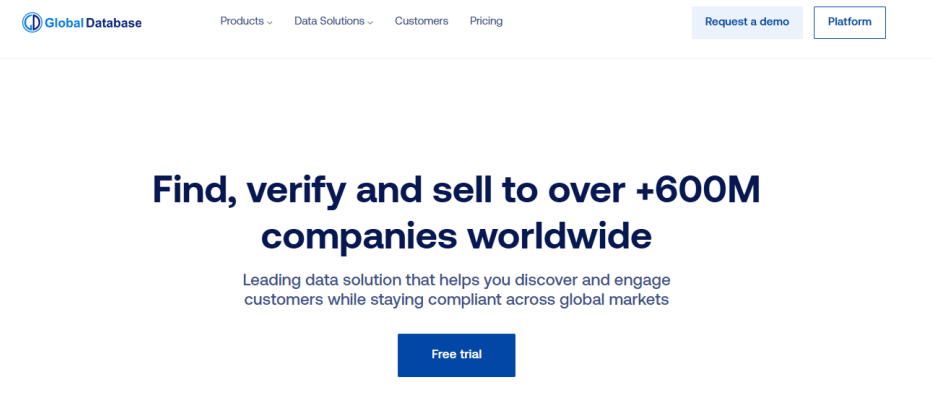
Global Database is a first-party B2B data provider that sources company information directly from 400+ government registries worldwide. It covers 300+ million companies across 195 countries — both public and private — combining deep company financials with verified entity data, ownership structures, and compliance-grade company profiles.
What sets Global Database apart is the combination of financial depth and entity verification in a single platform. It delivers up to 20 years of company financials — full balance sheets, income statements, profit and loss accounts, KPIs, financial ratios, and original PDF filings — all sourced directly from government registries. On top of that, it provides KYB verification, ownership mapping, UBO identification, and corporate hierarchy data.
For compliance teams, credit risk analysts, fintech product builders, and data teams building commercial applications, Global Database provides both the financial intelligence and the verified company identity in one place — eliminating the need to stitch together multiple providers.
Features
- 400+ government registry sources — Data sourced directly from official registries. First-party verified. Not scraped, not aggregated from third-party resellers.
- 300M+ company profiles — Public and private companies across 195 countries. From newly incorporated firms to multinational enterprises.
- 20+ years of company financials — Full balance sheets, income statements, profit and loss accounts, KPIs, and financial ratios. Historical depth going back two decades in supported markets.
- Original PDF filings — Access the original filed documents directly from government registries. Full audit trail for compliance and due diligence.
- Ownership & UBO data — Shareholder structures, beneficial ownership, and parent-subsidiary relationships mapped across jurisdictions. Essential for compliance and due diligence.
- KYB & compliance API — Verify legal entities, validate tax IDs (VAT, EIN, CNPJ), check registration status, and retrieve company documents in real time.
- Flexible licensing — API access, bulk file delivery, and reseller/derivative product rights. Built for teams building data products, not just consuming data.
Limitations
- Enterprise-oriented pricing. No self-serve plan — you’ll need to engage with sales.
- Coverage depth varies by country. EU, US, and UK markets have the richest financial data. Smaller jurisdictions may have thinner profiles.
- Not a market data platform. If you need stock prices, tick data, or trading feeds, this isn’t the tool.
Pricing
Custom pricing based on data volume, use case, and licensing requirements. Contact Global Database for a tailored quote. Free demo available.
FAQs
- What is Global Database best used for?
Global Database is built for KYB verification, compliance screening, credit risk assessment, company enrichment, and building B2B data products. It combines verified entity data with 20+ years of company financials — balance sheets, income statements, P&L accounts, KPIs, ratios, and original PDF filings — across 195 countries. - Does Global Database provide private company financial data?
Yes. Global Database provides in-depth financial data for private companies including full balance sheets, income statements, profit and loss accounts, KPIs, financial ratios, and access to original PDF filings from government registries. Financial history goes back 20+ years in supported jurisdictions. - How is Global Database different from Dun & Bradstreet?
Global Database sources data directly from 400+ government registries as a first-party provider, including original filed documents. D&B aggregates data from multiple sources and layers its own proprietary scoring. Global Database offers more transparent sourcing, deeper registry-sourced financials, and flexible licensing, while D&B offers a larger legacy footprint and established credit scoring (PAYDEX, D&B Rating).
2. MonetaiQ
Website: monetaiq.com
Description
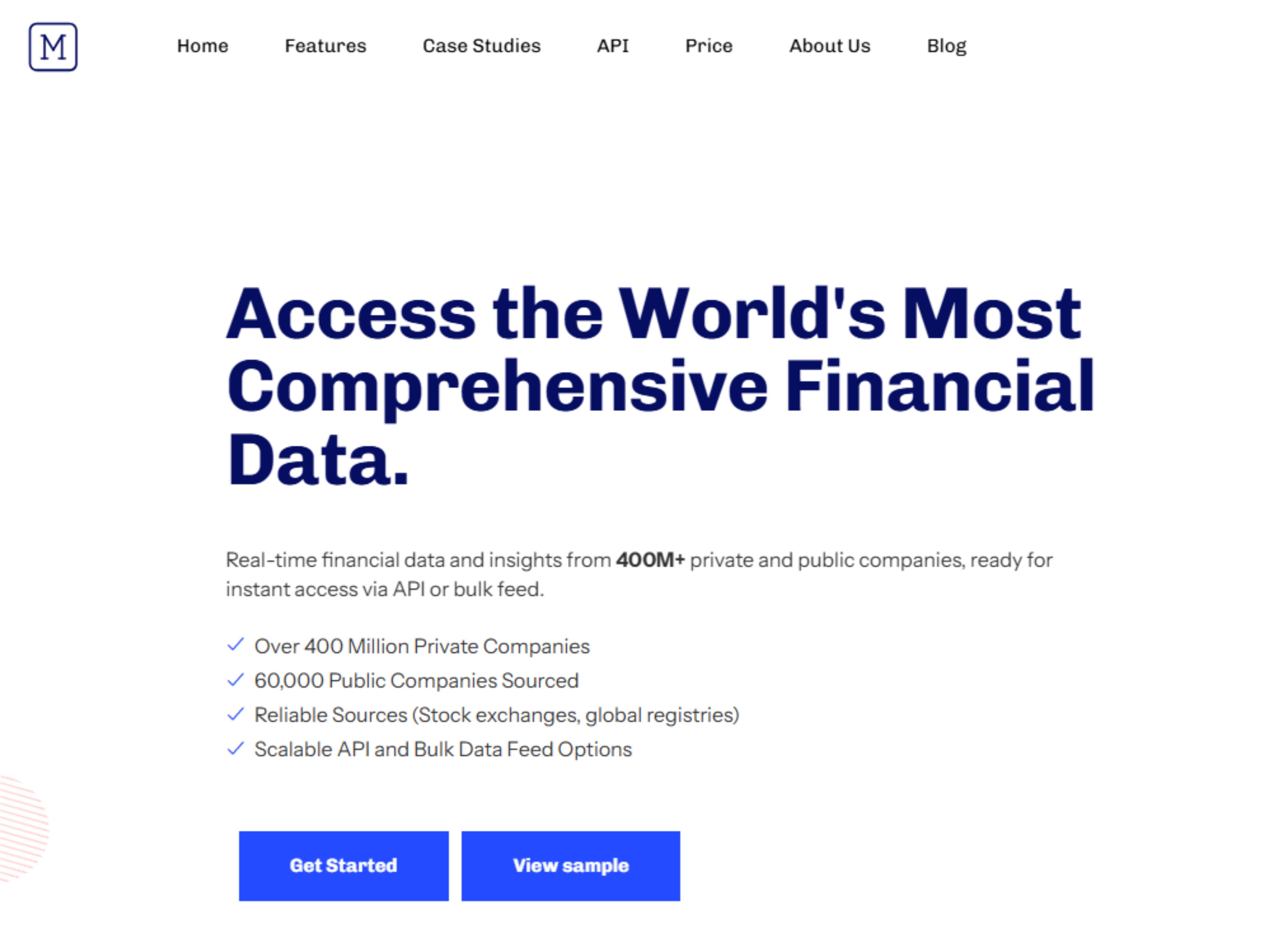
MonetaiQ is a financial data platform focused on delivering audited, standardized financial statements for both public and private companies. It delivers structured income statements, balance sheets, and cash flow data sourced from regulatory filings and official registries.
It covers 400 million+ private companies worldwide, with financial histories going back 20+ years in supported jurisdictions. The platform also layers proprietary credit risk scoring on top of financial data, making it a strong fit for teams building underwriting, credit assessment, or financial analytics products.
Where Global Database combines financials with entity verification and KYB, MonetaiQ focuses specifically on financial depth and credit risk — making it the deeper option for pure financial analysis use cases.
Features
- Registry-sourced financial statements — Income statements, balance sheets, and cash flow data for private companies, sourced from official filings. Standardized across borders for cross-country comparison.
- 400M+ private company coverage — Data on private companies across 190 countries, from newly registered firms to established enterprises.
- 20+ years of financial history — Historical financial data going back two decades in supported markets. Essential for trend analysis and credit modeling.
- Credit risk indicators — Proprietary credit scores and risk metrics derived from financial data. Useful for lending, underwriting, and supplier assessment.
- Daily data updates — Financial data refreshed daily from regulatory filings. Not quarterly. Not monthly. Daily.
- API + bulk data delivery — RESTful API for real-time queries. Bulk file feeds for large-scale integrations into data warehouses and analytics platforms.
Limitations
- Financial depth depends on the jurisdiction. Markets with strong filing mandates (EU, UK, Nordics) have the richest data. Emerging markets may have thinner financial coverage.
- Not a KYB verification tool. MonetaiQ provides financial data and credit risk — not identity verification, sanctions screening, or AML checks. Pair it with Global Database for full compliance workflows.
- No free tier. Pricing starts at $49/mo.
Pricing
| Plan | Price | Key Features |
|---|---|---|
| Starter | $49/mo | Entry-level access to financial data and API |
| Pro | $99/mo | Expanded coverage, higher rate limits |
| Business | $199/mo | Full access, bulk delivery, priority support |
FAQs
- Does MonetaiQ provide financial statements for private companies?
Yes. MonetaiQ provides income statements, balance sheets, and cash flow data for 400 million+ private companies across 190 countries. Data is sourced from regulatory filings and government registries, with up to 20+ years of financial history in supported jurisdictions. - How is MonetaiQ different from Crunchbase or PitchBook?
Crunchbase and PitchBook focus on funded startups, VC/PE transactions, and investor activity. MonetaiQ focuses on financial statements and credit risk for all private companies — not just those that have raised capital. The data is registry-sourced and audited, not self-reported. - Can I use MonetaiQ for credit risk assessment?
Yes. MonetaiQ includes proprietary credit risk indicators derived from financial statement data. It’s used by lending, underwriting, and procurement teams to assess the financial health of private companies.
3. Dun & Bradstreet
Website: dnb.com
Description
Dun & Bradstreet is the legacy incumbent in business data. Founded in 1841, D&B has spent nearly two centuries building the world’s largest commercial database — covering 600+ million business entities globally. Its D-U-N-S Number is the de facto standard for business identification in procurement, credit, and compliance workflows worldwide.
For private company data, D&B provides credit scores (PAYDEX, D&B Rating), company profiles, financial data, and corporate linkage. Its data is deeply embedded in enterprise systems — from SAP and Salesforce to Oracle and Microsoft Dynamics — making it the default choice for large organizations with existing D&B integrations.
The trade-off? Pricing is enterprise-grade, contracts are rigid, and data freshness on smaller or newer companies can lag behind registry-first providers.
Features
- 600M+ business entities — The largest commercial database in the world. Global coverage across virtually every country.
- D-U-N-S Number — The universal business identifier. Required by many government agencies, procurement systems, and regulatory bodies.
- Proprietary credit scoring — PAYDEX (payment behavior), D&B Rating (overall risk), and Failure Score (probability of closure). Industry standard for credit decisioning.
- Corporate linkage — Parent-subsidiary relationships, headquarters identification, and global family trees. Essential for enterprise risk management.
- D&B Direct+ API — RESTful API for real-time company data, credit reports, and risk assessments. Integrates with major enterprise platforms.
- Third-party risk management — Screening, monitoring, and alerting for supplier and counterparty risk.
Limitations
- Expensive. Median annual contract is ~$37,500 according to buyer-reported data. Enterprise deals can run $100K+ depending on data volume and modules.
- Rigid contracts. Multi-year terms with auto-renewal clauses are common. Negotiation leverage is limited for smaller buyers.
- Data freshness concerns. D&B aggregates from multiple sources. Smaller or newly registered companies can have stale or incomplete profiles — especially outside the US and Western Europe.
- Limited transparency on data sourcing. D&B’s proprietary blend makes it difficult to trace specific data points back to their original source. This can be a compliance concern for regulated workflows.
Pricing
Enterprise pricing. Not publicly listed. Typical contracts range from $25,000–$100,000+/year depending on modules, data volume, and user seats. Credit-based consumption models for API access.
FAQs
- How much does Dun & Bradstreet cost?
D&B does not publish pricing. Based on buyer-reported data, the median annual contract is approximately $37,500. Pricing varies significantly based on modules selected, data volume, and enterprise licensing terms. Expect multi-year commitments. - What is a D-U-N-S Number?
The D-U-N-S Number is a unique nine-digit identifier assigned by Dun & Bradstreet to individual business entities. It’s used globally for business identification, credit reporting, and procurement processes. Many government agencies and large enterprises require it. - Is Dun & Bradstreet good for private company financial data?
D&B provides credit scores, basic financial data, and payment behavior data for private companies. However, for full financial statements (income statements, balance sheets, cash flow), dedicated financial data platforms like MonetaiQ or Moody’s Orbis offer more depth. D&B’s strength is credit scoring and risk assessment, not financial statement granularity.
4. Moody’s (Orbis)
Website: moodys.com/orbis
Description
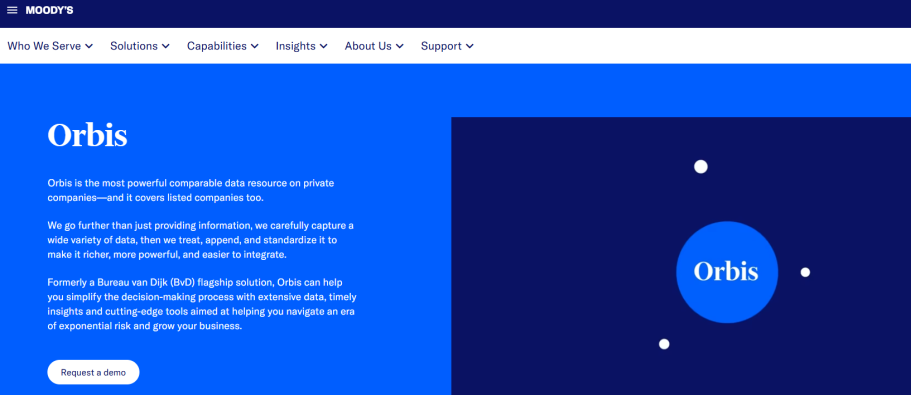
Moody’s Orbis — originally built by Bureau van Dijk before its $3 billion acquisition by Moody’s in 2017 — is the world’s largest database focused specifically on private company financials, ownership, and corporate linkage.
Orbis covers 600+ million entities worldwide, with detailed financial information on 48 million of them. It blends data from 170+ providers, standardizes it into comparable formats, and delivers it through web interfaces, APIs, bulk feeds, and cloud integrations. For enterprise risk teams, compliance departments, and financial institutions that need deep, standardized private company data at scale, Orbis is the benchmark.
The catch? It’s priced for enterprise buyers. And the complexity of the platform means onboarding isn’t fast.
Features
- 600M+ entities globally — One of the broadest company databases in the world. 48 million entities with detailed financial information.
- Standardized financials — Financial data from 170+ sources, normalized into comparable formats. Enables cross-country financial analysis.
- Ownership & corporate structures — Deep ownership trees, beneficial ownership identification, and global corporate hierarchies. Goes beyond what registries report by mapping influence and known associates.
- Credit risk tools — Financial strength indicators, probability of default models (EDF-X), and peer benchmarking.
- Compliance & KYC integration — AML screening, enhanced due diligence, and perpetual risk monitoring. Integrates with Moody’s broader anti-financial crime suite.
- Flexible delivery — Web interface, APIs, bulk feeds, cloud delivery, and connectors for Salesforce, SAP, and other enterprise platforms.
Limitations
- Enterprise pricing. Orbis is not available on a self-serve basis. Expect significant annual commitments comparable to D&B or S&P.
- Complexity. The platform is powerful but not simple. Onboarding and training take time, especially for teams used to lighter-weight APIs.
- Data freshness varies. Orbis aggregates from 170+ sources. Some jurisdictions update frequently; others can lag behind registry-first providers that connect directly to government sources.
- Not API-first. While APIs are available, the platform was originally designed around its web interface and bulk feeds. The developer experience doesn’t match modern API-first providers.
Pricing
Enterprise pricing. Not publicly listed. Contact Moody’s for a tailored quote based on modules, data scope, and delivery method. Annual contracts with multi-year terms are standard.
FAQs
- How many companies does Moody’s Orbis cover?
Orbis covers 600+ million entities worldwide, with detailed financial information on approximately 48 million. Data is sourced from 170+ providers, standardized, and enriched by Moody’s. - Is Moody’s Orbis the same as Bureau van Dijk?
Bureau van Dijk (BvD) was acquired by Moody’s in 2017 for approximately $3 billion. Orbis was BvD’s flagship product and now operates under the Moody’s brand. The data and platform remain substantially the same, with additional integration into Moody’s broader risk and compliance suite. - How does Moody’s Orbis compare to Global Database for private company data?
Orbis offers deeper financial standardization and a broader aggregated dataset (170+ sources). Global Database provides more transparent, first-party registry sourcing from 400+ government registries. The choice depends on whether you prioritize data depth and standardization (Orbis) or source transparency and flexible licensing (Global Database).
5. S&P Capital IQ Pro
Website: spglobal.com/capitaliqpro
Description
S&P Capital IQ Pro is the flagship platform of S&P Global Market Intelligence. It’s a comprehensive financial research and analytics platform covering 109,000+ public companies and 60 million+ private companies — including 14 million with recent financial data and 1.3 million early-stage companies.
Capital IQ’s strength is the depth of its financial data and the sophistication of its analytical tools. It offers 5,000+ financial data items, analyst estimates from 200+ brokers, M&A transaction data, and integrated credit ratings from S&P Global. For investment banks, private equity firms, and financial institutions, it’s one of the primary platforms for financial analysis and deal sourcing.
For private company data specifically, Capital IQ provides company profiles, financial data, key executives, ownership information, and comparable company screening. The platform integrates with Excel via a powerful plugin and offers API access through S&P Global Marketplace.
Features
- 60M+ private companies — Including 14 million with recent financial data. Covers company profiles, financials, executives, and ownership.
- 5,000+ financial data items — Deep financial statement coverage including industry-specific templates for banking, insurance, REITs, and more.
- M&A and deal data — Comprehensive transaction database covering mergers, acquisitions, private placements, and venture capital.
- AI-powered research — ChatIQ and Document Intelligence tools for natural language analysis of financial documents and filings.
- Excel integration — Advanced Excel plugin for pulling financial data directly into models and spreadsheets.
- S&P Global Marketplace API — Programmatic access to financial, reference, and cross-reference data. Python SDK available.
Limitations
- Extremely expensive. Reported pricing ranges from $125,000/year (25 users) to $600,000+/year for larger firms. This is a tool for institutional buyers, not startups.
- Private company financial coverage is strong for larger firms but thins out for smaller, newly registered companies — especially outside the US and Western Europe.
- The platform is built for financial analysts and investment professionals. It’s not designed for compliance-focused workflows like KYB verification or AML screening.
- API access is available through S&P Global Marketplace but is priced separately and requires additional licensing.
Pricing
Enterprise pricing. Not publicly listed. Based on buyer-reported data, annual costs range from ~$5,000/user to $25,000+/user depending on modules and firm size. Multi-year enterprise contracts are standard.
FAQs
- How much does S&P Capital IQ cost?
S&P Capital IQ does not publish pricing. Based on buyer-reported data, a CPA firm with 25 users was paying approximately $125,000/year. A private equity firm with 4 users was paying significantly less. Pricing depends on modules, user count, and data scope. - Does S&P Capital IQ cover private companies?
Yes. Capital IQ Pro covers 60 million+ private companies, with 14 million having recent financial data. Coverage includes company profiles, financials, executives, and ownership. However, financial depth is stronger for larger and mid-market firms. - How does S&P Capital IQ compare to MonetaiQ for private company data?
Capital IQ is a comprehensive research platform built for investment professionals, with deep analytics, deal data, and analyst estimates. MonetaiQ focuses specifically on registry-sourced financial statements and credit risk for both public and private companies, at a fraction of the cost. If you need financial statements for compliance or credit assessment, MonetaiQ is more accessible. If you need full-spectrum investment research, Capital IQ is the premium option.
6. Zephira.ai
Website: zephira.ai
Description
Zephira.ai is an API-first company data platform built for developers, fintechs, and RegTechs that need instant access to registry-sourced company data across 100+ countries.
Zephira occupies the modern, developer-first end of the market. Where legacy providers like D&B and Moody’s deliver data through enterprise platforms and bulk feeds, Zephira delivers it through clean REST APIs, interactive playgrounds, and structured JSON responses designed for high-volume automation.
For teams building KYB workflows, onboarding automation, or data enrichment pipelines, Zephira provides a modern integration experience that legacy providers can’t match. Its AI enrichment layer also adds insights from financial databases, business reports, and global directories on top of core registry data.
Features
- Registry-sourced company data — Legal names, registration numbers, VAT IDs, company status, and legal forms pulled directly from government registries in 100+ countries.
- Ownership & UBO mapping — Shareholder structures and beneficial ownership data for compliance and due diligence workflows.
- Financial data — Turnover, total assets, working capital, profit figures, and 20+ years of financial history sourced from official filings.
- AI-powered enrichment — Zephira’s AI layer enriches core registry data with insights from financial databases, business reports, and global directories.
- Developer-first API — Interactive API playgrounds, structured JSON responses, and clear documentation built for fast integration.
- Real-time monitoring — Get instant notifications when a company’s structure, ownership, or financial data changes.
Limitations
- Newer platform. Track record is still being built compared to established players like D&B, Moody’s, or Global Database.
- Coverage is strongest in Europe and major global markets. Depth can vary in smaller jurisdictions.
- Pricing is not publicly listed. You’ll need to request a demo and engage with sales.
- Not a financial analysis platform. If you need deep financial modeling or credit scoring, pair Zephira with MonetaiQ.
Pricing
Custom pricing. Contact Zephira.ai for a demo and tailored quote based on data volume and use case.
FAQs
- What is Zephira.ai best used for?
Zephira.ai is built for KYB verification, company enrichment, onboarding automation, and compliance workflows. Its API-first delivery model makes it ideal for developers building high-volume automated processes. - Does Zephira.ai provide financial data for private companies?
Yes. Zephira provides financial data including turnover, assets, liabilities, and profit figures sourced from official filings. It also offers 20+ years of financial history for companies in supported jurisdictions. - How does Zephira.ai compare to Global Database?
Both source data from government registries. Zephira emphasizes developer experience and API-first delivery for high-volume automation. Global Database offers broader coverage (400+ registries, 195 countries) and flexible licensing including reseller rights. The best choice depends on whether you prioritize integration speed or data breadth and licensing flexibility.
Full Comparison Table
| Feature | Global Database | MonetaiQ | D&B | Moody’s Orbis | S&P Capital IQ | Zephira.ai |
|---|---|---|---|---|---|---|
| Primary Focus | Financials, entity verification & KYB | Financial statements & credit risk | Credit scoring & business identity | Standardized financials & risk | Financial research & analytics | Developer-first KYB |
| Best For | Compliance, credit risk, data products | Credit assessment, financial analytics | Procurement, credit decisioning | Enterprise risk, due diligence | Investment research, deal sourcing | Onboarding automation, enrichment |
| Private Company Coverage | 300M+ | 400M+ | 600M+ | 600M+ (48M with financials) | 60M+ (14M with financials) | 100+ countries |
| Financial Statement Depth | ✅ Deep (balance sheets, P&L, KPIs, ratios, original PDFs) | ✅ Deep (audited) | ✅ Basic | ✅ Deep (standardized) | ✅ Deep (5,000+ items) | ✅ Basic |
| Credit Scoring | ❌ | ✅ Proprietary | ✅ PAYDEX, D&B Rating | ✅ EDF-X, Financial Strength | ✅ S&P Credit Ratings | ❌ |
| Ownership / UBO Data | ✅ | ❌ | ✅ Corporate linkage | ✅ Deep ownership trees | ✅ Corporate hierarchy | ✅ |
| KYB / Compliance | ✅ | ❌ | ✅ | ✅ | ❌ | ✅ |
| Original Filed Documents | ✅ PDF filings | ❌ | ❌ | ❌ | ✅ SEC filings | ❌ |
| Historical Depth | 20+ years | 20+ years | Varies | Varies by source | 20+ years | 20+ years |
| Data Source | 400+ gov registries (first-party) | Regulatory filings | Aggregated (proprietary blend) | 170+ providers (aggregated) | Aggregated + proprietary | Gov registries + AI |
| API Delivery | ✅ REST + Bulk | ✅ REST + Bulk | ✅ D&B Direct+ | ✅ API + Bulk + Cloud | ✅ Marketplace API | ✅ REST |
| Developer Experience | Good | Good | Enterprise-grade | Enterprise-grade | Enterprise-grade | Excellent |
| Country Coverage | 195 countries | 190 countries | Global (200+ countries) | Global (200+ countries) | Global (110+ countries) | 100+ countries |
| Free Tier | ❌ | ❌ | ❌ | ❌ | ❌ | ❌ |
| Pricing | Custom (enterprise) | From $49/mo | ~$37.5K/yr median | Enterprise (custom) | ~$5K–$25K/user/yr | Custom |
| Contract Terms | Annual | Monthly | Multi-year | Multi-year | Multi-year | Custom |
How to Choose the Right API
| Use Case | Recommended Provider |
|---|---|
| KYB verification & onboarding | Global Database or Zephira.ai |
| Credit risk assessment | MonetaiQ or Moody’s Orbis |
| Private company financial statements | MonetaiQ or S&P Capital IQ |
| Supplier due diligence | D&B or Global Database |
| Investment research & deal sourcing | S&P Capital IQ |
| Building a fintech or data product | MonetaiQ API + Global Database API |
| Enterprise risk management | Moody’s Orbis or D&B |
| Startup-friendly budget | MonetaiQ (from $49/mo) |
| Developer-first integration | Zephira.ai |
| Ownership mapping & corporate hierarchy | Global Database or Moody’s Orbis |
Most enterprise teams combine 2-3 providers. A common stack: Global Database for entity verification and ownership, MonetaiQ for financial depth and credit risk, and D&B or Moody’s for legacy system compatibility.
The Data Source Question
Not all private company data is created equal. How the data is sourced determines whether you can use it in regulated workflows.
- Registry-sourced (first-party):Data pulled directly from government business registries. Providers like Global Database and Zephira.ai connect directly to 100–400+ registries. This is the gold standard for compliance — the data traces back to the original government filing.
- Aggregated (multi-source):Data collected from multiple third-party providers, standardized, and blended. D&B and Moody’s Orbis aggregate from 170+ sources. Broader coverage, but source transparency is limited. Useful for research and analytics; requires additional diligence for regulated use cases.
- Regulatory filings: Financial data sourced from mandated company filings with stock exchanges, tax authorities, and registry bodies. MonetaiQ specializes in this — delivering structured financial statements from official filings. S&P Capital IQ also sources from filings but supplements with proprietary research.
For teams in regulated industries — banking, insurance, financial services — understanding the data provenance isn’t optional. It’s a compliance requirement.
10 Frequently Asked Questions About Private Company Data APIs
1. What is a private company data API?
A private company data API provides programmatic access to information about privately held businesses — including financial statements, ownership structures, registration data, credit scores, and key personnel. Unlike public company APIs that pull from stock exchanges, private company APIs source data from government registries, regulatory filings, and proprietary databases.
2. Why is private company data harder to access than public company data?
Private companies have no universal disclosure requirement. While public companies must file with regulators (SEC, FCA, etc.), private company reporting varies by country, company size, and legal form. This fragmentation means private company data must be sourced from hundreds of individual registries and filing systems worldwide.
3. What is the best private company data API for compliance and KYB?
Global Database and Zephira.ai are purpose-built for KYB and compliance workflows. Global Database sources from 400+ government registries across 195 countries with ownership and UBO data. Zephira.ai offers an API-first approach with AI-powered enrichment across 100+ countries. Both provide the registry-sourced verification that regulated industries require.
4. How much does private company data cost?
Pricing ranges dramatically. MonetaiQ starts at $49/mo for basic financial data access. Enterprise providers like D&B (~$37,500/yr median), Moody’s Orbis, and S&P Capital IQ (~$5,000–$25,000/user/yr) require significant annual commitments with multi-year contracts.
5. Can I get financial statements for private companies?
Yes, in markets where filing is mandated. MonetaiQ specializes in structured financial statements (income statements, balance sheets, cash flow) sourced from regulatory filings, covering 400 million+ private companies. Moody’s Orbis provides standardized financials for 48 million entities. Coverage depth depends on the jurisdiction — EU and UK markets have the richest data.
6. What is a D-U-N-S Number and do I need one?
The D-U-N-S Number is a nine-digit identifier assigned by Dun & Bradstreet to individual business entities. It’s used for credit reporting, procurement, and regulatory compliance. Many government agencies and large enterprises require it. If your workflows involve D&B data, the D-U-N-S Number is the primary key for entity resolution.
7. What’s the difference between registry-sourced and aggregated private company data?
Registry-sourced data is pulled directly from government business registries — the original filing authority. Providers like Global Database and Zephira.ai use this approach. Aggregated data is collected from multiple third-party sources and blended together. D&B and Moody’s Orbis use this model. Registry-sourced offers better provenance for compliance; aggregated offers broader enrichment.
8. Which private company data API is best for startups and small teams?
MonetaiQ offers the most accessible entry point at $49/mo with financial statement data for 400 million+ companies. Most other providers in this space require enterprise contracts. For KYB and company verification on a smaller scale, Zephira.ai provides a developer-friendly API with custom pricing that can accommodate smaller teams.
9. Can I use private company data APIs for credit risk assessment?
Yes. MonetaiQ provides proprietary credit risk indicators derived from financial statement data. D&B offers PAYDEX and D&B Rating scores. Moody’s Orbis provides EDF-X probability of default models. S&P Capital IQ integrates S&P Global credit ratings. The right choice depends on whether you need registry-sourced credit indicators (MonetaiQ) or established legacy scoring (D&B, Moody’s).
10. Do I need multiple private company data providers?
Most enterprise teams combine 2-3 providers. A typical stack includes one entity verification provider (Global Database or Zephira.ai for KYB and ownership), one financial data provider (MonetaiQ for statements and credit risk), and one legacy provider (D&B or Moody’s for established scoring and procurement compatibility). Combining providers gives you both compliance-grade verification and financial depth.