
Getting reliable stock market data shouldn’t be this hard.
You need price feeds. Financial statements. Historical data going back decades. And you need it delivered through a clean API that doesn’t break every time you scale.
The problem? There are dozens of financial data APIs on the market. Some are built for day traders. Others target quant teams. A few focus on company fundamentals. Most overlap — but the differences in pricing, coverage, and rate limits matter more than any feature page will tell you.
This guide cuts through the noise. We reviewed 8 financial data APIs that serve public company and stock market data in 2026. Each one is broken down by what it actually does well, where it falls short, what it costs, and who should use it.
Whether you’re building a trading bot, a research platform, or a fintech product that needs audited financial statements — this comparison will save you weeks of trial and error.
What to Look for in a Financial Data API
Before diving into the comparison, here’s what separates a good API from a time-wasting one:
- Data coverage — How many exchanges, asset classes, and geographies does it support?
- Historical depth — Can you backtest through 2008? Through 2000? Some APIs cap history at 5 years.
- Real-time vs. delayed — If you’re trading live, 15-minute delay kills you. If you’re doing research, it’s fine.
- Rate limits — Free tiers are great for testing. But when you hit production, calls-per-minute matters.
- Documentation — Bad docs cost engineering hours. Period.
- Licensing terms — Can you redistribute the data in your product? Most APIs restrict this.
1. MonetaiQ
Website: monetaiq.com
Description
MonetaiQ is a financial data platform built for teams that need audited, standardized financial statements — not just price feeds.
Most APIs on this list focus on stock prices, candlesticks, and tick data. MonetaiQ solves a different problem. It delivers structured balance sheets, income statements, and cash flow data sourced directly from global stock exchanges and regulatory filings. Updated daily. Covering 60,000+ publicly listed companies across 190 countries.
If you’re building equity research tools, credit assessment platforms, or financial analytics products, this is the data layer that feeds your models — not your trading terminal.
Features
- Regulatory-sourced financial statements — Income statements, balance sheets, and cash flow data pulled directly from stock exchange filings and regulatory bodies. Not estimated. Not scraped. Audited.
- Daily data updates — Financial data refreshed daily from regulatory filings. Not quarterly. Not monthly. Daily.
- 190-country coverage — Ticker data for 60,000+ publicly listed companies across 190 countries.
- Stock performance metrics — Share price, market capitalization, trading volumes alongside financial fundamentals.
- API + bulk data delivery — RESTful API for real-time queries. Bulk file delivery for large-scale data integrations.
- Credit risk indicators — Proprietary scoring layered on financial signals. Useful for underwriting and risk assessment.
Limitations
- Not designed for tick-level or intraday trading data. This is a fundamentals-first API.
- Real-time price streaming is not the focus. Financial statement data is updated daily from regulatory filings — not intraday.
- No free tier listed on the website. You’ll need to commit to a paid plan to start pulling data.
Pricing
| Plan | Price | Key Features |
|---|---|---|
| Starter | $49/mo | Entry-level access to financial data and API |
| Pro | $99/mo | Expanded coverage, higher rate limits |
| Business | $199/mo | Full access, bulk delivery, priority support |
FAQs
- Does MonetaiQ provide real-time stock prices?
MonetaiQ focuses on financial statement data updated daily from regulatory filings across 190 countries. It includes stock performance metrics like share price and market cap, but it’s not built for real-time tick-level price feeds. - What types of financial statements does MonetaiQ offer?
MonetaiQ provides income statements, balance sheets, and cash flow data for 60,000+ publicly listed companies across 190 countries. All data is sourced from official stock exchange filings and regulatory bodies. Plans start at $49/mo (Starter), with Pro ($99/mo) and Business ($199/mo) tiers for expanded access. - Can I use MonetaiQ for private company financial data?
Yes. MonetaiQ also covers 400 million+ private companies with registry-sourced financial data, credit scores, and historical financials going back 20+ years. See our guide to the [best private company data APIs in 2026] for more detail.
2. Global Database
Website: globaldatabase.com
Description
Global Database is a first-party B2B data provider that sources company information directly from 400+ government registries worldwide. While most APIs on this list focus on stock prices and market data, Global Database covers the full company profile — financials, ownership structures, registration data, and key personnel — for both public and private companies.
For teams building compliance workflows, KYB verification, or enterprise data products, Global Database provides the registry-sourced company layer that sits underneath financial analysis. It covers 300+ million companies across 195 countries, including public companies listed on global exchanges.
Think of it as the entity data backbone. MonetaiQ gives you the financial statements. Global Database gives you the verified company identity, ownership chain, and registration data behind those statements.
Features
- 400+ government registry sources — Data sourced directly from official registries. Not scraped. Not aggregated from third parties. First-party verified.
- 600M+ company profiles — Coverage spans both public and private companies across 195 countries.
- Ownership & UBO data — Shareholder structures, beneficial ownership, and parent-subsidiary relationships mapped across jurisdictions.
- KYB & compliance API — Verify legal entities, validate tax IDs (VAT, EIN, CNPJ), and retrieve registration status in real time.
- Company financials — Revenue, balance sheets, and key financial indicators for companies that file with government registries.
- Flexible licensing — API access, bulk file delivery, and reseller/derivative product rights for teams building data products.
Limitations
- Not a market data API. If you need tick-level stock prices, candlestick charts, or real-time trading feeds, this isn’t the tool.
- Pricing is enterprise-oriented. There’s no self-serve plan — you’ll need to engage with sales.
Pricing
Custom pricing based on data volume, use case, and licensing requirements. Contact Global Database for a tailored quote. Free demo available.
FAQs
- What is Global Database used for?
Global Database is used for KYB verification, compliance screening, company enrichment, and building B2B data products. It provides registry-sourced company data including legal status, ownership structures, financials, and key personnel across 195 countries. - Does Global Database cover public companies?
Yes. Global Database covers both public and private companies — over 300 million in total. For public companies, it provides registration data, ownership structures, and financial indicators sourced from government registries. - How is Global Database different from MonetaiQ?
Global Database focuses on verified company identity, ownership, and registry data. MonetaiQ focuses on deep financial statements and credit risk indicators. They complement each other — Global Database for entity verification, MonetaiQ for financial analysis.
3. Polygon (Massive)
Website: massive.com (formerly polygon.io)
Description
Polygon — now rebranded as Massive — is the go-to API for developers building real-time trading tools and intraday analytics.
It started as a mission to make US financial market data accessible to everyone. Today, it serves stocks, options, forex, indices, and crypto through RESTful APIs and WebSocket connections. Low latency. Unlimited calls on paid plans. No daily rate caps.
If you need streaming tick data, trades, and quotes in real time — Polygon is built for that.
Features
- Real-time WebSocket streaming — Live trades, quotes, and aggregates with ~20ms mean latency.
- Unlimited API calls — No daily call limits on all premium plans.
- Flexible aggregates — Query any timespan. 1 minute, 7 minutes, 16 days. Any interval you need.
- Snapshot APIs — View the entire market at a glance. Gainers, losers, and current-day movers.
- Multi-asset coverage — Stocks, options, futures, forex, indices, and crypto.
- Flat file downloads — Bulk download current and historical market data for offline analysis.
Limitations
- Primarily US-focused. International exchange coverage is limited compared to EODHD or Alpha Vantage.
- Fundamentals and financial statements are not the core strength. If you need audited filings, look elsewhere.
- Free tier has tight rate limits (5 calls/min). The Starter plan offers only 5 years of history — not enough for serious backtesting.
- Real-time data requires the Developer plan ($79/mo) or higher.
Pricing
| Plan | Price | Key Features |
|---|---|---|
| Basic | Free | End-of-day data, 5 API calls/min |
| Starter | $29/mo | Unlimited calls, 5 years history, 15-min delay |
| Developer | $79/mo | Real-time data, tick data, NBBO, 15 years history |
| Advanced | $199/mo | Full history, market events, halt data |
| Business | Custom | Enterprise licensing, redistribution rights |
FAQs
- Is Polygon.io the same as Massive?
Yes. Polygon.io rebranded to Massive as it expanded beyond US stock data into a broader financial data platform. The API and infrastructure remain the same. - Does Polygon offer real-time stock data?
Real-time data is available starting at the Developer plan ($79/mo). The Starter plan includes a 15-minute delay on quotes and trades. - Can I redistribute Polygon data in my product?
Redistribution rights require a Business plan with custom licensing. Standard plans are for internal use and personal projects only.
4. Finnhub
Website: finnhub.io
Description
Finnhub is the API most developers start with — and for good reason. It offers the most generous free tier in the market, combining stock quotes, company news, sentiment data, and earnings calendars in one package.
It’s not the deepest on any single dataset. But for prototyping, building MVPs, or powering lightweight analytics dashboards, Finnhub gets you up and running fast.
Features
- Generous free tier — Enough request capacity for meaningful development and early-stage products.
- WebSocket support — Real-time streaming without polling. Lower latency for live dashboards.
- Balanced dataset mix — Quotes, news, sentiment signals, earnings calendars, and IPO data in one API.
- Global stock coverage — Data from major global exchanges including US, European, and Asian markets.
- Alternative data — Social sentiment, congressional trading, and FDA calendars for event-driven strategies.
- Clean documentation — Well-organized docs with code examples across multiple languages.
Limitations
- Fundamentals coverage is shallower than dedicated financial statement APIs. Company financials lack the depth of MonetaiQ or EODHD.
- Historical depth is limited on the free plan. Premium endpoints and longer history are gated behind paid tiers.
- Rate limits tighten quickly on the free tier during high-traffic periods.
- No bulk download option — everything is API-call based.
Pricing
| Plan | Price | Key Features |
|---|---|---|
| Free | $0 | 60 calls/min, basic endpoints, US stock data |
| All-in-One | From $25/mo | Higher rate limits, premium endpoints, global coverage |
| Enterprise | Custom | Dedicated support, bulk access, SLA |
FAQs
- Is Finnhub really free?
Yes. The free plan provides 60 API calls per minute with access to stock quotes, news, and basic company data. It’s enough for prototyping and small-scale applications. - Does Finnhub support real-time stock data?
Finnhub offers real-time US stock data via WebSocket on all plans, including the free tier. Some international exchanges may have delays. - How does Finnhub compare to Alpha Vantage?
Finnhub offers a broader dataset mix (sentiment, calendars, alternative data) and better WebSocket support. Alpha Vantage provides deeper technical indicators and options data. The right choice depends on your use case.
5. EODHD
Website: eodhd.com
Description
EODHD (End of Day Historical Data) does exactly what the name promises — and does it well. It delivers historical market data across 60+ global exchanges with one of the longest historical datasets available at its price point.
If your use case is backtesting, academic research, or building a platform that needs decades of price history across multiple markets, EODHD is hard to beat on value.
Features
- 60+ global exchanges — Broad international coverage including US, European, Asian, and emerging market exchanges.
- Deep historical data — End-of-day pricing data going back 30+ years for many markets.
- Fundamental data — Financial statements, earnings, and key ratios for global companies.
- No-code add-ons — Google Sheets, Excel, and WordPress plugins for non-developer access.
- Multi-language libraries — Python, C#, Java, MATLAB, R, and more.
- Bond and ETF data — Coverage extends beyond equities into fixed income and fund data.
Limitations
- Real-time data is available but it’s not EODHD’s strongest selling point. Latency can’t compete with Polygon or dedicated streaming APIs.
- API documentation is functional but not as polished as Finnhub or Polygon.
- Some data quality inconsistencies reported on smaller, less liquid exchanges.
- No WebSocket support for real-time streaming.
Pricing
| Plan | Price | Key Features |
|---|---|---|
| Free | $0 | Limited API access, US data only |
| All-World | $19.99/mo | All exchanges, 30+ years history, fundamental data |
| Extended | $49.99/mo | Real-time data, technical indicators, screener |
| All-in-One | Custom | Bulk access, redistribution, enterprise support |
FAQs
- How far back does EODHD historical data go?
EODHD offers end-of-day pricing data going back 30+ years for many major exchanges. Historical depth varies by market — US and European exchanges have the longest coverage. - Does EODHD provide fundamental financial data?
Yes. EODHD provides financial statements, earnings data, and key financial ratios for companies across 60+ exchanges. It also offers macroeconomic indicators. - Can I use EODHD data in Google Sheets?
Yes. EODHD offers a dedicated Google Sheets add-on that lets you pull market data directly into your spreadsheets without writing code.
6. ORTEX
 Website: public.ortex.com
Description
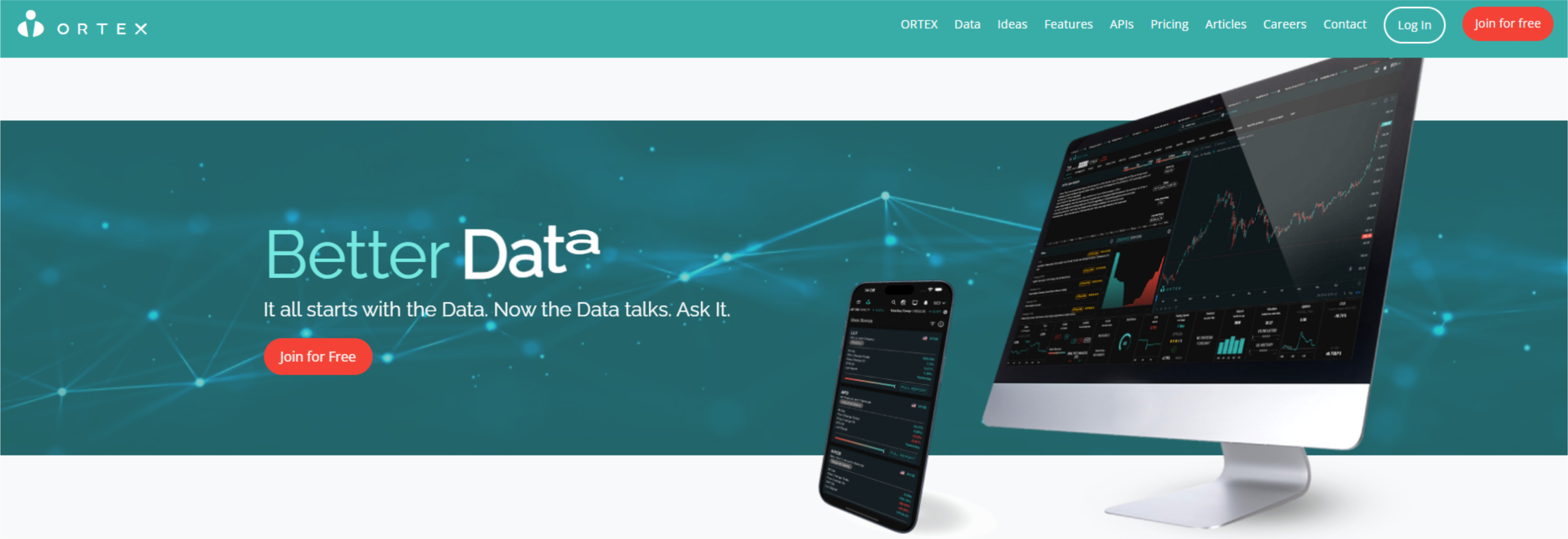
ORTEX is not a general-purpose market data API. It’s a specialized analytics platform built around short interest, institutional data, and trading signals.
Where most APIs give you price and volume, ORTEX gives you what’s happening behind the scenes — who’s shorting, how much it costs to borrow shares, what insiders are doing, and where analyst consensus is shifting. It sources securities lending data from the world’s largest network of agent lenders, prime brokers, and broker-dealers.
For traders and analysts who make decisions based on institutional activity rather than technical patterns, ORTEX fills a gap that no other API on this list covers.
Features
- Real-time short interest data — Shares on loan, cost to borrow, utilization, days to cover. Updated intraday.
- Insider transaction analysis — Who traded, why, and how significant the trade was relative to their position. Insiders ranked by historical performance.
- Analyst tracking — Real-time analyst recommendation changes, target price revisions, EPS estimate momentum.
- Trading signals — Proprietary signals generated from short interest, insider activity, and institutional behavior.
- Stock screener — Screen across all ORTEX datasets to find opportunities based on short squeezes, insider buying, or analyst upgrades.
- API + Excel add-in + Python SDK — Integrate ORTEX data into your own tools, dashboards, and automated workflows.
Limitations
- Not a substitute for basic market data. You’ll still need a primary price/fundamentals API alongside ORTEX.
- Focused on equities. No forex, crypto, or commodity data.
- No free tier. You need a paid subscription to access any data.
- The Basic plan delivers delayed short interest. Real-time requires the Advanced tier.
Pricing
| Plan | Price | Key Features |
|---|---|---|
| Basic | $29/mo ($348/yr) | Analyst data, corporate actions, delayed short interest, institutional holders |
| Advanced | $79/mo ($948/yr) | Everything in Basic + real-time short interest, options data, insider activity, trading signals |
| API Add-on | $18.85/mo | Programmatic access to ORTEX datasets |
| Enterprise | Custom | Bulk API access, custom data feeds, tailored licensing |
FAQs
- What makes ORTEX different from other financial data APIs?
ORTEX specializes in data most APIs don’t cover — real-time short interest, insider transactions, and institutional analytics. It’s a complement to standard market data providers, not a replacement. - Does ORTEX offer an API?
Yes. ORTEX provides a REST API, Python SDK, and Excel add-in. The API add-on starts at $18.85/month and gives programmatic access to short interest, insider data, analyst changes, and more. - Can I use ORTEX for algorithmic trading?
ORTEX provides trading signals and real-time institutional data that can feed algorithmic strategies. However, it doesn’t provide execution capabilities — you’ll need a broker API for order placement.
7. Alpha Vantage
Website: alphavantage.co
Description
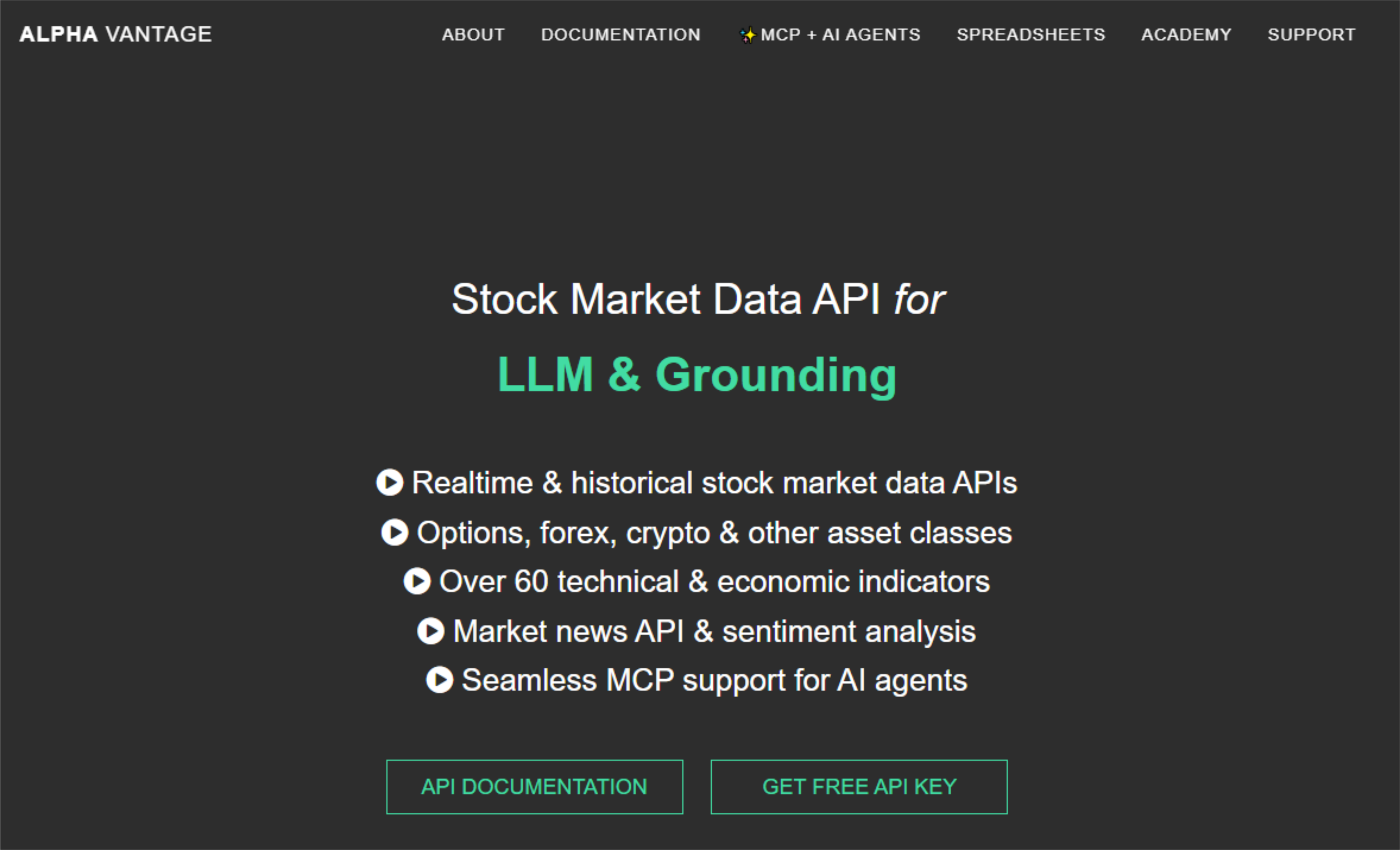
Alpha Vantage has been a staple in the financial data API space since its launch. Backed by Y Combinator, it offers a wide range of data across stocks, ETFs, forex, commodities, and crypto — with a particularly strong set of technical indicators (50+).
It’s one of the few providers licensed by both Nasdaq and OPRA (Options Price Reporting Authority), which gives it an edge in options data quality. If you’re building tools that combine price data with technical analysis, Alpha Vantage deserves serious consideration.
Features
- 50+ technical indicators — SMA, EMA, RSI, MACD, Bollinger Bands, and dozens more. Built directly into the API.
- Options data — Licensed by OPRA for institutional-grade options pricing. Real-time and historical.
- Multi-asset coverage — Stocks, ETFs, mutual funds, forex, commodities, and crypto.
- Fundamental data — Company financials, earnings, and corporate data for US-listed companies.
- MCP server support — Native integration for AI agents and LLM workflows.
- Spreadsheet add-ons — Google Sheets and Excel add-ons for direct data access.
Limitations
- The free tier is limited to 25 requests per day — enough to test, but not enough to build anything real.
- Options data at the real-time level requires the most expensive tier, making it a costly option for small teams.
- International coverage is weaker than EODHD for non-US exchanges.
- Documentation is comprehensive but can feel cluttered. Finding the right endpoint takes more time than it should.
Pricing
| Plan | Price | Key Features |
|---|---|---|
| Free | $0 | 25 requests/day, most endpoints accessible |
| Pro | $49.99/mo | Unlimited calls, 75 requests/min |
| Ultra | $149.99/mo | Higher rate limits, priority support |
| Enterprise | Custom | SLA, dedicated support, custom feeds |
FAQs
Is Alpha Vantage free to use? Alpha Vantage offers a free tier with up to 25 API requests per day. It’s useful for testing and light experimentation, but production use requires a paid plan.
Does Alpha Vantage support options data? Yes. Alpha Vantage is one of the few providers licensed by OPRA for institutional-grade options data. Real-time options pricing is available on higher-tier plans.
How does Alpha Vantage compare to Polygon for real-time data? Polygon offers lower latency and unlimited calls on paid plans, making it better for high-frequency or streaming use cases. Alpha Vantage is stronger on technical indicators and options data. Choose based on whether you need speed or analytical depth.
8. Zephira.ai
Website: zephira.ai
Description
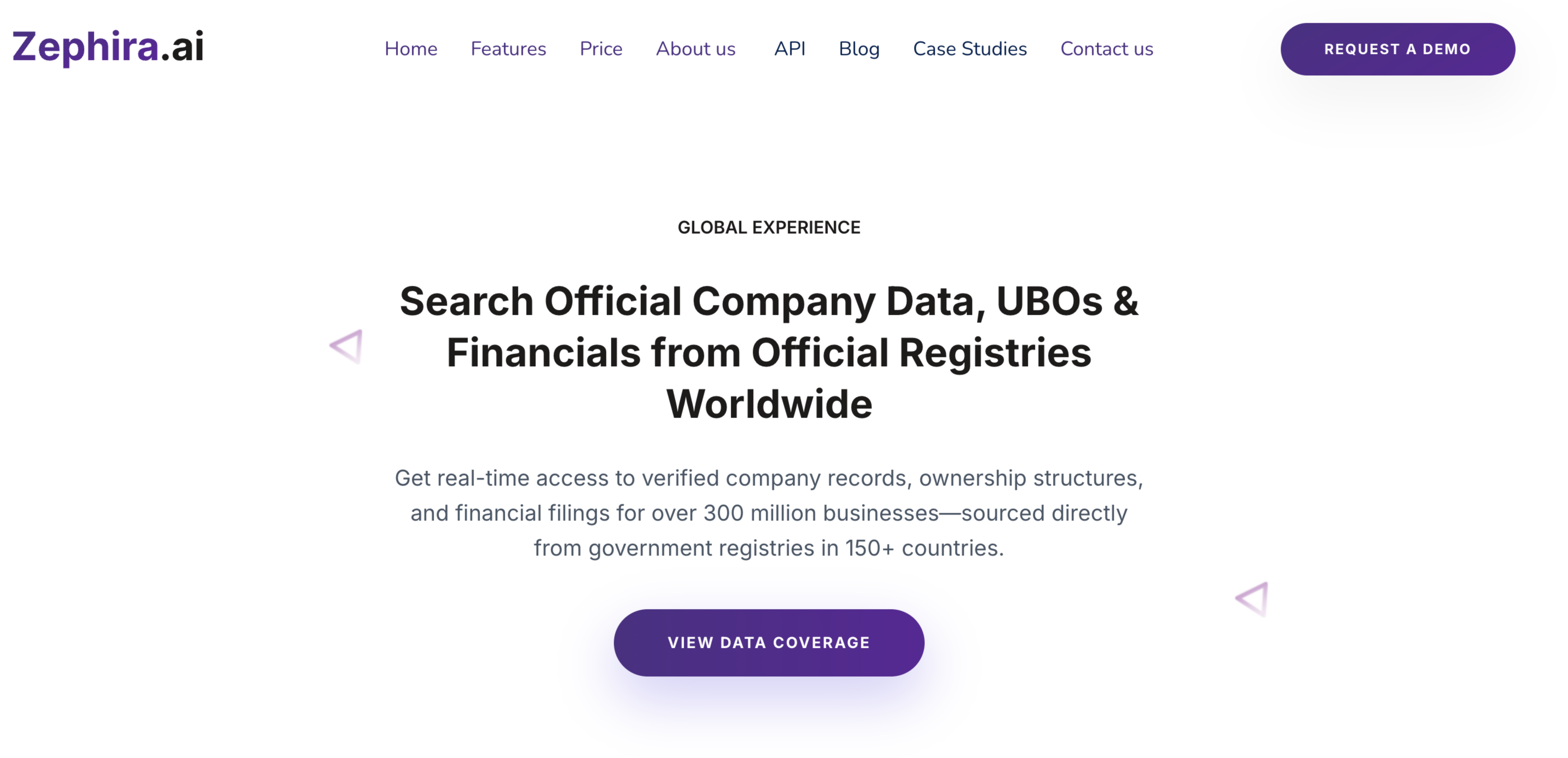
Zephira.ai is an API-first company data platform built for developers, fintechs, and RegTechs that need instant access to registry-sourced company data across 100+ countries.
Like Global Database, Zephira focuses on verified entity data rather than stock prices. But where it stands out is its developer experience — clean API docs, interactive playgrounds, and structured JSON responses designed for high-volume KYB workflows, onboarding automation, and data enrichment pipelines.
For teams building products that need to verify company identities, pull normalized firmographics, or enrich CRM data with registry-sourced information, Zephira provides a modern, API-first alternative to legacy providers.
Features
- Registry-sourced company data — Legal names, registration numbers, VAT IDs, company status, and legal forms pulled directly from government registries in 100+ countries.
- Ownership & UBO mapping — Shareholder structures and beneficial ownership data for compliance and due diligence workflows.
- Financial data — Turnover, total assets, working capital, profit figures, and 20+ years of financial history sourced from official filings.
- AI-powered enrichment — Zephira’s AI layer enriches core registry data with insights from financial databases, business reports, and global directories.
- Developer-first API — Interactive API playgrounds, structured JSON responses, and clear documentation built for fast integration.
- Real-time monitoring — Get instant notifications when a company’s structure, ownership, or financial data changes.
Limitations
- Not a market data API. No stock prices, no tick data, no candlesticks. This is company intelligence, not trading infrastructure.
- Coverage is strongest in Europe and major global markets. Depth can vary in smaller jurisdictions.
- Pricing is not publicly listed. You need to request a demo and engage with sales.
- Newer platform compared to established players like Global Database or D&B. Track record is still being built.
Pricing
Custom pricing. Contact Zephira.ai for a demo and tailored quote based on data volume and use case.
FAQs
- What is Zephira.ai used for?
Zephira.ai is used for KYB verification, company enrichment, onboarding automation, and compliance workflows. It provides registry-sourced company data including legal status, ownership, financials, and firmographics across 100+ countries. - Does Zephira.ai provide financial data for public companies?
Yes. Zephira provides financial data including turnover, assets, liabilities, and profit figures sourced from official filings. It also offers 20+ years of financial history for companies in supported jurisdictions. - How does Zephira.ai compare to Global Database?
Both source data from government registries. Zephira emphasizes developer experience and API-first delivery for high-volume automation. Global Database offers broader coverage (400+ registries, 195 countries) and flexible licensing including reseller rights. The best choice depends on whether you prioritize integration speed or data breadth.
Full Comparison Table
| Feature | MonetaiQ | Global Database | Polygon | Finnhub | EODHD | ORTEX | Alpha Vantage | Zephira.ai |
|---|---|---|---|---|---|---|---|---|
| Primary Focus | Financial statements | Company registry data | Real-time market data | Multi-purpose market data | Historical market data | Short interest & institutional | Technical indicators & options | Company verification |
| Best For | Equity research, credit risk | KYB, compliance, entity data | Trading bots, intraday | Prototyping, MVPs | Backtesting, research | Institutional analytics | Technical analysis | Onboarding, enrichment |
| Public Company Data | ✅ 60K+ companies | ✅ 300M+ companies | ✅ US-focused | ✅ Global | ✅ 60+ exchanges | ✅ Global equities | ✅ Global | ✅ 100+ countries |
| Private Company Data | ✅ 400M+ companies | ✅ 300M+ companies | ❌ | ❌ | ❌ | ❌ | ❌ | ✅ |
| Financial Statements | ✅ Deep (audited) | ✅ Basic | ❌ | ✅ Shallow | ✅ Moderate | ❌ | ✅ US-focused | ✅ Registry-sourced |
| Real-Time Prices | ❌ | ❌ | ✅ ~20ms latency | ✅ WebSocket | ✅ Paid plans | ✅ | ✅ Paid plans | ❌ |
| Historical Depth | 20+ years | 20+ years | Up to full history | Limited on free | 30+ years | Varies | 20+ years | 20+ years |
| Short Interest Data | ❌ | ❌ | ❌ | ❌ | ❌ | ✅ Real-time | ❌ | ❌ |
| Ownership/UBO Data | ❌ | ✅ | ❌ | ❌ | ❌ | ❌ | ❌ | ✅ |
| Options Data | ❌ | ❌ | ✅ | ❌ | ❌ | ✅ | ✅ OPRA-licensed | ❌ |
| Technical Indicators | ❌ | ❌ | ✅ | ❌ | ✅ | ❌ | ✅ 50+ | ❌ |
| Free Tier | ❌ | ❌ | ✅ (limited) | ✅ (generous) | ✅ (limited) | ❌ | ✅ (25 req/day) | ❌ |
| API Delivery | ✅ REST + Bulk | ✅ REST + Bulk | ✅ REST + WebSocket | ✅ REST + WebSocket | ✅ REST | ✅ REST + Python SDK | ✅ REST | ✅ REST |
| Pricing From | $49/mo | Custom | Free / $29/mo | Free / $25/mo | Free / $19.99/mo | $29/mo | Free / $49.99/mo | Custom |
| Country Coverage | 190 countries | 195 countries | US primary | Global | 60+ exchanges | US + global | Global | 100+ countries |
| Data Source | Regulatory filings | 400+ gov registries | Exchanges (licensed) | Multiple sources | Exchanges | Agent lenders, brokers | Nasdaq + OPRA licensed | Gov registries + AI |
| Update Frequency | Daily | Real-time | Real-time | Real-time | End-of-day / real-time | Intraday | Real-time | Real-time |
How to Choose the Right API
There’s no single best API. The right choice depends on what you’re building.
| Use Case | Recommended API |
|---|---|
| Building a trading bot | Polygon (Massive) |
| Equity research platform | MonetaiQ + Alpha Vantage |
| Quick prototype or MVP | Finnhub |
| Backtesting strategies over decades | EODHD |
| Short interest & institutional analytics | ORTEX |
| Technical analysis tools | Alpha Vantage |
| Company financial statement analysis | MonetaiQ |
| Options trading platform | Alpha Vantage or Polygon |
| KYB & compliance verification | Global Database or Zephira.ai |
| Company enrichment & CRM data | Global Database or Zephira.ai |
Most production systems combine 2-3 APIs. A common stack: Polygon for real-time prices, MonetaiQ for audited financial statements, Global Database for entity verification, and ORTEX for institutional signals.
What About Private Company Data?
Every market data API in this guide covers publicly listed companies. That’s the easy part.
But 90%+ of companies worldwide are private. They don’t file with the SEC. They don’t show up on stock exchanges. If your product or workflow requires financial data on private companies — revenue, balance sheets, ownership structures, credit risk — you need a completely different set of tools.
MonetaiQ, Global Database, and Zephira.ai all cover private companies to varying degrees. But for a dedicated deep-dive into this space, we’ve published a separate comparison.
10 Frequently Asked Questions About Financial Data APIs
1. What is a financial data API?
A financial data API is a programmatic interface that delivers market data — stock prices, financial statements, trading volumes, and company information — directly into your application, dashboard, or analytics platform. Instead of manually downloading spreadsheets, APIs let you automate data retrieval and build real-time financial products.
2. What is the best free financial data API in 2026?
Finnhub offers the most generous free tier with 60 API calls per minute, real-time WebSocket streaming, and access to quotes, news, and sentiment data. EODHD and Alpha Vantage also offer free plans, though with tighter rate limits. For serious development, free tiers are best used for prototyping before upgrading to paid plans.
3. Which API is best for real-time stock market data?
Polygon (Massive) leads for real-time streaming with ~20ms latency, unlimited API calls, and WebSocket support. Alpha Vantage is a strong alternative if you also need options data and technical indicators. Finnhub offers real-time WebSocket on its free tier, making it the best entry point for developers on a budget.
4. How do financial data APIs charge for access?
Most financial data APIs use tiered subscription models. Entry plans typically range from $19.99/mo (EODHD) to $49.99/mo (Alpha Vantage Pro). Real-time and streaming data usually require higher tiers — $79/mo+ for Polygon and ORTEX. Enterprise plans with custom licensing, redistribution rights, and SLAs are available from most providers.
5. Can I get financial statements through an API?
Yes. MonetaiQ specializes in audited financial statements (income statements, balance sheets, cash flow) sourced directly from regulatory filings, covering 60,000+ public companies across 190 countries with daily updates. EODHD and Alpha Vantage also offer fundamental data, though with less depth and geographic coverage.
6. What is the difference between market data APIs and company data APIs?
Market data APIs (Polygon, Finnhub, Alpha Vantage) deliver stock prices, trading volumes, and technical indicators. Company data APIs (Global Database, Zephira.ai) deliver entity information — registration data, ownership structures, financials, and compliance data. MonetaiQ bridges both worlds with financial statements for public and private companies.
7. Which financial data API has the best historical data?
EODHD offers 30+ years of end-of-day pricing data across 60+ global exchanges — the deepest historical coverage at its price point. Polygon provides full price history on its Advanced plan ($199/mo). MonetaiQ offers 20+ years of financial statement history sourced from regulatory filings.
8. Can I use financial data APIs for algorithmic trading?
Yes. Polygon (Massive) is the top choice for algorithmic trading with its low-latency WebSocket streaming and tick-level data. ORTEX adds an institutional edge with real-time short interest and trading signals. You’ll need a separate broker API (Alpaca, Interactive Brokers) for order execution — data APIs provide the intelligence, not the trades.
9. Do I need multiple financial data APIs?
Most production systems combine 2-3 APIs. A typical stack includes one real-time price feed (Polygon or Alpha Vantage), one fundamentals provider (MonetaiQ), and one specialized source (ORTEX for institutional data or Global Database for entity verification). Combining APIs gives you broader coverage without overpaying for features you don’t use.
10. What is the best financial data API for company verification and KYB?
Global Database and Zephira.ai are purpose-built for KYB and company verification. Global Database sources from 400+ government registries across 195 countries with ownership and UBO data. Zephira.ai offers an API-first approach with AI-powered enrichment across 100+ countries. For financial verification specifically, MonetaiQ adds credit risk indicators and financial statement depth that standard KYB APIs don’t provide.